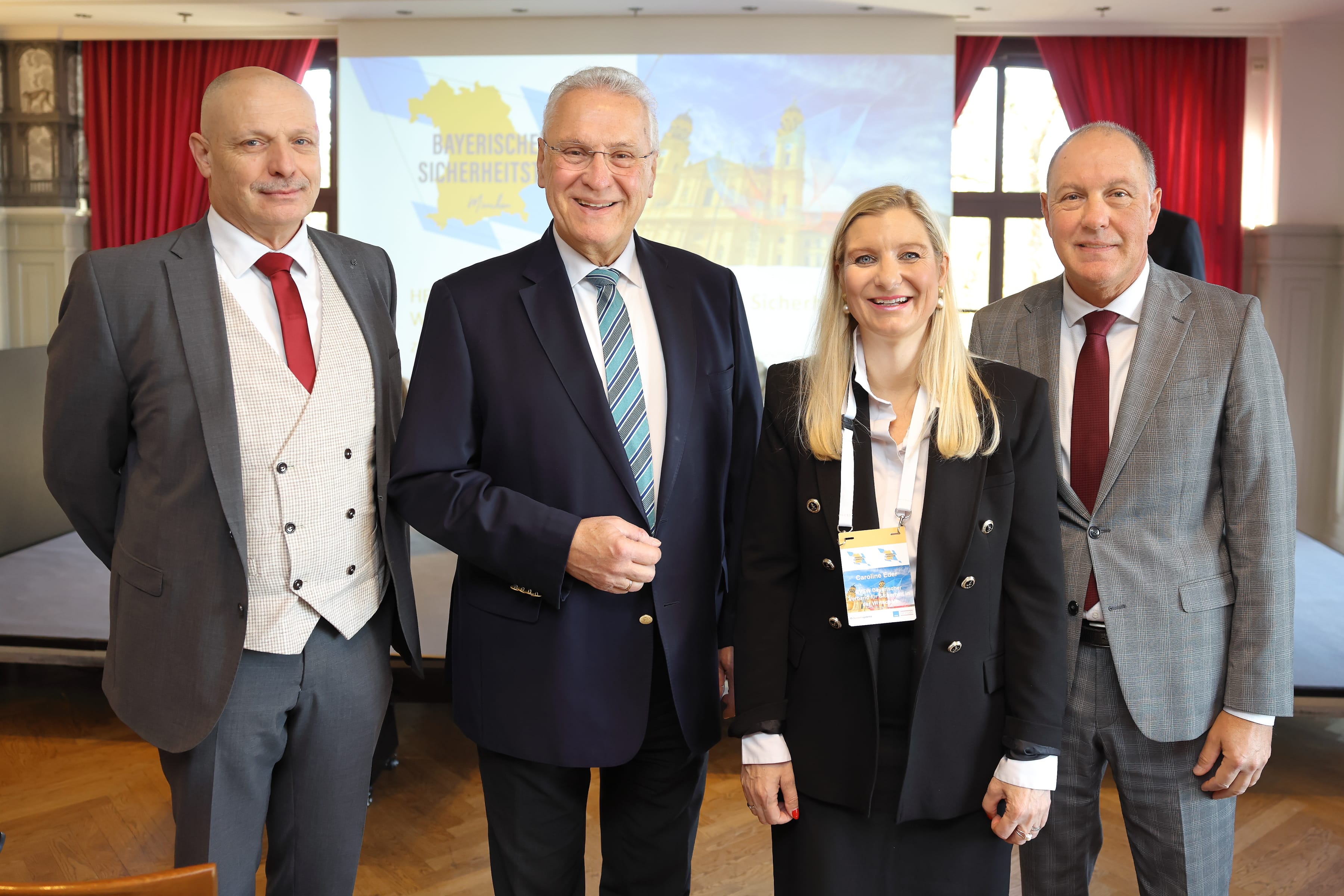
Markus Klaedtke, Chairman of the BVSW; Joachim Herrmann, Bavarian Minister of State for the Interior, Sport and Integration; Caroline Eder, BVSW Managing Director; and Werner Landstorfer, President of the BDSW (from left to right). Image credits: BVSW e.V., BDSW e.V.
More than 140 participants gathered at Munich’s Nockherberg venue for the 12th Bavarian Security Day, organised by the BVSW and the BDSW. The audience included representatives from corporate security, private security service providers and public security authorities. The strong turnout reflected a security environment shaped by rising cyber attacks, sabotage against critical infrastructure, disinformation campaigns and espionage. The event focused on one central question: how can public authorities and private-sector actors work together more effectively to counter hybrid threats?
For readers outside Germany, the organisers are worth a brief explanation. BVSW is the Bavarian Association for Security in Business, which represents corporate security interests in Bavaria, Germany’s largest federal state by area and one of its most important industrial regions. BDSW is the German Security Industry Association, the main national body representing private security companies. Their joint event therefore brought together both in-house security professionals and the contract security sector, alongside police, fire and government officials.
Hybrid threats demand a broader security response
A key theme running through the conference was the changing nature of the threat landscape. Hybrid threats do not usually take the form of open military confrontation. Instead, they combine cyber attacks, sabotage, espionage, disinformation and other disruptive tactics aimed at weakening critical systems, undermining public trust and creating instability.
Joachim Herrmann, Bavaria’s State Minister of the Interior, for Sport and Integration, opened the event by arguing that these threats can no longer be viewed solely through the traditional distinction between internal and external security. In Germany, this is a particularly sensitive issue because the constitutional separation between police and military is firmly embedded in the political system. Herrmann stressed that this principle remains important, but that hybrid threats increasingly cut across these boundaries and require close coordination between different parts of the state.
He pointed to several measures already under way in Bavaria and Germany. These include implementation of the NIS2 Directive, the EU-wide cyber security framework for operators of essential and important entities, the establishment of the Bavarian State Office for Civil Protection in April 2026, and regular joint exercises involving the Bavarian police and the Bundeswehr’s regional command. Herrmann also underlined the important role of the private security industry and called for greater public awareness of hybrid threats without creating unnecessary alarm.
Defence industry under growing pressure
The impact of hybrid threats on the defence sector was a particular focus of the conference. Sven Dawson, Head of Corporate Security at Airbus Defence and Space, argued that a country’s military capability can be weakened not only by direct attacks on armed forces, but also by targeting the industrial base on which defence depends.
His remarks highlighted a broader point that is relevant well beyond Germany. Resilience does not stop at the factory gate. If an energy supply, transport link, communications provider or specialist subcontractor is essential to a defence manufacturer’s operations, then these dependencies also become potential attack points. Dawson noted that suppliers are increasingly in the crosshairs because the major defence companies themselves often already have comparatively mature security arrangements in place.
He described the existing exchange between business and public authorities on hybrid threats as productive, but argued that these structures need to be expanded and more tightly integrated if resilience is to improve across the whole supply chain.
Civil protection still faces structural gaps
The subsequent panel discussion turned to civil protection and crisis management. Wolfgang Zacher, President of Bavaria’s newly created State Office for Civil Protection, outlined some of the practical constraints that would emerge in a major crisis. Around 90 per cent of Germany’s civil protection system is supported by volunteers, which creates clear limits in prolonged or simultaneous incidents.
He also pointed to a less visible but significant issue: the lack of a full overview of overlapping roles. In practice, one person may simultaneously be a reservist, a volunteer firefighter and an employee in a critical company. In a major emergency, these parallel obligations can create bottlenecks and competing demands.
Werner Landstorfer, President of the BDSW, said the private security industry was prepared to help compensate for such shortages. Wolfgang Schäuble, head of Munich’s fire service, added that public communication also needs to improve. In his view, people should be told more clearly that resilience is not only the responsibility of institutions. Citizens themselves also need to take preparedness more seriously.
Bodycams and data protection in private security
Another topic with wider European relevance was the use of body-worn cameras in the private security sector. Antonia Buchmann, a senior official from the Data Protection and Freedom of Information Commissioner of Rhineland-Palatinate, addressed the legal and privacy-related issues surrounding their use.
She noted that bodycams have become an established piece of equipment for police in Germany, where they are primarily used to protect officers and de-escalate situations. In private security, too, there are many operational settings in which bodycams may be useful. However, German and European data protection rules impose strict conditions.
In particular, filming uninvolved bystanders should be avoided wherever possible. If this cannot be prevented, faces may need to be blurred afterwards. Data storage raises further compliance issues. According to Buchmann, recordings should be stored only within Europe, access should be tightly controlled and logged, and data should be deleted promptly once it is no longer needed.
For international readers, this part of the discussion is especially relevant because it reflects a broader European trend: physical security technologies are increasingly assessed not only in terms of operational benefit, but also through the lens of privacy, governance and accountability.
Cyber security risks during employee off-boarding
The conference also addressed an issue that is often underestimated in practice: the cyber security risks associated with departing IT staff. Christian Schaaf, Managing Director of Corporate Trust, warned that dismissed or departing IT employees may still retain access to sensitive systems or data if companies fail to close hidden remote access paths, delete dormant user accounts or review existing permissions.
His message was clear. Organisations need robust off-boarding procedures that include immediate revocation of access rights, comprehensive logging of system activity and regular reviews of legacy permissions. For companies facing increasingly complex hybrid threat scenarios, such basic governance steps remain essential.
From silos to integrated resilience
A broader strategic perspective came from Dirk Bürhaus, Managing Director of Kötter Cyber Security. He argued that the traditional separation of responsibilities between cyber security, physical security, personnel security and risk management is becoming a serious weakness.
These silo structures create organisational gaps and make coordinated responses harder when an attack spans several domains at once. Bürhaus therefore called for integrated security strategies that connect physical and digital protection measures with organisational processes. In his view, companies can strengthen resilience only when information from different security functions is brought together and countermeasures are coordinated accordingly.
Security dialogue continues beyond the conference hall
Alongside the formal sessions, the Bavarian Security Day also served as a networking platform. Participants used the breaks for professional exchange, and the evening programme on the previous day included Eisstockschießen – a traditional Bavarian ice-stock game – at the Nockherberg winter festival, giving the event a distinctly regional setting.
Caroline Eder, Managing Director of the BVSW, said the event had shown how well cooperation within the security sector already works and confirmed that planning for the 13th Bavarian Security Day, scheduled for 16 and 17 November 2027, would begin shortly.
A conference shaped by practical realism
The 12th Bavarian Security Day did not offer simple answers to complex threats. What it did provide was a realistic picture of the challenges facing Germany’s security community: the growing convergence of cyber and physical threats, the vulnerability of supply chains and critical infrastructure, the pressure on civil protection structures, and the need to align operational security with legal and data protection requirements.
For an international audience, the event offers a useful snapshot of how one German region is approaching hybrid threats. It also underlines a broader lesson: resilience increasingly depends not on isolated measures, but on structured cooperation between public authorities, critical industries, private security providers and society itself.