
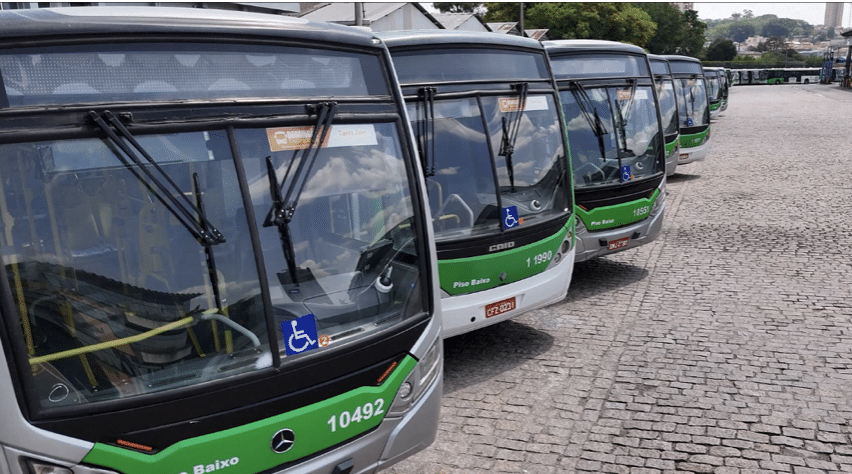
With more than 650 buses, heavy city traffic and situations at bus stops and on board that change daily, the Brazilian transport operator Viação Santa Brígida in São Paulo relies on networked video technology from Dahua Technology. Cameras, passenger counting and vehicle data are all fed into a central control centre. This example illustrates how video security in public transport is increasingly becoming a tool for day-to-day operations.
Anyone managing a fleet of more than 650 buses through a metropolis like São Paulo needs one thing above all else: a clear overview. Where are the vehicles? What is happening on board right now? How full are the buses? And what has actually happened when drivers, passengers or the control centre report an incident?
For Viação Santa Brígida, such questions were not merely a matter of security. They also concerned the day-to-day management of the fleet. The transport operator was therefore looking for a way to make information from the vehicles centrally available and to be able to assess situations in real time wherever possible.
Together with Dahua Technology, a mobile video and fleet management solution was implemented that combines camera technology, intelligent analysis functions, vehicle tracking and centralised monitoring.
Cameras become part of fleet management
The principle is simple at first glance: several cameras capture the areas inside and outside the buses. What is crucial, however, is what happens to the information afterwards.
The interior cameras continuously record events in the passenger compartment whilst also enabling real-time monitoring. Should an incident occur, the operations centre can access the relevant footage and reconstruct the sequence of events. Rather than relying solely on subsequent accounts, video footage is thus also available to help assess a situation.
This applies to both security incidents and operational issues. The footage can, for example, help to investigate unusual situations in the passenger compartment or to reconstruct cases of fare evasion.
Particularly with a fleet of this size, the benefit lies less in the individual camera and more in the availability of information across many vehicles. Video thus evolves from an isolated security system into an integral part of operational fleet management.
A better view of the blind spot
Another key focus lies outside the vehicles. Due to their size, buses inevitably have areas that are only partially visible to the driver. This can become a safety concern, particularly at bus stops, when manoeuvring, and when passengers are boarding or alighting.
External cameras are designed to reduce these blind spots and give the driver a better overview of the vehicle’s immediate surroundings. Pedestrians, passengers boarding or alighting, or other road users can thus be made visible even when they are outside the driver’s direct field of vision.
This additional perspective is particularly relevant in São Paulo’s dense urban traffic. Here, large vehicles encounter pedestrians, two-wheelers, cars and passengers – often in confined spaces and with little time to react.
Passenger figures provide more than just statistics
In addition, an automated passenger counting system is in use. The system analyses boarding processes and provides data on passenger volumes and vehicle utilisation.
This offers the operator two potential applications. Firstly, it allows for a more accurate understanding of how heavily individual vehicles are utilised. Secondly, the recorded passenger figures can be cross-referenced with revenue data. Discrepancies may indicate potential cases of fare evasion.
This also highlights the shift in the scope of application: the sensor technology is not used exclusively for safety purposes, but also provides data for operational and financial decision-making.
Information converges at the control centre
The heart of the solution is therefore not located on the bus, but in the Integrated Control Centre of Viação Santa Brígida. There, live and recorded video footage is combined with the vehicles’ location and operational data.
Staff can monitor the fleet centrally via a video wall and Dahua’s management software. Should an unusual situation arise, the vehicle in question, its position and the available video recordings can be viewed together.
This can save time, particularly when verifying incidents. The control centre is able to assess a situation based on various pieces of information and then decide on further action.
For a transport operator with hundreds of vehicles in service at any one time, this represents a significant difference compared to traditional video systems: information does not first have to be gathered from various sources, but is made available in a consolidated form for operational use.
Video surveillance takes on a second role
According to Viação Santa Brígida, the introduction of the solution has, in particular, improved transparency regarding fleet operations. In addition to continuous video surveillance, the company cites more accurate passenger figures, better control of potential fare evasion and faster investigation of incidents as key benefits.
The external cameras are also designed to help reduce risks posed by blind spots and to support drivers, particularly at bus stops and in situations with limited visibility.
“Today, we can continuously monitor the cameras installed on our buses and provide our managers with more precise operational information,” explains a representative from Viação Santa Brígida. The technology helps the company to monitor fare evasion, improve the safety of drivers and passengers, and manage the fleet more efficiently.
Its use in São Paulo thus illustrates a trend that goes beyond this specific application: video technology in public transport is increasingly being linked to analytics, location and operational data. The camera is no longer used solely to document an incident after the fact. Its data can form part of a networked situational overview that integrates security tasks and operational processes.
For operators of large fleets, this is precisely where the potential added value lies: more information from the vehicles, available centrally and analysable more quickly. In a complex transport system such as São Paulo’s, traditional video surveillance can thus become a tool for safety, transparency and fleet management.

