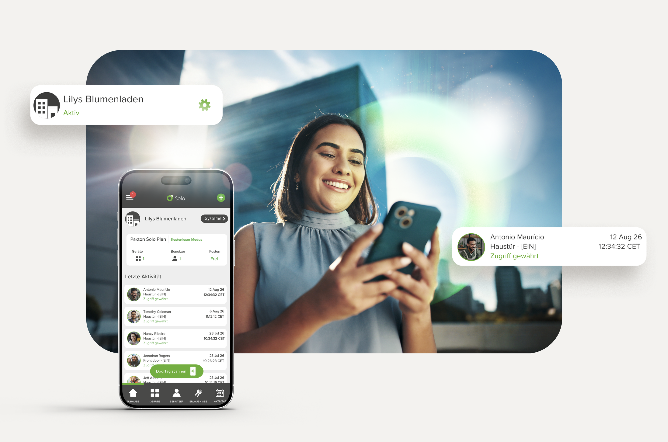
Paxton’s Solo is shaking up the rules of the game
From hardware-heavy systems to smartphone architecture: with Solo, Paxton is challenging the fundamental assumptions of access control – and positioning disruption as a strategic principle.
The access control market is under massive pressure to transform. Cloud architectures, mobile identities and stricter cybersecurity requirements are radically shifting expectations – away from complex infrastructure, towards scalable, software-centric platforms. Traditional systems with controllers, readers, servers and cabling are increasingly seeming oversized in many scenarios. This is precisely where Paxton comes in – turning the model on its head.
A break with architecture rather than evolution
For decades, access control followed a clear paradigm: intelligence in the controller, identity on the medium, management on the server. Scaling meant more hardware, more configuration, more complexity. Solo breaks with this principle.
“We started with a completely blank sheet of paper,” explains Paxton CEO Adam Stroud.
The key question: what would an access control system look like if we were to completely rethink it today – with the capabilities of modern smartphones and cloud infrastructures?
The answer is a radically simplified architecture in which the system’s intelligence shifts: away from central components, towards the user’s device.
“Solo is different. It is the first system that fully utilises the modern capabilities of a smartphone.” “This brings about a fundamental shift in the architecture of modern security.”
The smartphone at the heart of the solution
The key difference from existing mobile access solutions lies in the function of the smartphone. In traditional systems, the smartphone merely replaces the token. In Solo, it takes on an active role within the system.
“Your smartphone has enough processing power to make an access control decision itself.”
This fundamentally shifts the logic. The access decision is no longer made in the controller, but directly on the user’s device. At the same time, traditional reader hardware becomes redundant, as the smartphone interacts with a passive NFC tag. The need for a network connection at the door point is also completely eliminated, as communication takes place via the mobile device. Local databases lose their significance, as identities and authorisations are managed in the cloud.
The system is thus reduced to a minimum of physical infrastructure: DoorTag, controller, power supply, lock and app. Or to put it more succinctly: the smartphone is both the system and the key.
INFOBOX – Solo system architecture (brief overview)
- Smartphone as the central authority for identity, authentication and decision-making logic
- Passive NFC DoorTags instead of active reader hardware
- Controller without a local user database
- No on-site IP infrastructure or servers required
- Cloud-based management via mobile app
- Biometric authentication via end device (Face ID, fingerprint)
This architecture has far-reaching consequences for scalability and system design. Traditional bottlenecks – such as limited controller memory or complex network infrastructures – are largely eliminated. Instead, a distributed system with decentralised decision-making logic emerges.
Infrastructure-free installation as a paradigm shift
A key advantage lies in the installation. Solo does away with traditional IT infrastructure entirely. Commissioning is carried out via the app – including system creation, device integration and user management.
“The installation takes a fraction of the time required for a traditional system.”
For integrators, this means a significant gain in efficiency. Projects can be completed more quickly, planning efforts are reduced, and there is no longer any need to rely on IT departments.
INFOBOX – Benefits for installers
- Significantly reduced installation time due to the elimination of network and server infrastructure
- No coordination with IT departments required
- Higher project capacity with the same staffing levels
- Competitive advantage through lower overall project costs
- Opportunity to generate recurring revenue via cloud services
- Simplified maintenance due to reduced system complexity
Cybersecurity as an integral part
As hardware is simplified, security requirements are increasing. Regulation and the threat landscape are forcing manufacturers to adopt new approaches.
“There’s never been a time, where cyber security has been more important,” says Stroud, emphasising his stance on cybersecurity.
Solo relies on encrypted communication, cloud infrastructure based on Microsoft Azure, and Hardware Secure Elements. This is complemented by collaboration with Pentest Partners and certifications such as IASME Levels 1 and 2 and UL IoT Cybersecurity Diamond.
Particularly relevant is the absence of traditional passwords.
“There have never been passwords in Solo – and there never will be.” (‘There never has been, and there never will be, any concept of a password in Solo.’), Paxton’s CEO proudly emphasises.
Economic outlook and market strategy
In addition to the technology, Solo specifically addresses the economic challenges of the market. The reduced hardware and simplified installation significantly lower overall costs. At the same time, the cloud-based model enables new revenue structures.
Paxton is thus responding to clear market demands: 80% of installers want simple models for recurring revenue. Solo offers flexible subscription options for this purpose.
A key component of the market launch is the distribution of 10,000 free starter kits. The aim is to bring the technology to life.
“Because the system is so different, we want as many installers as possible to see it, use it, and understand it,” Stroud reiterates, explaining the importance of how the launch of Solo is being driven forward.
INFOBOX – Typical use cases for Solo
- Small and medium-sized enterprises without their own IT infrastructure
- Residential areas such as short-term rentals or student accommodation
- Healthcare environments (doctors’ surgeries, care homes)
- Distributed locations and remote assets
- Temporary installations such as construction sites
- Applications with high user turnover (e.g. gyms)
Between disruption and reality
Whether Solo will bring about lasting change in the market remains to be seen. The approach is technologically sound and clearly follows the principles of modern IT architectures. At the same time, success depends on factors such as market acceptance, trust in mobile devices and integration into existing systems.
One thing is clear, however: Solo is fundamentally shifting the market discussion. It is no longer just about optimisation, but about whether the existing access control architecture is even still fit for purpose.
“Not just an incremental change, but a fundamental step change.”
With these words, Stroud concluded his product launch presentation at the end of March at Paxton’s headquarters in Brighton, England. Paxton is thus taking a giant leap into a new era.