
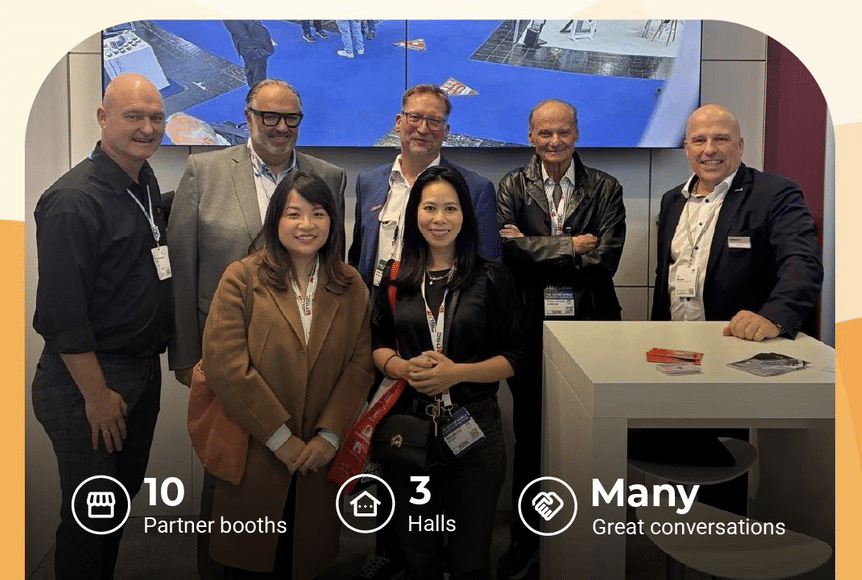
At Security Essen 2026, AG Neovo did not rely on one central exhibition presence. Instead, its professional displays appeared across a number of partner booths and were integrated into different security applications. The result was a less conventional trade-fair presence — and one that offered a useful view of how professional display technology is actually used within the European security market.
For many manufacturers, a major trade fair is primarily about concentrating attention on their own stand. AG Neovo took a different approach in Essen this year.
Its displays were presented through a range of partner companies and embedded in the systems and applications in which they are ultimately intended to operate.
Partners included ADI Global Distribution, Advancis Software & Services, Axis Communications, Cathexis Technologies, Funkwerk Systems, i-PRO, Milestone Systems, Octave, Senstar, VIVOTEK EU and VOMATEC Innovations.
That distributed presence is worth noting because professional displays rarely operate as standalone products in security environments. They form part of control rooms, video systems, management platforms and operator workstations.
In that context, a trade fair can sometimes show more about a display when it is integrated into a working system than when it is presented on an isolated product wall.
Less product staging, more operational context
The various partner booths represented different areas of security technology.
At some, video surveillance was the main focus. Elsewhere, management software, control-room applications or wider security systems took centre stage.
For AG Neovo, this meant that its displays were not presented as the central attraction, but as part of the working environment around those systems.
That may sound less spectacular, but it closely reflects how such products are used in practice.
Professional displays are rarely specified in isolation. What matters is whether they are suitable for the intended operating environment, remain dependable during extended use and fit into the existing system landscape.
In monitoring centres, security control rooms and operator workstations, practical requirements such as reliability, readability and continuous operation often matter more than headline product specifications.
The screen remains a working tool
Security Essen once again demonstrated how closely cameras, software and analytical functions are now connected.
That also affects the role of the display.
A screen is not necessarily the most sophisticated component in a security system. In many cases, however, it is the point at which the system becomes usable for the operator.
Where several camera feeds, maps, alarms or software interfaces have to be monitored simultaneously, information must be presented clearly and consistently.
The more complex the underlying technology becomes, the more important it is that the operator-facing layer remains straightforward.
This is particularly relevant in control-room environments. Additional data does not automatically improve situational awareness. Poorly structured information can just as easily create distraction.
The task of professional visualisation is therefore not to display as much information as possible, but to make the relevant information accessible at the right moment.
Different partners, different requirements
The range of partners also illustrates the diversity of applications in which professional displays are used.
The companies involved operate across distribution, video surveillance, security management and related technology areas. Their requirements are consequently not identical.
For a display manufacturer, this means designing products that can function across different system environments rather than around one narrowly defined use case.
That flexibility is particularly relevant in the European security market, where systems are frequently expanded over time and installations often combine technologies from several manufacturers.
Operators may retain one part of an existing system while replacing another. Displays therefore need to remain compatible with changing workflows and technical environments without becoming the limiting component.
Trade fairs also test partnerships
For AG Neovo, Security Essen was therefore not only a place to present hardware. It also provided a practical setting in which the company’s products appeared alongside a broad range of partner technologies.
The company described the event as a positive one, highlighting new contacts, discussions and follow-up opportunities.
From an industry perspective, however, another aspect is more revealing.
A manufacturer of professional displays increasingly has to demonstrate not only the quality of the product itself, but how naturally that product fits into systems developed by others.
In this market, visibility does not necessarily come from having the largest standalone presence.
It can also come from being present wherever the wider system requires reliable visualisation.
A quieter but revealing trade-fair presence
In that respect, AG Neovo’s appearance at Security Essen differed from the more conventional approach of building a single, highly visible product story around one booth.
Instead, the company appeared repeatedly in different parts of the exhibition.
The result was more understated, but arguably closer to the reality of professional security installations.
Displays rarely sit at the centre of the system.
Yet without them, much of what cameras, software and sensors detect or process remains inaccessible to the people who ultimately have to interpret the information and act on it.
That makes AG Neovo’s presence in Essen less of a conventional product showcase and more of an illustration of the role professional displays continue to play across different security applications: not as an end in themselves, but as working tools within the wider system.

