How centralised management platforms are reshaping professional AV, control room and KRITIS environments
Professional displays have undergone a fundamental transformation in recent years. What was once seen primarily as a display technology is increasingly becoming an integral part of digital operational, security and information infrastructures. In control centres, control rooms, businesses, educational institutions, smart buildings or KRITIS environments, displays no longer serve merely to display content. They are becoming part of operational processes, centralised situational awareness and networked decision-making structures.
This development is accompanied by increasing demands on the management, monitoring and control of such systems. Operating individual displays locally or configuring them manually is no longer sufficient in larger installations. What is needed are centralised platforms capable of efficiently administering, standardising and controlling distributed fleets of devices.
This is precisely where AG Neovo’s Neovo Manager comes in. The platform combines remote management, group control, role management, automation, monitoring and app management within a centralised management environment. The various demonstrations and technical descriptions of the system highlight one fundamental industry trend in particular: professional display infrastructures are increasingly evolving into software-defined systems.
From individual devices to centrally managed infrastructure
Complex display landscapes can quickly emerge, particularly in larger organisations. Devices are spread across different locations, building areas or client projects. At the same time, content, signal sources, operating times and permissions must be managed consistently.
Neovo Manager addresses this challenge via a central browser-based management interface. Administrators can check device statuses, configure systems or make adjustments remotely without having to be physically on site. Particularly in security-critical environments, this reduces response times and significantly simplifies the operational control of distributed infrastructures.
The approach thus follows principles originally derived from traditional IT management systems: centralisation, standardisation and remote access replace decentralised individual management.
A dashboard as an operational overview
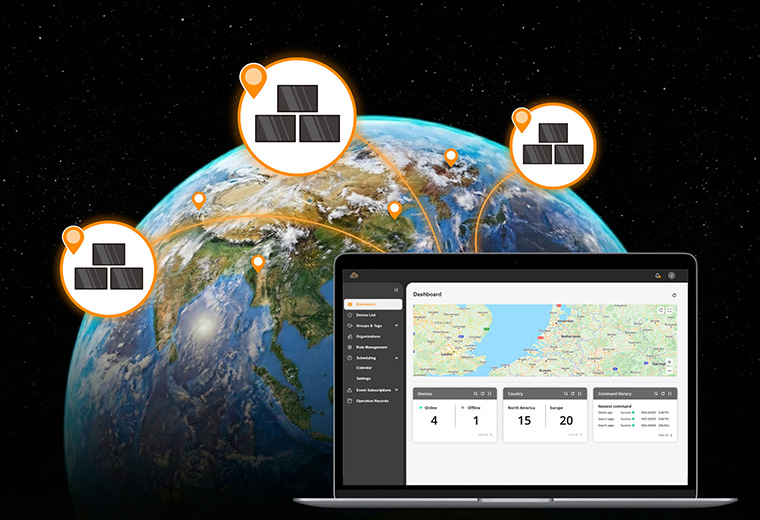
A central element of the platform is the consolidated dashboard view. Instead of having to monitor individual devices separately, managers are provided with a structured overview of all connected displays and their status.
Online statuses, alerts or potential issues are visible centrally. This creates an operational overview that offers significant advantages, particularly in multi-site environments. Administrators can identify more quickly which systems require attention and where action is needed. The platform thus adopts a ‘single pane of glass’ approach, as is increasingly being used in modern SOC, network and infrastructure platforms.
This transparency is of particular importance in control centres or KRITIS structures. This is because, in such environments, the quality of decision-making processes often depends directly on the stability and availability of visual information systems.
“See what’s online”: transparency instead of blind spots
A key benefit of modern AV management platforms lies in the continuous real-time transparency regarding the status of the entire device fleet. To this end, Neovo Manager provides centralised status information in a structured format, giving managers an immediate overview of which displays are online, which require attention and where potential problems might arise.
Particularly in distributed installations with numerous devices, this transparency significantly reduces operational uncertainties. As a result, displays are no longer viewed as isolated hardware, but as permanently visible and controllable infrastructure components.
Monitoring becomes a prevention strategy
In parallel, display management is increasingly evolving towards preventive operational monitoring. The platform integrates functions for the continuous monitoring of system metrics and device statuses to identify problems as early as possible.
This shifts the focus away from reactive troubleshooting towards proactive stability assurance. Systems should avoid failures wherever possible before they impact operational processes.
This is particularly relevant in control centres, control rooms or KRITIS environments, where even brief outages or faulty displays can have operational consequences. Continuous monitoring thus becomes part of modern resilience strategies.
“Know what’s running”: real-time app transparency
In addition to hardware status, monitoring running applications is also becoming increasingly important. Modern Android-based displays are increasingly evolving into standalone digital platforms on which different applications run in parallel.
Neovo Manager enables centralised monitoring of app status and usage. Managers can track which application is active and whether systems are operating as intended.
This transparency becomes a crucial factor, particularly in digital signage environments, enterprise collaboration scenarios or hybrid working environments. Applications must function consistently, content must be displayed reliably and operational statuses must remain centrally traceable.
Group control and scalable device organisation
As the number of devices grows, so does the importance of scalable management models. Neovo Manager therefore enables the organisation of displays via group and tagging functions.
Devices can be structured by location, role, project or customer environment. Configurations and control commands can thus be applied centrally to entire groups, rather than having to administer each system individually.
This offers a significant scaling advantage, particularly for integrators, managed service providers or companies with internationally distributed sites. Large device fleets can be managed in a standardised manner without losing operational oversight.
Role models and governance
Another key aspect of modern display platforms is the management of user rights. Not every user requires full access to all functions.
Neovo Manager supports differentiated role models with granularly definable permissions. Technical administrators can configure comprehensive system settings, whilst operational users are only permitted to perform defined functions.
This brings the platform closer to classic IAM and zero-trust concepts from cybersecurity. Professional AV systems are thus increasingly becoming part of holistic security and governance architectures.
Automation standardises operational processes
Time-controlled automation is also playing an increasingly important role within modern display infrastructures. Device actions such as switching on and off, rebooting or switching between signal sources can be performed automatically based on time and day of the week.
Neovo Manager specifically distinguishes between different device actions and input source processes. This allows operational workflows to be precisely standardised. Recurring routines can be orchestrated automatically without the need for constant manual intervention by administrators.
This results in significant efficiency gains, particularly in large installations. The platform is thus increasingly evolving from a management tool into an operational control system.
Android displays are becoming digital endpoints
At the same time, the displays themselves are also changing. Systems such as the NSD series or the Meetboard 4 Prime no longer function exclusively as output devices, but increasingly as intelligent digital endpoints within networked operational environments.
Neovo Manager supports the centralised management of such Android-based systems via APK deployment, updates and replacement processes. Applications can be deployed or updated centrally without having to manually edit individual devices.
This significantly reduces implementation times, particularly for larger rollouts, and simplifies maintenance, standardisation and security updates.
Pairing, Enrolment and Device Lifecycle Management
The technical integration of new devices is carried out via a pairing process. Displays are uniquely linked to the management platform via a six-digit PIN code.
The process resembles modern enrolment mechanisms from the mobile device management or IoT environment. Devices are registered in a controlled manner and uniquely assigned to a management instance.
Equally important is the controlled removal of devices from the management structure. Displays can be selectively unlinked and reassigned both locally and via the web interface. This results in flexible device lifecycle management, particularly for integrators or companies with dynamic project environments.
Remote control replaces physical presence
A key advantage of centralised management platforms also lies in location-independent remote control. Displays can be configured remotely, signal sources switched, or display parameters adjusted.
Virtual remote control functions, screenshot views and detailed monitoring functions are also part of the feature set. This gives administrators the ability to view current screen content and device statuses centrally.
This significantly reduces support and maintenance costs, particularly in distributed installations. Technicians no longer need to analyse many issues physically on-site.
Protection against local tampering
Protection against local interference also plays a particularly important role in public or security-critical environments.
To this end, Neovo Manager supports the locking of physical device buttons as well as the infrared remote control. This helps to reduce unintended changes or tampering.
The platform thus addresses a classic problem of distributed display infrastructures: the balance between centralised control and local access.
Early warning systems for resilient operating environments
In addition, the platform integrates warning and notification functions. If defined thresholds are exceeded or critical conditions are detected, administrators can be notified automatically.
As a result, display management is increasingly becoming an integral part of proactive operational and resilience strategies. The aim is not only to manage hardware, but to ensure stable information and communication processes in the long term.
Scalable platform also for pilot projects
The current deployment model of Neovo Manager is also of interest. The full range of functions is currently available free of charge for up to 20 connected devices.
This means that AG Neovo is addressing not only large enterprise installations, but also pilot projects, test environments and smaller rollouts. Companies are given the opportunity to evaluate centralised management structures on a smaller scale first, before implementing larger-scale projects.
Display management becomes part of digital resilience
Overall, Neovo Manager exemplifies just how much professional AV infrastructures are currently changing. Displays are increasingly evolving into intelligently manageable infrastructure components – comparable to network devices, IoT systems or traditional IT endpoints.
At the same time, the boundaries between AV technology, IT management and cybersecurity are becoming increasingly blurred. Centralised management platforms are no longer merely a convenience feature, but an integral part of modern operational and resilience strategies.
Particularly in KRITIS environments, control centres, smart buildings or hybrid security architectures, this gives rise to a new operational reality: the stability of digital information and display infrastructures is increasingly becoming a strategic factor for operational security, transparency and organisational resilience.