
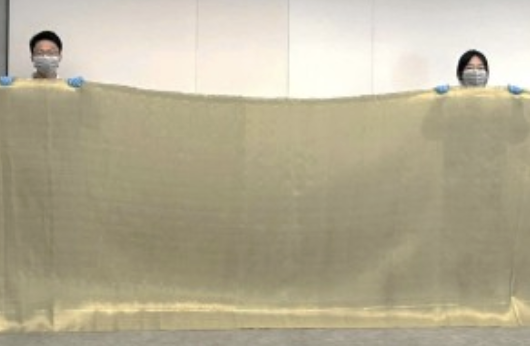
High-performance fabric made from the new high-performance fibre (photo: Jin Zhang Group, english.pku.edu.cn)
New composite material developed by researchers at Peking University dethrones existing Kevlar fibre
Researchers at Peking University have dethroned Kevlar as the most bulletproof fibre with a new composite material. This material is thinner, stronger, more resistant and better suited than Kevlar for deflecting bullets from people wearing protective vests and armoured vehicles. Kevlar, which is currently the gold standard, cannot be improved upon. Attempts to make the material even stronger have resulted in it becoming brittle, thereby reducing its ability to deflect bullets.
Breakthrough with nanotubes
Research leader Jin Zhang and his team spent six years working on developing a fibre that outperforms Kevlar. The solution consists of heterocyclic aramid, a high-performance fibre similar to Kevlar. However, Jin and his colleagues reinforced it with long carbon nanotubes. These are incredibly stiff and light, even though they are much thinner than a human hair.
On their own, however, they cannot absorb the energy released when a bullet strikes and thus render it harmless. This is only possible in combination with the aramid fibre. The desired effect only occurs when both fibres are firmly aligned parallel to each other and bonded together. It took Jin and his team several years to achieve this technically. This bond is of fundamental importance because it connects the components so firmly that the chains cannot slide past each other in the event of an impact. Only in this way can the material absorb more energy without failing.
More than twice as effective
The scientists fired shots at their revolutionary composite material and found that its ability to absorb energy is more than twice that of Kevlar fabrics. Bulletproof vests and car armour made from this material will be significantly thinner and lighter than those commonly used today, they conclude.

