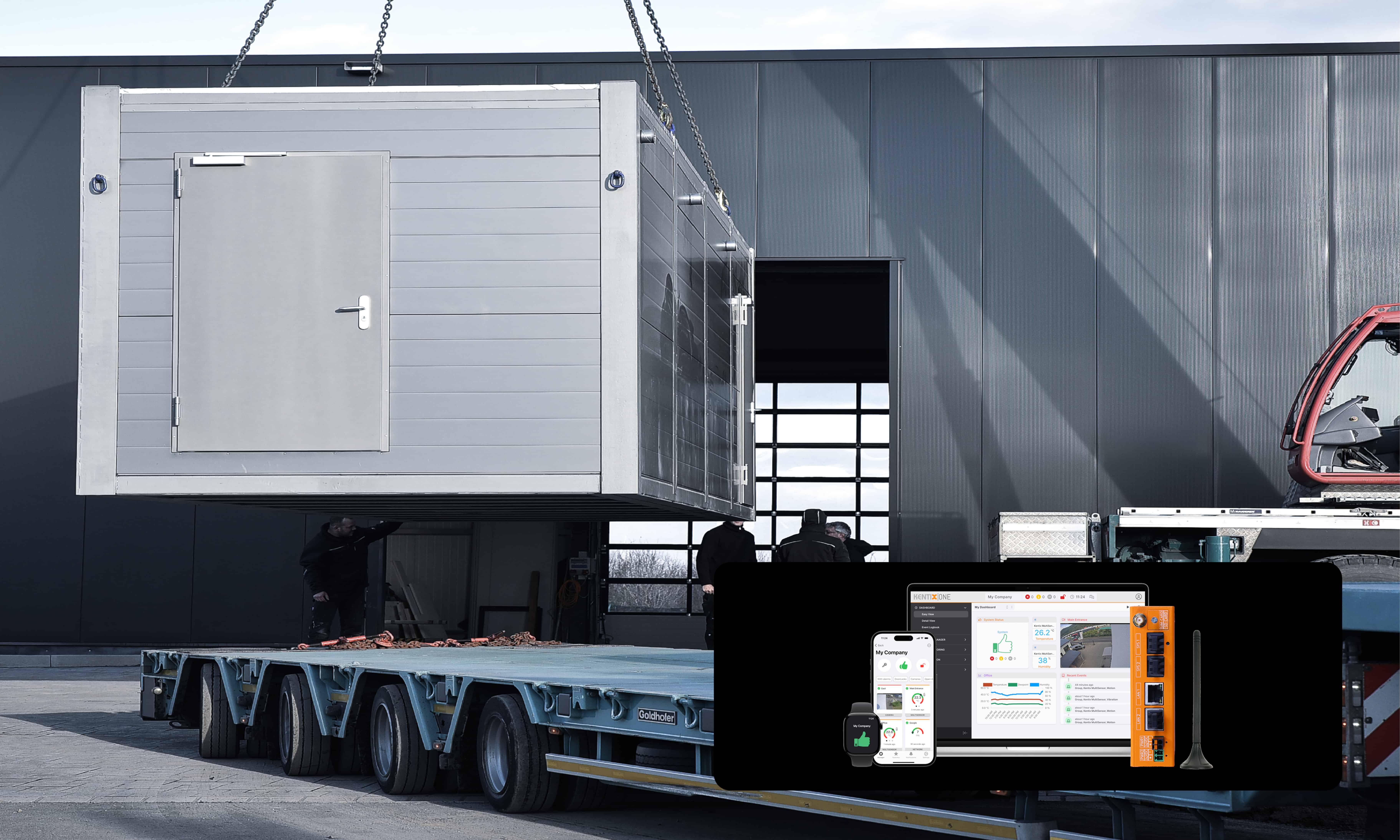
Container data centres promise rapid deployment, high scalability and clearly defined technical infrastructure. Yet their compact design does not make security any simpler. Access control, temperature, humidity, fire detection, power supply and video surveillance all have to work together reliably within a confined environment. For its new “IT Container FIX” solutions, Prior1 has therefore selected KentixONE as the central platform for physical security and critical infrastructure monitoring.
Prior1, a provider of modular IT infrastructure solutions, develops containerised data centres for environments in which security, energy efficiency and availability are subject to stringent requirements. For its new product line, the company was looking for a platform capable of bringing together different protection and monitoring functions while remaining scalable and suitable for requirements associated with EN 50600.
With KentixONE, Prior1 has chosen a central management platform through which security-relevant devices and sensors can be monitored and controlled in real time. A central dashboard consolidates the most important operational and security parameters, while the KentixONE app provides mobile access to status information and control functions.
The approach reflects a broader development in modern data centre security: individual systems are no longer managed as isolated components, but increasingly as part of one integrated security and monitoring architecture.
Access control becomes part of the overall security picture
Access management forms a central element of the solution. Using Kentix SmartAccess, IP wall readers provide two-factor authentication, while access events are logged and unauthorised attempts can trigger an immediate alarm.
The relevant data is stored centrally within KentixONE and remains available for subsequent analysis. Access events can also be linked to short video sequences, allowing an incident to be reviewed not only through access logs but with additional visual context.
Access control and sensor technology can furthermore be combined to create alarm zones. These can be armed or disarmed manually via the access control system or automatically according to predefined processes. The result is a closer connection between identity verification, intrusion protection and event management.
Video adds context to an alarm
Video surveillance is also integrated into KentixONE. Security-relevant events can therefore be detected in real time and supplemented with video information. Recordings can be retrieved when required, while live images support immediate assessment of an incident.
This is particularly relevant for decentralised or compact data centre installations where permanent on-site security personnel may not be present. The more information a system can bring together automatically, the more quickly responsible teams can determine whether an incident involves a technical fault, an unauthorised access attempt or another security-relevant event.
The quality of a security architecture therefore depends not only on whether an alarm is generated, but also on whether sufficient context is available to assess the event correctly and initiate an appropriate response.
Continuous monitoring of temperature, humidity and air quality
Physical access security is only one part of the risk profile. Environmental monitoring is equally important in protecting IT infrastructure. Kentix multisensors continuously monitor parameters including temperature, humidity and air quality.
The system also includes integrated four-factor early fire detection. This is designed to identify anomalies that may indicate critical conditions at an early stage, allowing intervention before more serious damage occurs. In high-density IT environments, such early warning is particularly important because thermal or electrical irregularities can rapidly affect availability.
External systems such as air conditioning and uninterruptible power supplies can also be integrated into the platform and continuously report their operating status. This creates a broader operational picture in which individual sensor values are not considered in isolation but as part of the technical condition of the data centre as a whole.
Energy monitoring extends to rack level
Kentix SmartPDUs extend monitoring down to the server rack. They track current and energy parameters as well as environmental conditions within the racks themselves.
Integrated residual current monitoring, or RCM, is intended to support electrical safety and fire prevention while also helping to identify gradual equipment failures. Any anomalies are transmitted to KentixONE in real time so that responsible teams can respond promptly.
The platform also provides efficiency indicators such as Power Usage Effectiveness, or PUE, and can generate monthly energy reports. In this way, the system links conventional security functions with energy efficiency and equipment condition monitoring.
That combination is becoming increasingly relevant for data centres. Security and energy efficiency cannot be treated entirely separately when overloads, defective components or inefficient operating conditions may themselves create risks to availability and operational resilience.
Container data centres require integrated concepts
The use of KentixONE within Prior1’s modular data centre concept illustrates how the security architecture of containerised facilities is evolving. A container may be compact in physical terms, but the associated security requirements are anything but limited. Access control, video, intrusion detection, early fire detection, environmental monitoring, energy management and technical status information all need to be considered together.
This is precisely where centralised management platforms can add value. Individual sensors and subsystems each provide only one part of the overall picture. Only when their information is brought together does it become possible to create a reliable basis for assessment and response.
Prior1 therefore sees the integration of Kentix technologies as a means of combining high security standards with the flexibility required in modular IT environments. This is particularly relevant in dynamic data centre operations where capacity may be expanded, systems adapted or individual sites managed under different operating conditions.
Physical security becomes an operational issue
The protection of modern data centres no longer begins at the door and ends with the camera. Physical security, environmental conditions, electrical supply and technical availability are increasingly interconnected.
For operators, this means that security management is also becoming a form of operational monitoring. An unauthorised access attempt, rising temperature, unusual current value or cooling failure may have very different causes, but all can affect the same critical infrastructure.
By combining KentixONE with SmartAccess, SmartMonitoring, video surveillance and energy monitoring, Prior1 is therefore pursuing a holistic approach to its container data centres. Security is treated not as the sum of individual components, but as a shared situational picture built from access, environmental conditions, energy data and technical status.
For modular data centres, this integrated perspective may increasingly become a defining quality criterion.