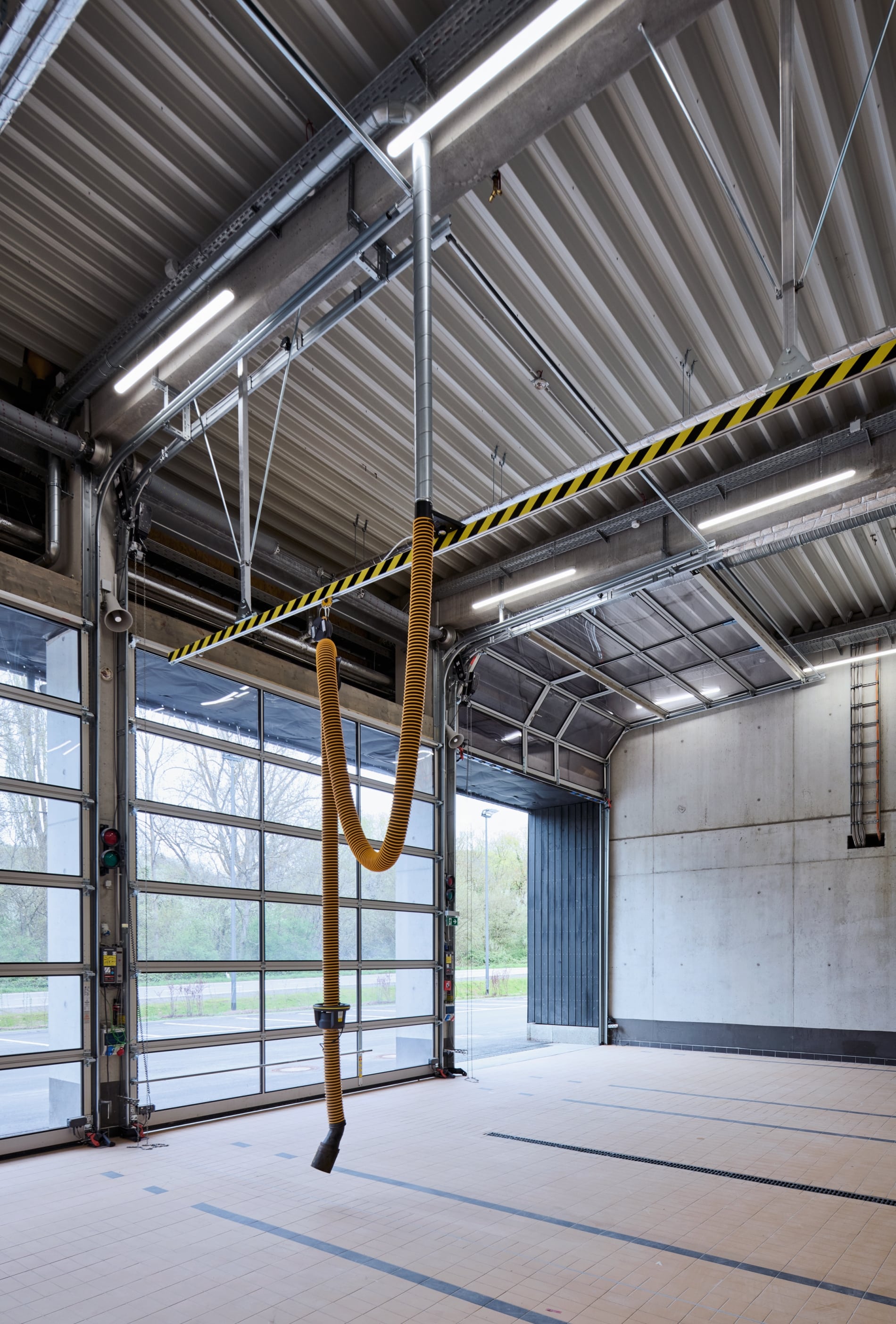
Critical infrastructure protection is often associated with cybersecurity, power supply, communications and advanced access-control technologies. Yet the continuity of an essential service can depend just as heavily on physical components such as industrial doors, vehicle gates and their drive systems. Fire stations provide a particularly clear example: if an emergency vehicle cannot leave the building because a gate fails, an apparently ordinary technical defect can immediately become an operational security issue. The relevance extends far beyond Germany, as door and access systems developed for demanding industrial and security environments are internationally traded products used in critical facilities worldwide.
Germany commonly uses the term KRITIS — short for kritische Infrastrukturen — to describe organisations and facilities whose failure could seriously affect public safety, essential services or the functioning of society. Other countries use different terminology and regulatory frameworks, but the underlying requirement is comparable: critical services must remain available even when individual systems fail or external conditions deteriorate.
This gives the German debate an international and industrial dimension. Security-related building components such as industrial doors, operators, access-control systems and perimeter solutions are exported and deployed across very different markets. Manufacturers such as Hörmann illustrate how technology developed within a European engineering and regulatory environment becomes part of fire stations, industrial facilities, transport sites and other security-sensitive locations around the world.
Fire stations reveal a fundamental dependency
Fire stations make the operational importance of physical access systems particularly visible. Emergency response follows a tightly timed sequence from alarm to deployment, and even short delays can have serious consequences. Vehicle-bay doors form the physical interface between the station and the incident scene: they must open quickly and reliably when crews deploy while protecting vehicles, specialist equipment and other assets against unauthorised access when closed.
An industrial door in this environment is therefore not merely part of the building envelope. It becomes part of the operational chain. If the system fails and emergency vehicles cannot leave the station, response times increase and the organisation’s ability to perform its core function is directly affected.
The same principle applies elsewhere. Energy facilities may depend on secure vehicle access for maintenance and emergency teams, transport operators on gates for controlled movement through depots, and industrial sites on doors that combine protection with uninterrupted logistics and production processes.
Exported systems must function in local environments
International deployment adds another layer of complexity because a technical solution developed in one country may operate under very different climatic, legal and operational conditions elsewhere. A system installed at a German fire station may face entirely different demands from one used in Scandinavia, the Middle East, North America or Asia, where temperature extremes, humidity, dust, coastal exposure, local power conditions and building regulations can influence specification and maintenance.
Security-relevant building technology therefore has to be adapted to the environment in which it will operate. The core requirement remains constant: authorised personnel and vehicles must be able to move when necessary, while sensitive areas remain protected against unauthorised access.
This dual function makes industrial doors particularly relevant from a security perspective. They are both protective barriers and operational enablers, and their value depends on how effectively both requirements are combined.
Failure scenarios need to be considered from the outset
The criticality of an access system becomes most visible when normal operating conditions no longer exist. A power outage is an obvious example: an electrically operated gate may work flawlessly in daily use but become a serious bottleneck if there is no dependable fallback when power is lost.
Manual release mechanisms, backup power, alternative controls and defined emergency procedures can therefore be essential parts of system design. Similar considerations apply to mechanical defects, damaged controls, communication failures or intentional interference.
For operators, this means that procurement should not focus only on normal performance. The consequences of failure must also be understood before installation, including how personnel can maintain access and how quickly the system can be restored.
Maintenance becomes a security issue
Mechanical and electromechanical systems deteriorate over time, and emergency functions can fail unnoticed if they are never tested. Regular inspection and maintenance are therefore relevant not only to facility management but also to operational security.
Drive systems, controls, safety mechanisms, emergency functions and the general technical condition of the installation should be checked at defined intervals. The appropriate frequency depends on use, applicable standards, manufacturer requirements and the importance of the facility.
For internationally supplied equipment, lifecycle support is particularly important. Access to trained technicians, local service partners, replacement components and spare parts can be as important as the original technical specification. A product that performs well but cannot be repaired quickly in the destination market can still create a significant operational vulnerability.
Physical and cyber security are increasingly connected
Critical infrastructure faces a wider range of threats than technical failure alone. Severe weather, flooding, sabotage, terrorism and hybrid attacks can all affect physical assets, while increasing digitalisation connects doors, drives and access systems to wider building-management and security environments.
Remote diagnostics, digital access management and networked controls offer operational advantages, but they also introduce new dependencies. A physical access system may rely on digital identities, communication links or software-based control, meaning that cyber disruption can produce physical consequences.
Conversely, physical interference with a gate, control cabinet or power supply can affect digital or operational processes that depend on continued access. Industrial doors and access systems therefore increasingly sit at the intersection of physical security, cybersecurity and facility operations rather than belonging neatly to one discipline.
German KRITIS policy provides one international reference point
Germany’s evolving KRITIS framework reflects a wider trend towards protecting critical services against physical as well as digital disruption. The legal requirements themselves apply within the German regulatory environment, but the underlying questions are relevant internationally: which physical assets are essential to the service, what could cause them to fail and what arrangements exist if they become unavailable?
Similar considerations appear in critical-infrastructure frameworks elsewhere, even where terminology and legal obligations differ. The common objective is to understand dependencies before they become operational weaknesses.
Industrial access systems fit naturally into this discussion because their importance is determined less by their technical complexity than by the role they play in the service chain.
Standards are important, but not sufficient
Internationally traded security products must meet the technical and safety requirements of the markets in which they are installed. Testing, certification and documented performance provide an important basis for procurement and help manufacturers deploy systems across multiple jurisdictions.
Compliance alone, however, does not determine whether a system is suitable for a critical facility. A certified product can still become a single point of failure if emergency operation has not been planned, local maintenance capacity is insufficient or replacement components cannot be obtained quickly.
For critical sites, procurement therefore needs to consider operational consequence alongside technical conformity. Operators should understand what happens if the component becomes unavailable, which alternative procedures exist and how quickly normal operation can be restored.
Planning must cover the entire lifecycle
Many vulnerabilities are easier to address during design than after a facility has entered service. Maintainability, emergency operation, accessibility and repair requirements should therefore be considered when systems are first specified.
For exported technology, coordination between manufacturer, local planner, installer and operator is particularly important. The technical solution may originate in one country while the regulatory environment, emergency procedures and maintenance organisation belong to another.
Successful international deployment consequently requires more than delivering equipment. Installation, commissioning, service responsibilities and the availability of replacement parts need to be considered as part of the same lifecycle.
Security technology is also an export industry
The example of industrial door systems highlights a broader industrial point. European manufacturers supply security-relevant building technologies to customers across international markets, and products developed within European technical frameworks can become part of critical facilities thousands of kilometres from their country of origin.
For operators, the value of such products lies not simply in where they are manufactured but in whether they can be adapted to local conditions, maintained reliably and supported throughout their service life. For manufacturers, international competitiveness increasingly depends on providing not only equipment but also the service structures and technical support required to keep that equipment operational.
Security technology therefore becomes more than a physical export. It carries engineering concepts, maintenance requirements and operational practices into the facilities where it is deployed.
Ordinary components can become critical dependencies
Critical-infrastructure discussions often focus on high-profile threats such as cyberattacks, hostile drones, sabotage or major power failures. Yet the ability to deliver an essential service can depend on components that appear far less dramatic.
A failed vehicle door can prevent a fire service from deploying, a blocked access point can delay emergency work at an energy facility, and a malfunctioning industrial gate can interrupt logistics or production. The criticality of such systems is therefore defined by their operational function rather than by their technological sophistication.
For operators, the implication is straightforward: physical access technology should be assessed as part of the wider security architecture and not simply as a building component. For manufacturers operating internationally, the challenge is equally clear: supplying security technology across borders also means ensuring that it can remain dependable under the technical, environmental and operational conditions of the destination market.