
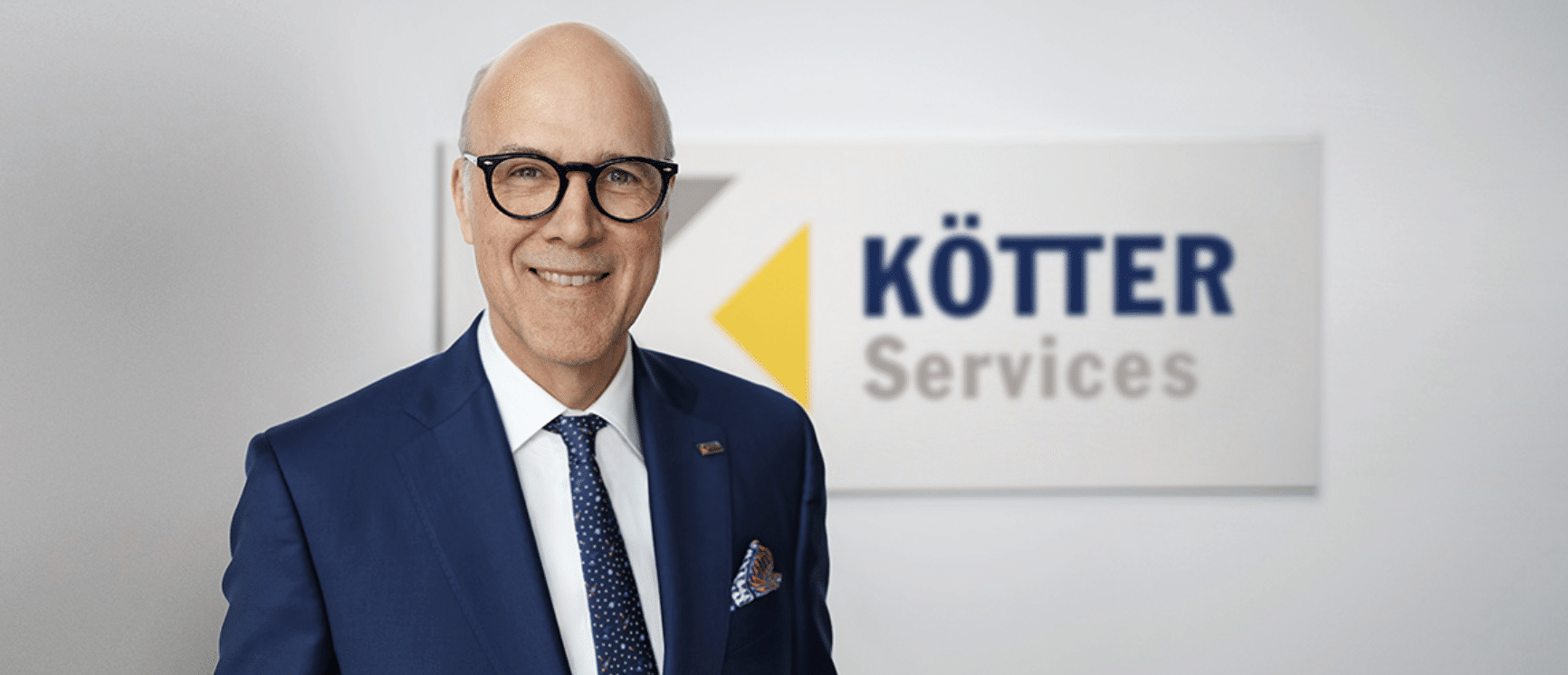
Friedrich P. Kötter has helped transform a long-established security firm into a diversified service group with more than 16,000 employees. On 21 September, the Essen-based family entrepreneur will turn 60. His career path also reflects the transformation of an industry in which traditional security services have long since merged with technology, cyber security, facility services and specialised services.
When Friedrich P. Kötter joined the management of the family business alongside his sister Martina Kötter in 1994, the security market was still much more clearly divided into individual sectors. Since then, the diversification strategy initiated by his father, Fritz Kötter, has been consistently expanded.
Today, according to its own figures, the KÖTTER Group ranks among the ten largest facility services providers in Germany and is the largest family-owned company in the German security sector. Its portfolio ranges from security services and security technology, through cyber security, cleaning and staffing services, to technical facility services, airport security, fire and rescue services, and services for the justice sector.
Kötter has played a key role in shaping this development over more than three decades.
Diversification as a strategic principle
The expansion of the portfolio followed a clear logic: customers should increasingly be able to obtain multiple operational and security-related services from a single source.
Alongside organic growth, targeted acquisitions also played a role in this. At the same time, the company remained family-owned.
Friedrich P. Kötter intends to continue along this path. “This focus on being a systems and specialist provider will continue to be a decisive factor in shaping our Group’s direction in the future,” he says. Further growth is to come primarily from within the company itself; however, selective M&A transactions remain an option.
This approach is particularly significant for the security sector. Physical security, technical systems and digital protection mechanisms are becoming increasingly difficult to view in isolation. Companies are increasingly requiring combined concepts encompassing personnel security, technology, cyber security and centrally managed service processes.
Consequently, the business model of large security service providers has also changed. The mere provision of personnel is increasingly taking a back seat to integrated, technology-supported solutions.
Service provision remains a business based on trust
Despite digitalisation and technical integration, the sector remains heavily people-driven.
Security and facility service providers are often directly integrated into their clients’ operational processes. Long-term dependencies arise, particularly at critical or sensitive sites. Reliability, qualifications and trust therefore remain key factors.
Friedrich P. Kötter explicitly articulates this principle in relation to employees: “A company – particularly a service provider – is only as good as the people associated with it.”
On the occasion of his birthday, he accordingly extends his thanks to staff, clients and partners. This statement also highlights one of the sector’s greatest challenges: driving technical innovation forward without underestimating the importance of qualified staff.
After all, automation, control centre technology, video analytics and cyber security cannot completely replace the human factor. Rather, they alter job profiles and place greater demands on qualifications and organisation.
An industry under pressure to change
The market in which KÖTTER operates has changed fundamentally since the 1990s.
Traditional security services are now complemented by digital access control, video analytics, networked control centres, automation and cyber security. At the same time, pressure to secure skilled staff and cost pressures are intensifying competition.
For large service providers, this presents a twofold challenge: they must build up technological capabilities whilst simultaneously organising labour-intensive services efficiently.
The integration of security services and technology is therefore less of a supplementary business and increasingly part of the company’s strategic positioning. Those able to coordinate different trades and integrate them into a unified security and operational concept are becoming increasingly important for companies with complex sites.
KÖTTER relies on a combination of a broad systems business with specialised services.
Call for reform from politicians
Friedrich P. Kötter is also marking his 60th birthday with a message on economic policy.
He is calling for better framework conditions for businesses and more far-reaching reforms. “Entrepreneurship in Germany finally needs to be valued more highly again and given sensible framework conditions,” says Kötter. Otherwise, deindustrialisation will continue, the effects of which the company, as a business-oriented service provider, is already feeling.
This statement highlights a particular vulnerability within the sector. Security, facility management and staffing service providers are closely linked to the economic development of their clients. If industrial facilities are downsized, investments postponed or sites closed, this has a direct impact on external services.
A broad client and service portfolio can cushion such risks, but service providers cannot completely insulate themselves from economic trends.
Influence beyond one’s own company
Friedrich P. Kötter has been one of the most well-connected representatives of the security industry for decades.
He has been a member of the Executive Board of the International Security Ligue for 30 years. He has been a member of the Executive Board of the Aviation Security Services Association International since 2002, and has served as First Vice-President of the Confederation of European Security Services since 2014.
He is also active in leading industry associations at national level: Kötter has been Vice-President of the Federal Association of the Security Industry since 2013 and Vice-President of the Federal Association of the Service Industry since 2018.
These roles provide him with insight into various national security markets and regulatory systems. International exchange is particularly relevant in an industry where requirements vary significantly from country to country – for example, in terms of qualifications, tendering, the use of technology and cooperation with government bodies.
According to Kötter, he also uses these networks to bring international experience more strongly into the German security and service sectors.
Closely connected to Essen and the Ruhr region
Despite his extensive international network, his ties to his home region have remained strong.
A native of Essen, he is a personal member of the Initiativkreis Ruhr and serves as Chairman of the Supervisory Board of JOBLINGE gAG Ruhr, which supports young adults in accessing training and employment.
As a founder and Deputy Chairman of the Supervisory Board of the muTiger Foundation, he is also committed to promoting moral courage. In addition, he serves as Deputy Chairman of the Supervisory Board of NATIONALBANK AG.
His entrepreneurial and social commitments thus remain closely linked to the Ruhr region – the very region where the group of companies has its origins.
Continuity without standing still
Today, Friedrich P. Kötter sits on the group’s board of directors. His role has thus shifted from operational management towards strategic guidance.
For family businesses, such a transition is more than just a personnel matter. It is about preserving established structures and values without blocking necessary changes.
This balancing act becomes particularly challenging in the security and service sectors. Digitalisation, automation, cyber security, a shortage of skilled workers and increasing regulatory requirements are simultaneously transforming business models and customer demands.
The journey of the KÖTTER Group demonstrates how a family business can respond to this: not by turning its back on its traditional business, but by gradually expanding it.
Over the decades, traditional security services have evolved into a significantly broader service model. Friedrich P. Kötter has played a key role in shaping this transformation.
His 60th birthday therefore marks not so much a conclusion as a mid-term review. The crucial question for the coming years will be how the principle of the integrated service provider can be further developed under changing technological and economic conditions – and how much continuity a family-run business needs in order to remain adaptable at the same time.
As a result, the opening is now much more focused and the text as a whole is less redundant. In particular, the passages on diversification, system providers and industry transformation now flow seamlessly into one another, rather than reformulating the same point repeatedly.

