
Project P25 focuses on networking, data analysis and efficient structures
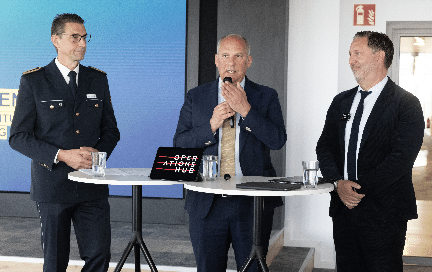
With the forward-looking Project P25, the Hesse Police is fundamentally realigning its approach to combating crime. Home Secretary Roman Poseck, together with Felix Paschek and Daniel Muth, presented the strategic realignment at the Innovation Hub in Wiesbaden/Frankfurt. The aim is to prepare the security authorities, both structurally and operationally, for the increasing complexity of modern forms of crime.
Response to changing threat landscapes
The initiative takes account of the fact that crime today is increasingly digital, internationally networked and organised in technologically sophisticated ways. Traditional investigative approaches are increasingly reaching their limits. This is precisely where P25 comes in: with stronger networking, accelerated processes and a targeted pooling of expertise.
Interior Minister Poseck emphasised that the police must keep pace with these changes in order to remain capable of acting against modern criminal networks. At the same time, the police’s presence on the ground should be strengthened and direct accessibility for citizens ensured.
Structural reform with a focus on efficiency and networking
At the heart of the project is a comprehensive reorganisation of the structures involved in combating crime. The Hessian State Criminal Police Office will be strengthened as the central specialist authority and more closely integrated with police headquarters and regional criminal investigation departments. The aim is to create an effective network that efficiently brings together information, expertise and operational measures – from international cooperation to local policing.
By merging previously separate investigative areas, new organisational units with clear responsibilities will be created. Interfaces are to be reduced, procedures accelerated and resources deployed in a more targeted manner. At the same time, the existing infrastructure will be retained: neither job cuts nor site closures are planned.
Data as the key to modern investigative work
A central component of the reorganisation is the expansion of data-driven investigative approaches. In future, analytical capabilities will be systematically pooled and further developed within specialised units. In particular, the new ‘Cyber, Intelligence’ criminal investigation units are intended to help identify complex criminal networks more quickly and analyse connections efficiently.
LKA President Daniel Muth emphasised that data analysis plays a key role in successfully combating crime. Only through the intelligent analysis of large volumes of data can the increasing complexity of modern crimes be managed.
New operational structures and specialised units
Another element of P25 is the establishment of so-called clearing centres. These are intended to efficiently handle offences involving minor damage and limited prospects of detection, thereby freeing up resources for more complex investigations.
In parallel, operational effectiveness will be strengthened through new structures. These include round-the-clock criminal investigation services and the expansion of regional criminal investigation units. The role of “local police officers” is also to be further strengthened to ensure the police remain close to the public.
Particular importance is attached to the new Operations Hub – an operational centre for combating serious and organised crime. As part of Frankfurt’s status as a centre of innovation, it is intended to improve the coordination of complex investigations and consolidate cooperation between various units.
Balance between digitalisation and presence
A central theme of the reorganisation is the combination of technological modernisation and traditional police work. Whilst data analysis, networking and digital tools are gaining in importance, a visible presence in public spaces remains an essential component of the security strategy.
State Police President Paschek emphasised that modern structures and efficient processes are not an end in themselves, but serve to deploy resources more effectively for the safety of the public. At the same time, the reorganisation enables new priorities to be set – for example, in the area of asset recovery or in combating complex forms of crime.
Conclusion: Strategic reorientation with a signal effect
With P25, the Hesse Police is pursuing a comprehensive transformation approach that combines structural, technological and operational elements. The initiative demonstrates how security authorities can respond to the increasing digitalisation and internationalisation of crime.
The project provides important impetus for the security industry. Topics such as data integration, intelligent analysis, organisational structure and process optimisation are coming more into focus. At the same time, it is becoming clear that modern security concepts only work through the interplay of technology, personnel and clear structures.
Caption: Minister for the Interior Roman Poseck, State Police President Felix Paschek and LKA President Daniel Muth – Image source: Frank Zinn / HMdI

