
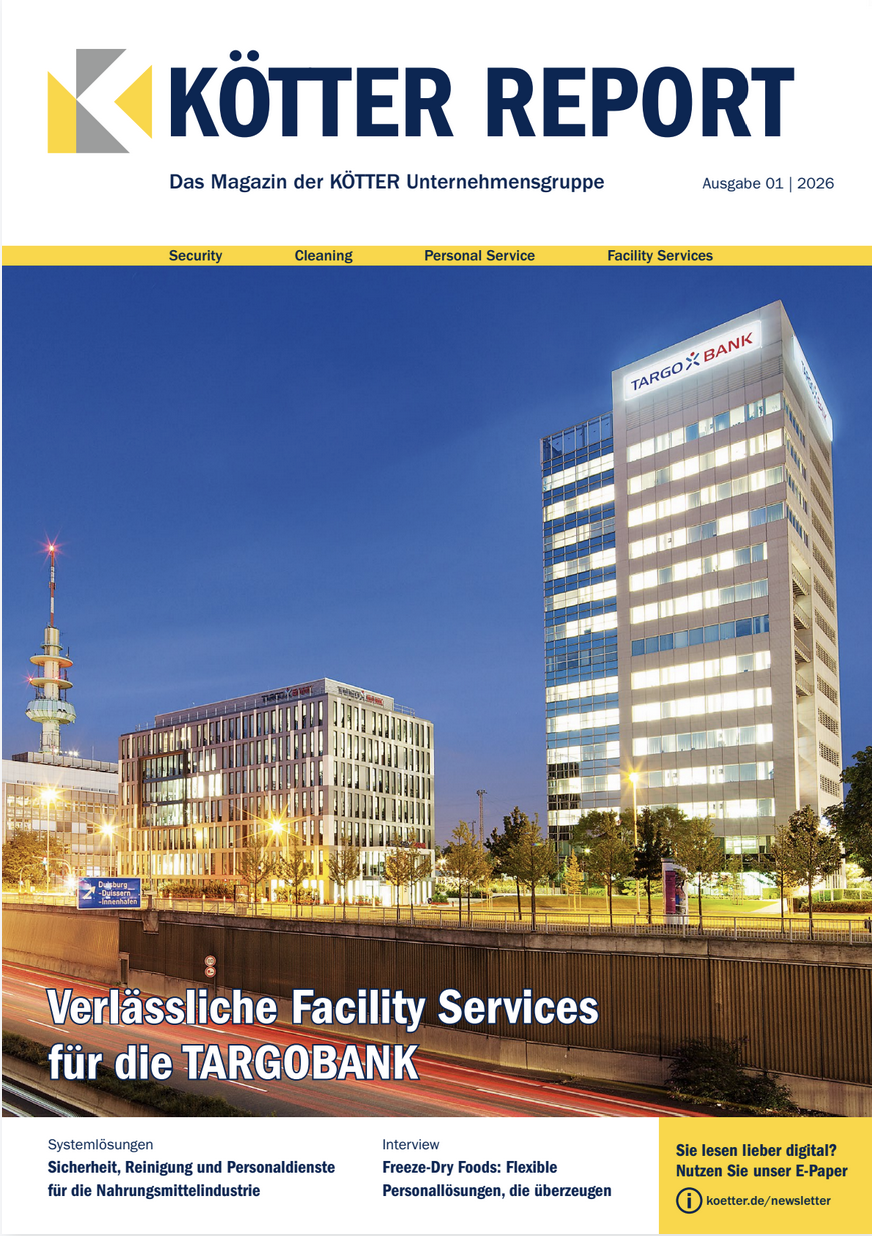
In the latest edition of the KÖTTER Report, the KÖTTER Group provides an insight into its operational development whilst demonstrating how integrated facility services are increasingly becoming a strategic success factor for businesses. Behind key figures such as several million customer contacts managed, large-scale cleaning services and extensive staffing operations lies a clear trend: security, cleanliness and personnel management are increasingly converging into holistic solutions.
Integrated services in the banking sector
A key practical example is the collaboration with TARGOBANK. At numerous locations, KÖTTER Services provides bundled services comprising security and building cleaning.
Reliable processes are crucial, particularly in the banking sector: branches must not only be clean and presentable, but also meet the highest security standards. The integration of both service areas enables standardised processes, clear responsibilities and consistent service quality – a key factor for day-to-day operations with high customer footfall.
Challenges in the food industry
The growing importance of integrated services is also evident in food production.
Rising energy and raw material costs, stricter regulatory requirements and volatile supply chains are increasing the pressure on the industry.
This is where combined services covering security, cleaning and staff planning come into play. Hygiene and safety standards, in particular, play a central role in preventing production downtime and ensuring product quality. At the same time, flexible staffing concepts are becoming increasingly important in order to respond to fluctuating demand and complex production processes.
A concrete example is the collaboration with Freeze-Dry Foods GmbH. The company relies on external support to maintain stable production and administrative processes. Crucial factors here are rapid responsiveness, predictable staffing resources and reliable processes throughout the entire value chain.
Staff as a strategic factor
In addition to technical and organisational solutions, the development of specialist and managerial staff is also coming into sharper focus. The report uses a practical example from Stuttgart to demonstrate how internal career paths can be designed.
Employees who originally worked in operational areas such as cleaning or waste disposal now hold managerial positions. This model underscores the importance of long-term staff development in an industry that increasingly requires skilled workers. At the same time, it strengthens employee retention and secures expertise within the company.
Scalable solutions for complex requirements
The examples presented in the report illustrate an overarching pattern: companies today no longer require isolated individual services, but rather scalable comprehensive solutions.
Whether in banking, industry or food production – the demands on safety, hygiene and staff organisation are rising in parallel. At the same time, there is a growing need for standardised processes that can be implemented consistently across multiple sites.
Integrated facility services offer an approach to reducing complexity here. By bundling services, interfaces can be minimised, processes harmonised and costs better managed.
Conclusion
The KÖTTER Report 2025 shows that facility services have long since gone beyond traditional support services. They are evolving into a central component of modern corporate strategies.
The combination of security services, cleaning and staffing solutions enables companies to reduce operational risks, unlock efficiency potential and, at the same time, respond flexibly to changing market conditions. Particularly in an environment of increasing regulatory requirements and economic uncertainty, this integrated approach is increasingly becoming a competitive advantage.

