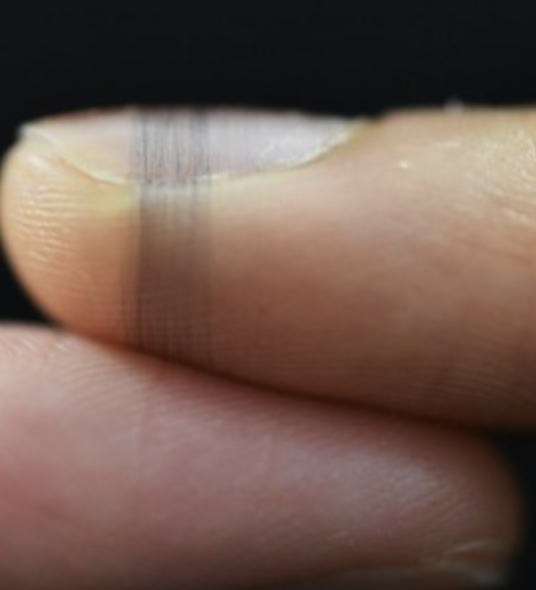
The new sensor made from “spider silk” is printed directly onto the finger (Photo: cam.ac.uk)
University of Cambridge experts take health monitoring to a revolutionary level
Researchers at the University of Cambridge (https://www.cam.ac.uk/ ) have developed new sensors that are 50 times thinner than a human hair and are printed directly onto the skin. The manufacturing process is inspired by spider silk, which can adapt and adhere to a variety of surfaces. Bioelectronics are integrated into the “spider silk” from Cambridge so that the “web” can be equipped with sensory capabilities. Plants are also suitable as carriers. Sensors printed on them could monitor growth and, for example, sound the alarm if there is a lack of water.
Extremely gentle printing
This low-waste and low-emission method could be used in a range of areas, from healthcare and virtual reality to electronic textiles and environmental monitoring. Electronic sensors on the skin could fundamentally change the way people interact with the environment, experts believe.
Sensors printed directly onto the skin could improve the perception of reality in games or virtual reality applications, for example. According to the developers, the printing process is so gentle that it has even been possible to place a sensor on a dandelion without the loose seeds falling off with a parachute.
Adaptation to microstructures
The team led by Yan Yan Shery Huang has produced the bioelectronic “spider silk” from PEDOT:PSS. This consists of a biocompatible, electrically conductive polymer as well as hyaluronic acid and polyethylene oxide. The researchers extracted the fine threads from an aqueous solution containing the base materials at room temperature. In a second step, they treated the threads so that they could adhere to biological substrates.
They even adapt to microstructures such as grooves on the fingertips. Most high-resolution sensors are currently manufactured in a multi-stage, energy-intensive process in clean rooms and require toxic chemicals. The sensors developed in Cambridge, on the other hand, can be manufactured anywhere.
Video: https://youtu.be/l14SvUWGH-o