Why AI-based video analysis is reshaping Europe’s security debate
Between data protection, KRITIS protection and real-time situational awareness: computer vision is emerging as a key technology in modern security architectures
Artificial intelligence is profoundly transforming the security industry – particularly in areas where large volumes of visual data need to be analysed in real time. One of the most important technologies in this field is so-called object detection. Systems not only analyse video images for general content, but also identify specific objects within a scene, locate them spatially and assess their relevance.
Whilst facial recognition is increasingly viewed with scepticism in Europe, both from a regulatory and societal perspective, object detection is emerging as a technically and ethically more nuanced alternative. This approach is gaining particular significance in the KRITIS sector, within transport and security infrastructures, and in the protection of public spaces.
Impetus is currently coming from the US, among other places. There, the US provider Omnilert is positioning itself as a specialist in visual security analytics with AI-supported weapon and threat detection. However, the debate surrounding such technologies extends far beyond individual providers and touches on fundamental questions of European security and data protection policy.
From image to situational awareness
Object recognition falls within the field of computer vision and is based on neural networks that analyse image or video data. Unlike traditional image classification, the technology answers not only the question ‘What can be seen?’, but also ‘Where is the object located?’.
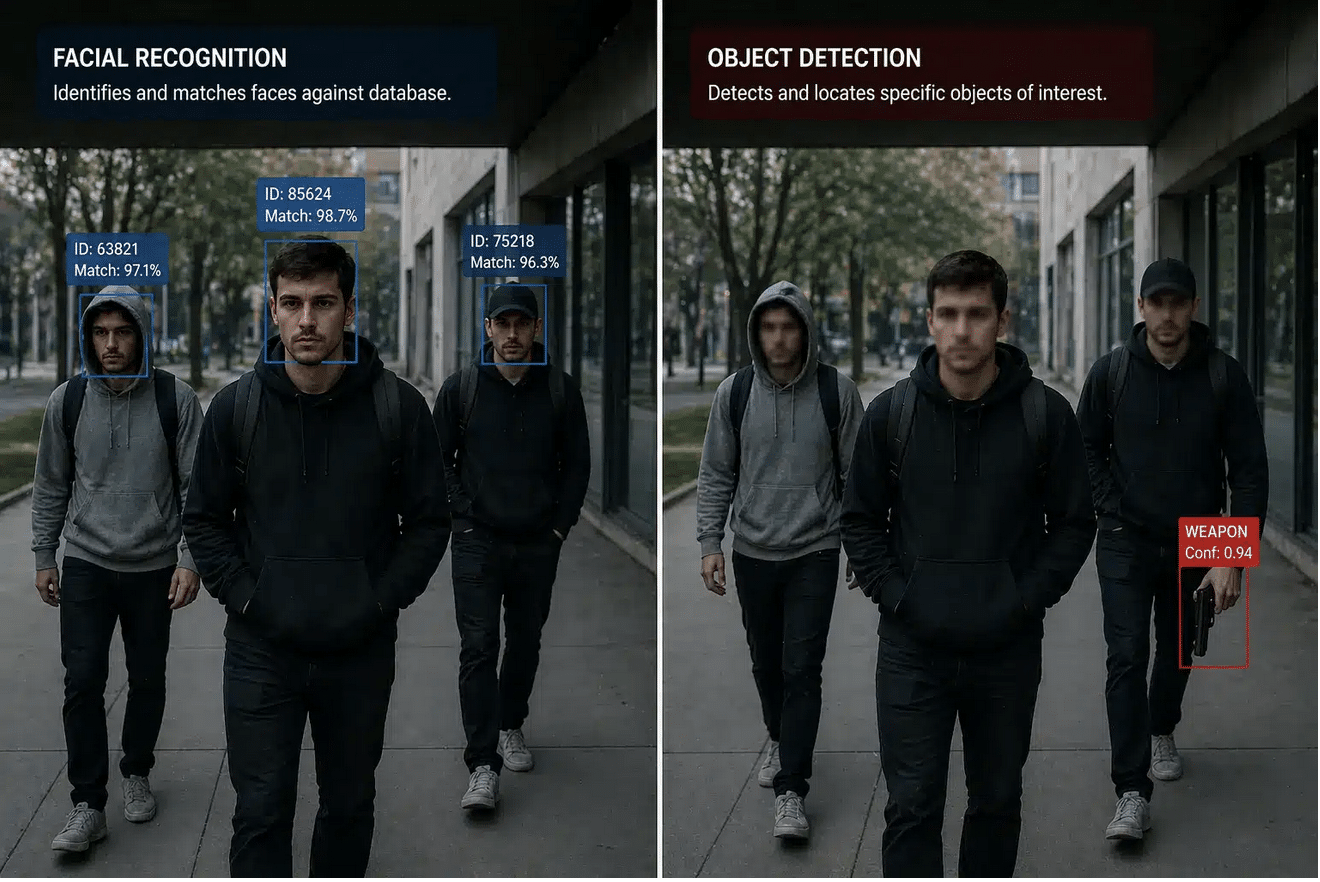
The system marks recognised elements with so-called bounding boxes and assigns them to categories – such as person, vehicle, rucksack or weapon. At the same time, modern systems calculate probability values to assess the certainty of a recognition.
This transforms raw data into operational situational awareness.
This capability is considered a key difference from earlier video analyses, which often merely registered movements without semantically understanding the content.
Data quality is becoming more important than model size alone
In the development of modern AI systems, the focus is increasingly shifting from pure model complexity towards the quality of the training data.
Whilst model-centric approaches primarily develop ever more powerful neural networks, data-oriented strategies rely more heavily on representative datasets, precise annotations and realistic training conditions.
This is particularly crucial for security applications. Systems must operate reliably under a wide variety of conditions:
- changing lighting conditions,
- dense crowds,
- weather conditions,
- partial occlusions,
- rapid movements,
- or complex urban environments.
Poorly trained systems, on the other hand, generate false alarms or overlook critical situations.
The European debate on trustworthy AI ties in precisely with this point. Data quality, transparency and bias minimisation are increasingly becoming regulatory requirements – particularly in the context of the EU AI Act.
Real-time capability is transforming security architectures
Modern object recognition systems now operate almost in real time. Current AI models analyse video streams at up to 30 frames per second and detect objects within fractions of a second.
Technologies such as YOLO (‘You Only Look Once’), SSD or newer transformer-based models like DETR have massively increased the systems’ performance.
This opens up new operational applications:
- traffic monitoring,
- perimeter protection,
- warehouse and logistics management,
- smart city applications,
- industrial quality control,
- and security-critical event detection.
This is particularly relevant in conjunction with existing video management systems (VMS), access control and real-time situational awareness.
Security industry discovers AI-powered threat detection
In the security sector, AI-based weapon and threat detection is gaining particular momentum. Systems continuously analyse video streams, searching for defined risk categories such as handguns, knives or other dangerous objects.
- The key advantage lies in the ability to analyse continuously. Whilst human operators quickly become fatigued when monitoring numerous cameras, AI works continuously without losing concentration.
- Large-scale infrastructure in particular, such as:
- airports,
- railway stations,
- stadiums,
- hospitals,
- schools,
- data centres,
- or corporate campuses
are thus increasingly becoming areas of application for AI-based object detection.
The systems do not replace security personnel, but function as early warning and support systems within existing security architectures.
Europe approaches data protection differently from the US
From a European perspective, however, technical capability is less crucial than the issues of data protection, proportionality and fundamental rights.
In this respect, object recognition differs fundamentally from biometric facial recognition.
Whilst facial recognition can identify individuals and generate movement profiles, object recognition focuses on objects or events. For example, the system detects a weapon or a piece of abandoned luggage – but not the identity of the person in question.
This difference has significant regulatory implications.
The European debate on data protection regards biometric identification as a particularly sensitive issue. Several European institutions, as well as numerous data protection authorities, view the mass use of biometric surveillance critically.
Object recognition, by contrast, is often regarded as a less invasive approach, as:
- no biometric profiles are generated,
- no individuals are tracked,
- no watchlists are used,
- and no permanent identity data is stored.
This could make the technology more regulatory-viable, particularly for sensitive European operational environments.
Bias and discrimination remain an issue, however
Nevertheless, object recognition is not without its ethical challenges.
Whilst the geometric characteristics of weapons or objects are less strongly linked to demographic characteristics than biometric facial data, recognition quality and error rates still depend heavily on training data, scenarios and system configuration.
Problems arise in particular in the following situations:
- poor lighting conditions,
- occluded objects,
- highly frequented environments,
- motion blur,
- or atypical situations.
Added to this is the risk of false alarms. Particularly in the security sector, both false positives and false negatives have significant operational consequences.
This is why many systems continue to rely on ‘human-in-the-loop’ approaches. AI detects potential threats, but the final assessment and escalation are carried out by human operators.
Integration is becoming the real competitive advantage
Technologically, it is now less about the detection itself than its integration into overarching security processes.
Modern systems increasingly link object detection with:
- access control,
- control centres,
- VMS platforms,
- incident management,
- mobile alerts,
- or automated response workflows.
As a result, computer vision is evolving from an isolated camera feature into an integral part of networked security ecosystems.
This development is gaining particular significance in the European KRITIS environment. Operators of critical infrastructure are under growing pressure to integrate physical security, cybersecurity and real-time situational awareness more closely.
Regulatory differentiation is likely to increase
With the EU AI Act, a clearer regulatory distinction between biometric identification and object-based video analysis is also emerging.
Many experts assume that in future, Europe will distinguish more clearly between:
- identity-based AI,
- behaviour-based analysis,
- and object-centred security analytics
- .
Object-focused systems in particular could thus remain easier to deploy from a regulatory perspective – especially where concrete threat prevention is the primary focus.
From the camera to the semantic security system
Ultimately, this development reflects a fundamental shift in modern security technology. Cameras no longer merely provide video images, but are becoming sensors within semantic security platforms.
Object recognition transforms visual data into the basis for operational decisions – in real time, automatically and increasingly in a context-aware manner.
For Europe, this creates a complex tension between:
- security gains,
- data protection,
- AI regulation,
- and social acceptance.
It is precisely for this reason that the debate surrounding object-centred AI systems is likely to gain further strategic significance in the coming years – not only technologically, but also politically and in terms of regulation.