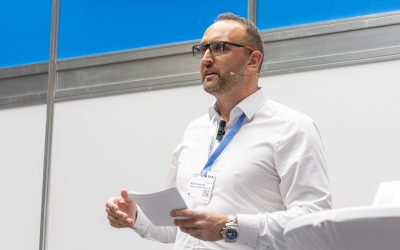
Joe Young, Vice President of Global Partner Development & Strategic Alliances at Convergint, outlines the role of the integrator as an orchestrator at the 2026 International Genetec Press Meeting – and why co-creation is becoming the new standard.
Genetec’s international press meeting in Montreal focused not only on the manufacturer’s technological roadmap, but also on the question of how security solutions can be planned, implemented and operated consistently worldwide. Joe Young, responsible for Global Partners & Alliances at Convergint Technologies, used his presentation to outline Convergint’s development, operating model and partner-led go-to-market approach. The message: in a platform and AI-driven security landscape, the system integrator becomes the orchestrator – with measurable outcomes as the key performance indicator.
From the field to global partnership management
Young opened with a personal overview explaining his view of the industry. He has around 26 years of experience in physical security, starting as an installer, later moving into pre-sales engineering, supplemented by experience in the IT MSP environment and in leadership roles at G4S/Allied Universal in solutions engineering, innovation and partner management. This cross-disciplinary biography is not just a CV item, but a fundamental argument: anyone who knows installation, IT operations and security organisations from the inside understands why customers don’t ask for individual products, but for functioning end-to-end results.
Growth and identity: integrator without product conflicts
Why Convergint? Young described the reasons for his move as a combination of culture, leadership vision and the appeal of helping to shape the future of physical security from the perspective of a global integrator. The decisive factor here is the structural difference to manufacturers: Convergint does not produce its own products. This independence – ‘without product conflicts’ – positions the company as a neutral integration partner that can select and combine technology based on customer benefits.
Young described Convergint’s growth as being driven by two factors: organic growth and acquisitions. Over more than two decades, the company has steadily scaled up while maintaining its focus on core areas: access, intrusion, video, fire and communications. Leadership changes – from founders to subsequent management generations to the current leadership – were presented as cultural amplifiers: curiosity, willingness to learn and constant questioning of the company’s own business model as the basis for ‘continuous reinvention’.
Operating model: 220 locations, 11,000 frontline colleagues and ‘last mile’ as a differentiator
Young gave a very specific description of the operational scale: around 220 locations worldwide and approximately 11,000 ‘frontline colleagues’. This is not just a number, but a description of performance – because Convergint wants to master the ‘last mile’: design, installation, service and managed capabilities directly at the customer’s location.
Here, Convergint relies on three interlocking go-to-market movements that are designed to enable both scaling and consistency:
• Global & Enterprise for large international customers and standardised, repeatable rollouts,
• Vertical Markets as an industry driver for regulatory expertise and reusable reference architectures,
• Local CTCs (Convergint Technology Centres) as local units with autonomy – but within centrally pre-packaged best practices and partner-coordinated offerings.
This creates a hybrid model: fast locally, consistent globally.
From ‘presence’ to ‘capabilities’: standardisation as a prerequisite for global quality
A key point in Young’s presentation was the distinction between global presence and global capabilities. Presence can be bought or built – capabilities must be operationalised. Convergint therefore invests in standardised digital infrastructure and process landscapes to make delivery reproducible worldwide. Among other things, CRM, CPQ, source-to-pay, ERP, field service management, project management and enterprise asset management were mentioned. This is supplemented by training and sales enablement so that best practices are not only documented but actually put into practice in the field. The goal is clear: the same service quality, the same project logic, the same governance – regardless of whether a rollout takes place in North America, Europe or APAC.
Europe as a replication project: US model as a blueprint for parity
Europe was described as a region in which Convergint has been specifically replicating US models over the last 12–18 months: CTC structure, leadership approach, sales roles and vertical expertise. The term ‘parity’ was used as a benchmark – capabilities, not just flags on the map. At the same time, Young emphasised that each region has its own market logic. Parity therefore does not mean uniformity, but rather repeatable delivery capability despite local differences.
Vertical focus: regulatory requirements are translated into field logic by experts
Young made it clear that verticals can vary regionally – but there are global constants: healthcare, utilities/power, finance, data centres and education. The decisive factor is how these verticals are played out: Convergint relies on dedicated industry experts who master regulatory requirements and standards and translate them into ‘field-ready guidance’. In practice, this means that Not every account executive needs to know HIPAA, NERC or critical infrastructure standards in detail ‘by heart’ – but every solution should be built in such a way that compliance requirements are systematically met.
Supply chain and chipsets: ‘muscle memory’ and a new impetus towards the cloud
Young cited the return of global supply chain bottlenecks, particularly for chipsets, as a current issue. According to its own statements, Convergint is drawing on ‘muscle memory’ from previous crises: structured internal communication, consolidated guidance for the field, forecasting processes and greater transparency from partners in order to be able to provide customers with reliable information on delivery times, price effects and alternatives.
The strategic conclusion was interesting: Hardware shortages are particularly affecting on-premises infrastructure – servers, racks, classic project architectures. This could provide additional impetus for cloud adoption, as large cloud providers are often prioritised in the supply chain. Young pointed out that Convergint is having noticeably more discussions about cloud migration paths, especially with enterprise customers and in the data centre environment.
Data centres: High-growth vertical under infrastructure pressure
Young described data centres as one of the most dynamic growth areas, with very high growth rates in this segment. At the same time, data centre projects are particularly sensitive to chipset prioritisation and infrastructure availability. This is precisely where customer discussions on two topics are increasing in parallel: hardware availability and fallback strategies via cloud architectures.
Convergint is exporting playbooks from North America to other regions in order to be able to provide standardised answers more quickly.
AI: hype, ‘jobs to be done’ and the ‘AI-ready’ foundation
When it comes to AI, Young deliberately took a stance that contrasts with market rhetoric. Customers are inundated with promises, but what is crucial is a ‘jobs-to-be-done’ perspective:
What should the solution achieve in everyday life – and how can the result be measured?
Young formulated an expectation that many operators share: systems should function seamlessly – more like a smartphone experience, where components interact, operators are guided and outcomes are the focus. At the same time, he warned against the misconception that AI can be activated like a feature switch. True AI potential only emerges when the foundation is right: networked platforms, modernised infrastructure, suitable sensor technology, clean data and operability.
Convergint wants to reinforce this perspective with its own point of view and announced an industry POV document: ‘Path to Intelligent Security’, timed to coincide with the ISC. Convergint is thus positioning itself not only as an implementer, but also as a guide for realistic AI adoption.
Co-creation instead of resale: partner strategy with selectivity and shared accountability
A central part of the presentation was Convergint’s partner strategy. Young described a realignment: away from transactional resale, towards conscious, outcome-driven co-creation. The partner ecosystem is becoming more selective and partner management more professional – with a dedicated team and clear partner categories. The goal is joint market development through co-marketing, co-selling, co-delivery and co-innovation.
Young cited trust, transparency and shared responsibility for customer success as factors for success. The bottom line: partnership is not a supplier relationship, but a production model for repeatable solutions.
K–12 as a blueprint: Convergint × Axis × Genetec – pre-engineered, cloud-enabled, service-integrated
The co-creation model became particularly concrete in the example of the K–12 offering that Convergint is preparing together with Axis and Genetec. The goal is a solution that not only works technically in schools, but is also operationally viable – precisely because many users are not security specialists.
Young described how the development is strongly customer-driven: interview guides, site walks, discovery-oriented surveys based on ethnographic patterns and documented user stories (with consent). Instead of redesigning each deployment, the aim is to create a pre-engineered, repeatable architecture. Modernisation and cloud enablement were explicitly addressed, including a reference to Security Centre as a Service.
A particular added value lies in deeper operational integration: asset visibility and health monitoring should not only indicate failures, but also translate them into service processes – automatic notifications for offline devices, remote triage and dispatch of the right technician with the appropriate parts and necessary certifications.
Convergint measures success here not only in terms of installation, but over a period of 1–5 years: high adoption, high availability and effectiveness, demonstrable risk reduction and compliance alignment – and a clear link to the business objectives that justify its use.
Details of the offer were deliberately only teased at a high level; further publication is planned for the UNITE conference and corresponding announcements.
‘Step Up’: Community programme with economies of scale and learning loop
A second K–12-related element is the Convergint ‘Step Up’ programme.
Partners provide hardware and software, while Convergint takes care of installation and ongoing service.
Young described the expansion to a broader initiative, including a grant programme. The effect is twofold: concrete support for schools and, at the same time, a learning loop for Convergint, because proximity to communities reveals real operational requirements – from adoption and processes to topics such as reunification planning and drill processes.
Around 200 implementations have been mentioned so far, and international scaling has been emphasised (and in the Q&A, the idea of ‘reference schools’ as best practice locations was highlighted).
Q&A: Stakeholder buy-in, reference schools and ‘North Star’ implementations
The discussion focused on how Convergint obtains honest stakeholder input and formal approval in school districts. Stakeholder mapping, board buy-in playbooks, digital assessment tools and alignment with evolving standards were mentioned.
Particularly interesting: Reference schools are not intended to serve as a financial incentive, but as operational learning locations. Districts should see how a ‘North Star’ implementation works in everyday life – including process documentation, training logic, best practice sharing and operational readiness.
TPRM as a gate: Partner onboarding under risk and compliance control
Finally, Young explained Convergint’s Third-Party Risk Management (TPRM) as a formal onboarding gate for technology partners. Sourcing/procurement, IT, legal and commercial review teams check technical, legal and commercial minimum requirements.
The timeline varies depending on maturity and existing certifications – and Convergint rejects partners if minimum controls are not met. The goal: to protect customers, protect its own delivery standards and avoid risks that may materialise later in projects.
Technical classification of the presentation
Joe Young’s presentation at the press meeting in Montreal provided an integrator’s perspective that adds a crucial dimension to the industry discourse: the future of physical security will not be determined solely by the innovations of individual manufacturers, but by the ability to orchestrate technologies worldwide in a repeatable, compliant and serviceable manner.
Convergint positions itself as an independent, partner-driven integrator with vertical expertise, a standardised operating model and a clear goal: outcomes instead of components. The announced ‘Path to Intelligent Security’ perspective and the K–12 co-creation example show how this strategy is to be implemented in concrete terms – not as a vision on slides, but as a ready-made, operable architecture with measurable success criteria.
[DCM]