Security Essen 2026 demonstrates how high-security fencing, sensor technologies, radar, LiDAR, AI-powered video, drone detection, vehicle mitigation and access control are converging into multi-layered protection concepts for industry and critical infrastructure.
Perimeter protection is undergoing a fundamental transformation. Fences, gates and barriers remain indispensable physical components of site security, but for high-risk facilities they are no longer sufficient on their own. Sabotage, professionally prepared intrusion attempts, hostile vehicle attacks and the growing use of drones are changing both the threat landscape and the way operators must design their outer security zones.
Security Essen 2026 reflects this shift particularly clearly. Across the exhibition, perimeter security is evolving from a collection of isolated products into an integrated security architecture. Mechanical resistance, electronic detection, video analytics, access control and command-and-control technologies are increasingly being engineered as one coherent system.
For operators of critical infrastructure, industrial plants, logistics hubs, data centres, transport networks and public facilities, this changes the fundamental planning question. The issue is no longer simply whether a site is adequately fenced. The relevant questions are how early a suspicious approach can be detected, how reliably a genuine threat can be distinguished from a nuisance alarm, which camera is automatically assigned to the incident, whether a person or vehicle may in fact be authorised, and how much time remains for intervention.
Layered protection becomes the guiding principle
One of the clearest technological trends is the move towards layered perimeter protection. Rather than expecting one technology to fulfil every task, multiple detection and protection principles are combined so that the strengths of one layer compensate for the limitations of another.
An initial detection zone may begin well outside the physical boundary. Radar, LiDAR or video analytics can identify approaching persons or vehicles before they reach the fence. At the perimeter itself, fence-mounted sensors detect climbing, cutting or tampering. Cameras then provide visual verification, while high-security fencing, gates, bollards or road blockers increase physical delay. Access-control systems establish whether a person or vehicle is authorised. Finally, a security management platform correlates the information and presents operators with a coherent incident picture.
MIRA Technologies, exhibiting in Hall 6, Stand 6F29, illustrates this increasingly integrated model. Its portfolio combines fence detection, radar, fibre optics, microwave and LiDAR with a higher-level command-and-control layer. The MAGUS family consolidates information from different sensor sources and evaluates them together. The strategic direction is clear: the market is moving away from isolated detectors and towards sensor fusion.
OPTEX Europe, Hall 7, Stand 7C35, follows a similarly layered approach. Active infrared beams, PIR sensors and LiDAR detection can be deployed according to the risk profile of individual zones and integrated with video and management platforms.
Senstar, Hall 8, Stand 8C06, takes integration even further within the sensor itself. Its MultiSensor combines short-range radar, PIR, accelerometer data, vibration analysis and video. A sensor-fusion engine evaluates the combined context, helping to distinguish genuine intrusion events from environmental effects such as vegetation, wind or shadows.
This highlights one of the central challenges of modern perimeter security: detecting activity is no longer the principal problem. Evaluating it correctly is.
The fence becomes an active detection layer
The integration of detection directly into the physical boundary is particularly significant because it gives the fence a dual role: mechanical barrier and electronic sensor.
Tillmann & Schroyen, together with CAPRA, will demonstrate DefenceLine SENSE in Hall 5, Stand 5D08. The solution combines a closed high-security fence with intelligent sensor technology designed to detect penetration, climbing and sabotage attempts directly at the perimeter. Events can subsequently be transferred to higher-level security or control-room systems.
Shanghai Gato IT, Hall 2, Stand 2A39, also links fence, alarm and video technology. Its SAM100 management platform can correlate alarms from electric fence systems with IP video so that the relevant camera zone is automatically displayed when manipulation occurs.
Where very long fence lines are involved, precise localisation becomes equally important. Novatec Germany, Hall 6, Stand 6C16, addresses this with its Perimeter Locator, which deploys RFID-based tags directly on individual fence sections and gates. The objective is not merely to identify that manipulation is taking place, but to determine where it is occurring.
Fibre optics turn kilometres of infrastructure into a sensor
For pipelines, railways, energy infrastructure and other highly extended sites, distributed fibre-optic sensing is becoming increasingly relevant. Instead of installing discrete sensors every few metres, the fibre itself becomes a continuous detection medium.
AP Sensing, Hall 7, Stand 7F29, will present Distributed Acoustic Sensing solutions capable of detecting and classifying vibrations and acoustic events along an optical fibre. Such technology can identify manipulation, unauthorised access or sabotage attempts across pipelines, transport corridors and other linear infrastructure.
The strategic advantage is substantial: a technology originally designed for communications infrastructure can simultaneously become part of the physical security architecture across very long distances. For widely dispersed critical infrastructure, fibre sensing can therefore complement conventional perimeter systems particularly effectively.
Radar, microwave and LiDAR push detection beyond the fence
Fence sensors report an attack when the boundary itself is reached. Radar and LiDAR move the detection point further outward.
Magos Systems, Hall 5, Stand 5C15, combines radar with AI-based classification. Its MASS+AI platform can distinguish between people, vehicles and animals, while an autonomous security drone can additionally be dispatched to investigate a relevant event.
FORTEZA, Hall 6, Stand 6F28, will demonstrate its FMC-24-Pro microwave detection series for open-area protection, while SICK, Hall 5, Stand 5A34, uses 3D LiDAR to create a spatial representation of monitored areas. Its multiScan family employs filtering algorithms and multiple echoes to distinguish environmental influences such as rain, dust or ambient light from relevant objects. The multiScan100-S extends this concept with safety-related functions and large three-dimensional protective fields.
The consequence is an important technological shift. Outdoor detectors are evolving from simple motion sensors into spatial intelligence systems capable of determining location, direction of travel and, in some cases, the type of object detected.
AI video moves from observation to decision support
A comparable evolution is taking place in video surveillance. The decisive advance is no longer simply higher resolution, but the automated interpretation of what a camera sees.
AI-based analytics can separate people and vehicles from vegetation, shadows, animals or other irrelevant movement. This is particularly important in perimeter environments, where excessive false alarms can overwhelm operators and intervention teams.
Smartlogy Sicherheitstechnik, Hall 5, Stand 5C38, combines 4K cameras with AI-based object classification. Defined security zones can be monitored and relevant events transmitted to an app, monitoring centre or security service. Following verification, the system can also support direct audio intervention.
Verkada, Hall 5, Stand 5A35, takes this concept a step further with AI-Powered Deterrence. Cameras analyse suspicious behaviour and can automatically initiate voice warnings. Together with licence-plate-recognition zones, compound alerts, intercom and access control, video becomes an active component of the response chain rather than a passive recording tool.
For security operations centres, this fundamentally changes the quality of incoming information. Instead of receiving an undifferentiated motion alarm, an operator may receive a qualified event: person detected, restricted zone entered, movement towards the fence, video attached, and potentially further sensor information already correlated.
Mobile systems bring security to temporary sites
Another expanding segment is the protection of temporary or difficult-to-connect locations. Construction sites, solar farms, storage compounds or critical-infrastructure projects frequently lack permanent power supplies and fixed network infrastructure.
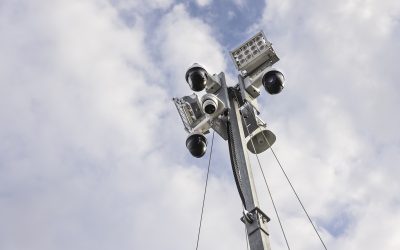
Mobile surveillance towers address this problem by combining cameras, mobile connectivity, AI analytics and increasingly autonomous energy systems.
VCS, Hall 5, Stand 5B27, will show the iTower Observa, a compact version of its mobile surveillance platform. Other variants can be equipped with photovoltaic modules, batteries or fuel cells and configured with cameras, thermal imaging, radar or infrared sensors.
TelescopicMast, Hall 5, Stand 5C36, follows a similar concept with its MSB-EDGE, combining three solar panels with protected batteries and an optional fuel cell. ViSec, Hall 5, Stand 5C28, integrates a mobile security tower with AI-based video analytics and remote monitoring. Even power availability is becoming part of the monitored security environment: Starrysea/LiTime, Hall 2, Stand 2D46, enables the remote supervision of charge and battery status in LiFePO4 systems.
This is more significant than it may initially appear. In an autonomous perimeter solution, loss of power immediately translates into a potential surveillance gap.
The perimeter expands into the third dimension
Perhaps the most profound change concerns the definition of the perimeter itself. A fence establishes a two-dimensional boundary. Drones do not respect it.
Protecting low-altitude airspace is therefore becoming an additional security layer for energy sites, airports, government facilities, military locations, data centres and major events.
LivEye, Hall 5, Stand 5D31, is making drone detection a major focus for 2026 and intends to demonstrate how scalable detection can be implemented using a German critical-infrastructure project as an example.
hensec, Hall 5, Stand 5A12, extends the concept towards a permanent airspace situation picture. The company opened a civilian drone situation centre for critical-infrastructure operators in early 2026, combining drone detection with radio monitoring, spectrum analysis and the detection of GNSS spoofing and jamming.
Hybrid Aerospace Amynetron, Hall 5, Stand 5C25.16, extends the chain from detection to physical intervention. Its “Greif” counter-sUAS drone is designed to capture small hostile drones mechanically and bring them to the ground in a controlled manner.
Viewpro, Hall 2, Stand 2C15, meanwhile focuses on airborne optical reconnaissance with compact EO/IR gimbals. Its A10TR Pro combines optical zoom, thermal imaging, laser rangefinding and AI-based detection of people and vehicles.
The implication is difficult to ignore: the high-security perimeter increasingly extends beyond the top of the fence.
Physical resistance remains indispensable
Despite rapid advances in sensing and AI, detection alone does not stop an attack. Electronic systems reduce the time to alarm; physical systems increase the time required to penetrate the site.
Michael Thomas Perimeter Engineering & Solution, Hall 5, Stand 5D18, will demonstrate resistance-tested security fencing with integrated detection as well as high-security bollards, gates, barriers, road blockers and vehicle-lock systems.
Hostile Vehicle Mitigation is an important part of this equation. Beijing ZhuoAoShiPeng Technology, Hall 2, Stand 2B26, will present retractable, fixed and removable bollards together with road blockers and wedge barriers for high-risk access points.
Mechanical protection should therefore not be understood as the analogue opposite of digital security. It is precisely because electronic systems can identify an attack earlier that defined physical resistance becomes strategically valuable: it converts detection time into usable intervention time.
Access points become the convergence point of security disciplines
The most complex areas of a perimeter are often its openings: vehicle entrances, pedestrian gates, loading areas and emergency access routes.
At these points, gate control, mechanical barriers, vehicle identification, access control, video and communications converge. A modern entrance therefore has to do considerably more than open and close. Ideally, the overarching system should know which vehicle is approaching, whether authorisation exists, and whether other security-relevant information is simultaneously available.
The joint appearance of Tessarek Security Systems and Weckbacher Sicherheitssysteme, Hall 6, Stand 6B29, illustrates this convergence. Tessarek contributes barriers, sliding and swing gates and bollards, while Weckbacher adds mechanical and digital locking systems, access control, intrusion detection and video.
Telenot, Hall 7, Stand 7E12, is also developing deeper integration. Its hilock 5000 ZK access-control system is increasingly being connected with video and hazard-management functions, allowing access events to be evaluated together with other security information.
This contextual layer is crucial. A movement becomes a meaningful security event only when the system can determine whether it is expected, authorised or suspicious.
From isolated alarms to a shared operational picture
As the number of sensors increases, event correlation becomes increasingly important. Radar, fence detection, video, access control and drone detection cannot generate five independent alarms that operators must manually reconstruct into a single incident.
A typical scenario illustrates the direction of travel. Radar detects a person outside the site at night and tracks their movement. A PTZ or thermal camera automatically turns towards the coordinates. AI confirms the object as a person. Seconds later, the fence sensor reports manipulation. The access-control platform confirms that there is no authorised activity in that zone.
Instead of four disconnected alarms, the operator receives one correlated security event containing position, video, object classification and threat level. Audio intervention, automatic camera tracking or a physical response can then be initiated.
This is precisely where integration becomes more important than the specification of any individual sensor.
Genetec, Hall 8, Stand 8C13, already combines video, access control, intrusion, communications and intelligent search within a common architecture. Hybrid cloud models can additionally allow operators to integrate existing on-premises installations progressively into broader platforms.
For operators, the decisive quality metric is therefore changing. It is not the number of sensors installed that determines security effectiveness, but the ability to transform them into an actionable situational picture and a clearly defined response process.
Cybersecurity becomes part of physical perimeter protection
The more connected the perimeter becomes, the more its own digital attack surface expands.
Intelligent fences, IP cameras, radar units, access controllers and cloud-based management platforms depend on reliable networks and secure communications. If a network link fails or a component is compromised, an otherwise functional sensor can effectively become a blind spot.
Cybersecurity can therefore no longer be treated as a separate IT discipline. It becomes part of physical resilience itself.
Lantech Communications Europe reflects this development with industrial networking technologies addressing cryptographic integrity, secure SSH and TLS communications, MAC-based authentication and IEC 62443-oriented security functions.
For critical-infrastructure operators, the implication is straightforward: modern perimeter protection must consider mechanical, electronic and digital resilience together.
Detect – Verify – Delay – Respond
The technologies on show at Security Essen point towards a clear architectural model for contemporary perimeter security.
The process begins with detection through radar, LiDAR, video, microwave or fibre sensing. It continues with classification and verification using AI, sensor fusion and video. Physical delay is then provided by high-security fencing, gates, bollards and other barriers. Access and vehicle-control systems establish whether movements are authorised. Finally, security management platforms and control rooms coordinate the response.
The strength of this principle is that it is technology-neutral. A solar park requires a different architecture from an urban data centre. An airport faces different challenges from a pipeline, a water utility or a temporary construction site. Terrain, vegetation, weather, traffic, access points, threat scenarios and the available intervention time determine which combination is appropriate.
Security Essen 2026 presents the perimeter as a complete system
Across the exhibition, the individual technologies tell a remarkably consistent story. AP Sensing turns fibre into a detection line. Tillmann & Schroyen integrates sensing into high-security fencing. SICK monitors space using 3D LiDAR. Senstar combines multiple detection technologies in one sensor. Magos connects radar with AI and autonomous drones. MIRA brings different technologies together at command-and-control level. OPTEX demonstrates layered protection, mobile platforms secure temporary sites, and companies such as LivEye and hensec extend the perimeter into the airspace.
At the same time, mechanical specialists ensure that detection time becomes genuine reaction time through high-security fences, gates, bollards and road blockers.
The evolution of perimeter protection can therefore be reduced to four words:
Detect – Verify – Delay – Respond.
Sensors detect. AI and video assess. Physical protection delays. Access control provides context. Security management platforms orchestrate the response.
The central message emerging from Security Essen 2026 is consequently broader than any individual product innovation: the perimeter of the future is not a product. It is a connected security architecture.
Its effectiveness will no longer be measured solely in fence height, camera megapixels or radar range. What matters is how early a threat can be identified, how reliably it can be distinguished from harmless activity, how long physical barriers can resist penetration, and how quickly multiple technical signals can be transformed into a coordinated response.
Perimeter protection is thus becoming far more than site boundary security. It is emerging as a central element of physical resilience — and one of the most strategically important technology fields at Security Essen 2026.