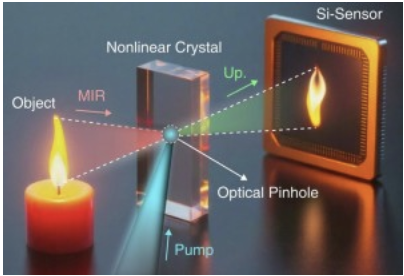
How the new high-tech pinhole camera works (illustration: Kun Huang, english.ecnu.edu.cn)
Special laser from East China Normal University “burns” a tiny hole in a crystal
Researchers at East China Normal University (https://english.ecnu.edu.cn/ ) led by Heping Zeng have developed a new lensless system that delivers clear images in the mid-infrared range. Even in low light conditions and over long distances, the system opens up new possibilities for improved night vision, industrial inspection and environmental monitoring.
Much greater depth of field
“Many useful signals lie in the mid-infrared range, such as heat and molecular fingerprints, but cameras that operate at these wavelengths are often noisy, expensive or require cooling. In addition, conventional lens-based designs have limited depth of field and require careful construction to minimise optical distortion. We have developed a highly sensitive, lensless approach that offers much greater depth of field and a much larger field of view than other systems,” said the project manager.
He and his team used a pulsed laser to create a tiny optical hole with a diameter of 0.2 millimetres in a non-linear crystal. It is not a physical hole, but only exists when the laser is in operation. Due to its special optical properties, the crystal converts the infrared image into visible light so that it can be recorded with a standard camera. In this way, the scientists have enabled clear images in the mid-infrared range at a distance of 11 to 35 centimetres.
Wide range of applications
‘This approach can improve night-time safety, industrial quality control and environmental monitoring. And it could make infrared imaging systems more affordable, portable and energy-efficient. It can even be used for wavelengths in the far infrared or terahertz range – areas where lenses are difficult to manufacture or perform poorly,’ adds team member Kun Huang. A pinhole camera consists of a closed box with a small hole in the front. Whatever is in front of this ‘optic’ is projected upside down on the back of the camera. If the back is made of frosted glass, the image can be seen.