
Axis Communications at EuroShop 2026
At EuroShop 2026 in Düsseldorf, Axis Communications will demonstrate how video security in the retail sector is increasingly evolving into a data-driven platform. Instead of traditional surveillance, the focus today is on the added value of metadata, analytics and IT integration. For Thorsten Grimm, Key Account Manager for End Customers DACH at Axis Communications, this shift in perspective is a key industry trend.
From security product to data source
A glance at the Axis stand makes it clear that the focus has shifted. Topics such as ‘Metadata from the Edge’, ‘Total Cost of Ownership’ and ‘Sustainability’ are given equal prominence alongside traditional security applications.
“Many people initially think: what does this have to do with security?” explains Grimm. “For us, metadata and analytics are now key building blocks. They provide the real added value of our cameras.”
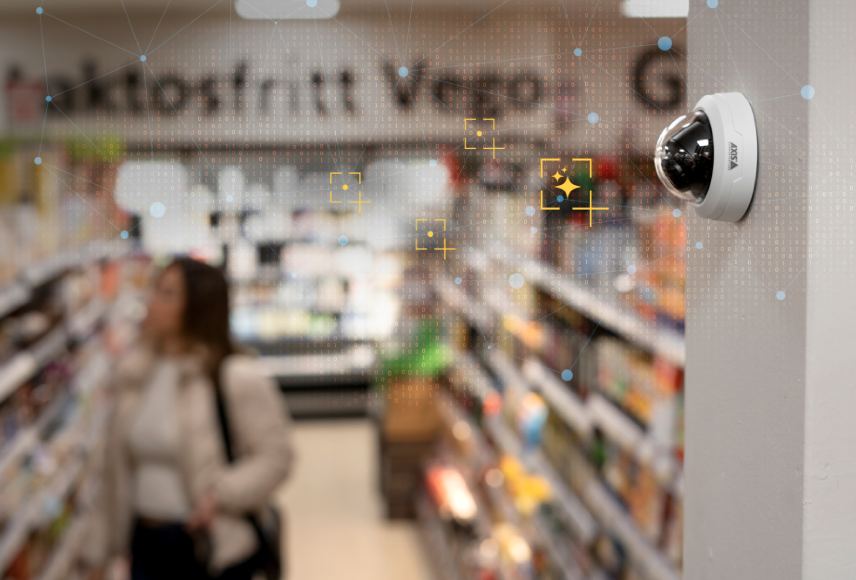
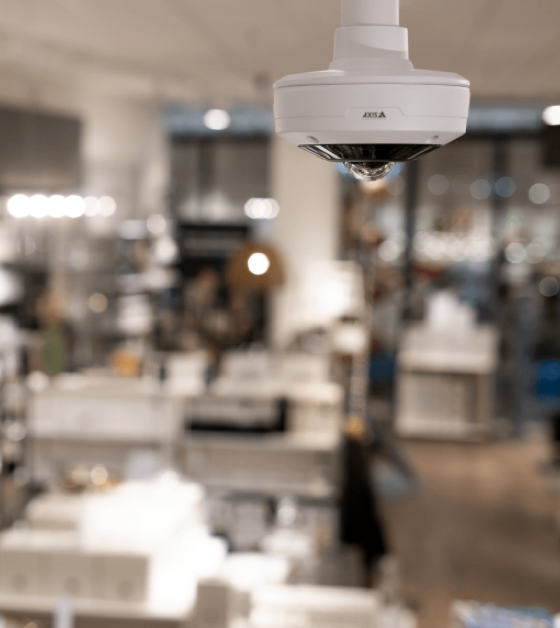
The foundation for this is the latest ARTPEC-9 chipset generation, which provides significantly more processing power directly on the device. This enables cameras to generate and select relevant data ‘at the edge’, which is then further processed by analytics or business intelligence systems.
Axis itself deliberately positions itself as a platform provider. “We don’t provide every analysis ourselves,” says Grimm. “Our task is to lay the foundations: image quality, metadata and a reliable hardware platform. Our partners build their applications on top of this.”
Partnerships as an integral part of the solution
This ecosystem-based approach is also evident at the trade fair. Hexagon, a provider of video management and analytics platforms, is presenting itself as a key partner. Together, the two companies are implementing major retail projects across Europe.
“Our product is always part of a solution,” emphasises Grimm. “Partnerships have always been a core element of our business model.”
For smaller and medium-sized retailers, however, Axis also offers more compact end-to-end solutions with its own video management software. These systems cover typical retail requirements without the complexity of large enterprise platforms.
IT departments determine the requirements
Another trend is emerging from discussions at the trade fair: the key contacts in the retail sector are changing. Whereas security departments used to take centre stage, today it is often the IT teams of retail companies.
“We are increasingly talking to the IT departments of major retailers,” reports Grimm. “They are no longer just asking about image quality, but about cybersecurity, lifecycle management and device administration.”
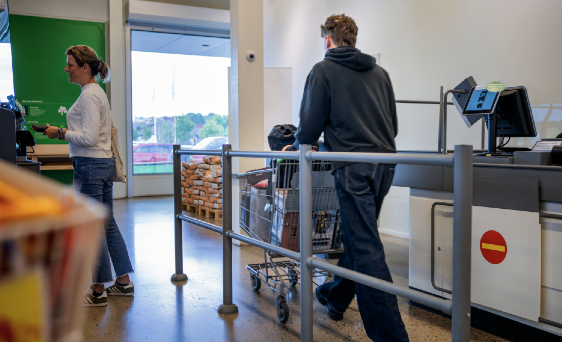
With large-scale rollouts involving thousands of cameras, the main focus is on issues such as firmware updates, network security and centralised management of device fleets. Cloud integration and modern video management systems are also gaining in importance.
AI in retail – between possibilities and limitations
Hardly a single stand at EuroShop can do without the buzzword “AI”. Axis is taking a deliberately nuanced stance here. Grimm warns against using artificial intelligence solely as a marketing pitch.
“Many manufacturers promise to automatically detect conspicuous behaviour by customers. Our clear answer is: no,” he says. “Technically, a lot would be possible, but legally and ethically, this is not permitted in Europe.”
European data protection legislation and the EU AI Act set clear limits. Applications such as facial recognition or the automatic tracking of individuals through the shop are practically impossible to implement in European retail.
“The technology is there,” explains Grimm. “But legally, we are not allowed to use it in many cases. That is why we must explain transparently what is actually possible.”
Process optimisation rather than pure surveillance
Despite these restrictions, video analytics remains an important component of modern retail strategies. Many retailers now use camera systems primarily for process optimisation.
“Pure video recording is almost a by-product,” says Grimm. “The real added value comes from analytics.”
Typical applications include:
- Analysis of customer flows
- Detection of counter-flow movements at entrances and exits
- Support for self-checkout processes
- Documentation of logistical processes
One example is the detection of so-called ‘push-outs’, when shopping trolleys are moved out of the shop via the wrong exit. In such cases, cameras can react automatically – for instance, via a strobe speaker that audibly alerts customers to use the correct exit.
Technology as support – not as a replacement for processes
A key issue remains the role of people in security processes. Security service providers often wish to replace staff with technology. Yet Grimm sees limits here too. “Technology can provide support, but it does not replace clear processes,” he emphasises.
One growing area, for example, is bodycams for security staff or shop assistants. These serve not only to document incidents but can also help de-escalate situations.
At the same time, the question repeatedly arises as to who takes action in an emergency – such as in the event of theft. After all, the use of technology alone does not solve all challenges in the retail sector.
Retail remains a key market
For Axis Communications, the retail sector remains a strategically important market – particularly in the DACH region. Despite high price sensitivity, major retail chains continue to invest in modern security and analytics infrastructure.
“Retail is one of our most important segments,” says Grimm. “Alongside critical infrastructure, cities and transport, retail is one of the key growth markets.”
EuroShop 2026 thus clearly demonstrates that video security in retail is evolving from traditional surveillance towards a data-driven platform that integrates security, operational processes and business intelligence. Axis is deliberately positioning itself as the technological foundation of a growing partner ecosystem – with cameras serving as intelligent sensors at the heart of the digital retail infrastructure. [DCM]