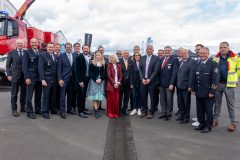
Home Secretary Roman Poseck, alongside Mayor Wingenfeld, German Red Cross President Donata Freifrau Schenck zu Schweinsberg and other representatives, touring the RETTmobil trade fair.
With more than 500 exhibitors from 27 countries and around 33,000 trade visitors, RETTmobil International in Fulda once again underlines its role as the world’s leading trade fair for rescue services and civil protection. From 6 to 8 May 2026, the event will bring together not only the industry but also, increasingly, the security policy debate on the future of hazard prevention, crisis management and civil resilience.
The opening address by Hesse’s Minister of the Interior, Roman Poseck, already made it clear how significantly the perception of civil protection in Germany has changed. Issues such as the impacts of climate change, hybrid threats, cyberattacks and the ‘turning point’ in security policy have long since shifted the focus away from traditional disaster management towards a more comprehensive resilience strategy.
Poseck described RETTmobil as a “catalyst for the future” and pointed out that modern hazard situations are now significantly more complex and dynamic than they were just a few years ago. Extreme weather conditions, forest fires, flooding and large-scale infrastructure failures in particular mean that federal states and local authorities must increasingly view their operational capability as a strategic security issue.
Hesse is massively expanding its civil protection capabilities
Against this backdrop, the Minister for the Interior highlighted Hesse’s investments in fire and civil protection. Since 2008, more than 100 million euros have been channelled into the state’s equipment programme. The number of state-owned vehicles has almost tripled, rising from under 300 to around 900.
Particular focus is being placed on 26 new disaster management logistics vehicles, which are equipped with modules for forest firefighting, flood response and evacuation scenarios. With an investment of around 21 million euros, Hesse is thus pursuing an approach that is becoming increasingly typical of modern civil protection concepts: modular, flexible and rapidly scalable operational architectures.
The forest fire modules in particular demonstrate just how much operational profiles are changing. Prolonged dry spells and climate-related vegetation fires make it clear that civil protection has long had to adapt to scenarios that were still considered exceptional just a few years ago.
Training becomes a strategic factor
Alongside technology, training is also taking centre stage. The Hessian State Fire Service School in Kassel is currently being expanded at a cost of around 81 million euros. Capacity is increasing from 240 to 390 places. This will create one of the most modern training centres in Germany.
At the same time, Hesse is investing around 21 million euros in the youth fire service training centre in Marburg-Cappel. The focus on recruiting young talent is by no means coincidental. Many fire services and aid organisations are increasingly struggling with staff shortages, whilst at the same time the demands on emergency personnel are growing – both technically and psychologically.
RETTmobil thus also highlights a fundamental shift in the self-image of civil protection: modern hazard management is no longer based solely on vehicles and equipment, but increasingly on qualifications, networking and interdisciplinary cooperation.
Digitalisation is transforming emergency services and incident command
The transformation is also evident in technological terms. Many exhibitors at RETTmobil 2026 will be presenting solutions relating to digital incident command, networked communication, drone deployment, AI-supported situational awareness and resilient communication systems.
The convergence of physical hazard response and digital infrastructure in particular is increasingly becoming a key issue. This is because cyberattacks on critical infrastructure, communication networks or control centres are now regarded as real threat scenarios for emergency services.
This is also shifting the role of civil protection: rather than acting exclusively reactively, the focus is increasingly on prevention, situational awareness and resilient system architectures.
Violence against emergency services remains a key challenge
In addition to technology and modernisation, Roman Poseck also addressed an issue that has preoccupied the sector for years: the increasing violence against emergency services personnel.
According to the Hessian Ministry of the Interior, 5,507 police officers, firefighters and paramedics were victims of violence last year – a new record high. Poseck therefore welcomed the German government’s plans to tighten the penalties for attacks on emergency services personnel.
The discussion shows that civil protection is no longer merely a question of technical capability. Social resilience is becoming just as crucial – that is, the question of how much respect, trust and support emergency services actually receive in their day-to-day work.
RETTmobil as a strategic platform
RETTmobil International is thus increasingly evolving beyond a traditional trade fair. It is increasingly becoming a strategic platform for discussion on resilience, crisis preparedness and national security architectures.
Civil protection is taking on new significance in security policy, particularly in the context of climate change, geopolitical tensions, hybrid threats and growing dependence on critical infrastructure. The trade fair in Fulda highlights that Germany – albeit belatedly – is increasingly adapting to this reality.