Optimism in the shipbuilding industry
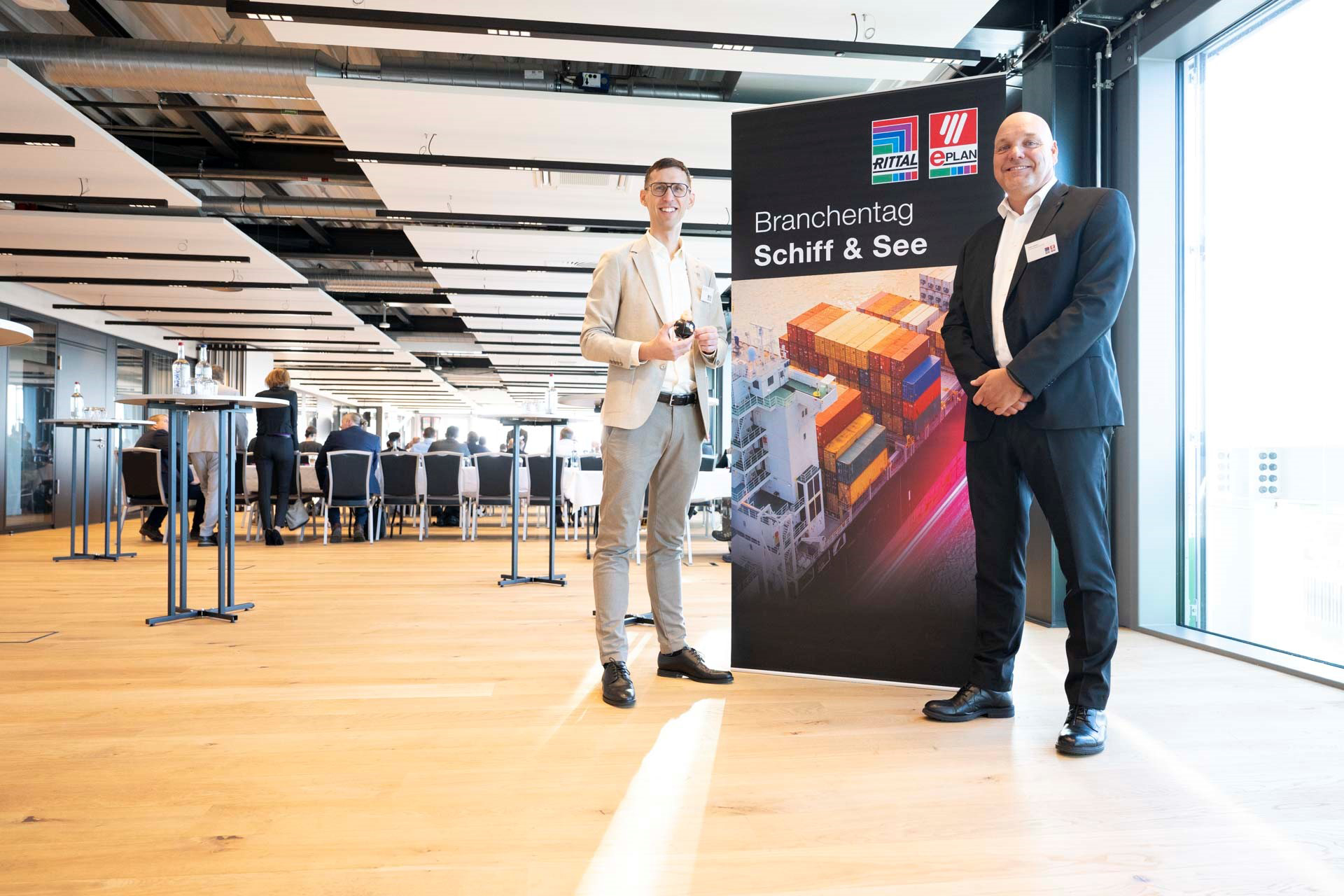
The outlook for German shipyards and suppliers is currently good. Order books are filling up along the entire value chain – a great opportunity for the German shipbuilding industry. Experts from associations and companies discussed how digital platforms and efficient technologies can be used to maintain a leading position at the 15th Ship & Sea Industry Day organised by Eplan and Rittal. Around 70 representatives from planning offices, component manufacturers, system providers and integrators, and shipyards attended the event.
The 15th Ship & Sea Industry Day, which took place on 6 November 2025 at the Hammerbrooklyn Factory in Hamburg, showed the significant influence that the current geopolitical situation is having on market developments. Representatives from the two industry associations VDMA Marine Equipment & Systems and the Association for Shipbuilding and Marine Technology (VSM) presented the latest figures. Flensburg University of Applied Sciences and companies such as Phoenix Testlab, CIMPA PLM, Rittal and Eplan discussed how players in the industry can make the most of market developments.
Economically, the industry is doing well this year. Hauke Schlegel, Managing Director of VDMA Marine Equipment & Systems, and Jon Steinlein, VSM, reported to the 70 participants that the maritime supply industry had seen a five per cent increase in turnover in 2024, with similar prospects for 2025. The order backlog in shipbuilding is at its highest level in ten years. Steinlein and Schlegel provided insights into an industry that, by global standards, is well positioned to participate in the rapidly growing global demand for ships. Both explained that German shipyards and suppliers have a good chance of benefiting from this growth.
Those who shy away from risk miss out on opportunities
According to the two association representatives, there are three main developments driving this dynamic growth: the global shipbuilding industry’s transition to alternative propulsion systems and fuels, increased energy efficiency to reduce emissions – combined with extensive fleet renewals – and geopolitical tensions leading to significant investment in naval projects around the globe. This was also confirmed by Andreas Kirchhofer, CIMPA PLM Services, in his presentation on the use of system life cycle management solutions. However, the risks have also increased: threats on the seas, the crisis at the WTO (World Trade Organisation), protectionism and regulations can quickly lead to a change of course. This makes it all the more important to position oneself well and network strategically. Prof. Michael Thiemke from Flensburg University of Applied Sciences reinforced this message to participants in his keynote speech ‘Maritime digitalisation: Are we on course?’. His advice: ‘Those who shy away from every risk and avoid every mistake will also miss every opportunity.’ Thiemke chose an interactive format to reflect the participants’ self-assessment in relation to digitalisation and cyber security. His conclusion: ‘Business as usual is no longer enough!’
Engineering platform simplifies acceptance processes
Software experts Malte Schulz and Marc-Michael Reeh from Eplan demonstrated how shipping companies can optimise and accelerate complex acceptance processes in design with the help of digital, integrated software solutions. The Eplan platform enables the acceptance process between suppliers, shipyards and shipping companies to be carried out digitally and automatically – not only for control and switchgear systems, but across various ship systems, from ship operation and process engineering to air conditioning and ventilation technology to electrical engineering. With engineering software from Eplan, it is possible to map the complete functional digital twin – from individual components and systems to the entire ship.
Interactivity was the order of the day in the breakout sessions after the lunch break. Divided into several groups, all participants went through four stations designed by Inspired Consulting, Bechtle PLM, Phoenix Testlab and Rittal. The focus was on practical issues. For example, participants were able to learn about the possibilities offered by Rittal’s new RiLineX power distribution platform.
Staying at the forefront of technology
Increasing electrification and digitalisation also require new cooling concepts. Ralf Schneider from Rittal explained how larger heat loads from the engine room or on-board IT can be efficiently dissipated. The manufacturer offers solutions that can utilise existing cooling water circulation systems. For infrastructure-independent cooling, the air conditioning expert presented the energy-efficient and DNV-certified cooling units from the ‘Blue e+ Dynamic’ series. Thanks to their stable mechanical construction, the cooling units are particularly suitable for use in dynamic applications on ships. Norman Klatt from Phoenix Testlab dispelled any fears about maritime specifications by guiding participants step by step through the ‘jungle’ of standards and classifications in the shipping industry.
The Ship & Sea Industry Day was held for the 15th time. With unbroken popularity and a wide range of participants, from suppliers and switch cabinet manufacturers to shipbuilders at the shipyard, it was once again clear that the Industry Day struck exactly the right chord with the industry.