
Since becoming independent in 2019, i-PRO has gradually reshaped its manufacturing, sales organisation and technology strategy. Edge-based video analytics, interoperability and cybersecurity now define much of its profile. Seven years on, the anniversary offers an opportunity not only to review that transformation, but also to assess how the company is positioning itself in an increasingly competitive international security market.
Seven years is not normally a major corporate anniversary. In i-PRO’s case, however, it provides a useful point at which to take stock.
Since becoming independent in 2019, the company that emerged from Panasonic’s former organisation for professional security and imaging technologies has developed its own corporate structures, decision-making processes and technology priorities.
Today, i-PRO presents a more clearly defined profile built around professional video surveillance, intelligent analytics, interoperability and cybersecurity. The significance of the anniversary therefore lies less in corporate history than in the question of what has actually been built during those seven years – and how sustainable that position may prove in the global market.
Organisational independence is largely complete
An important step came in spring 2026. At the end of March, i-PRO assumed direct responsibility in Japan for the wholesale and marketing functions for its products that had previously been handled by Panasonic Connect.
From April, around 500 dealers that had previously sourced i-PRO products through Panasonic Connect began conducting business directly with i-PRO. The company also expanded its sales presence in Japan with offices in Osaka and Nagoya.
This brought further elements of development, manufacturing, marketing and sales directly under the i-PRO organisation.
The company expects the closer structure to shorten internal communication routes, enable customer and market requirements to reach product development more quickly and strengthen after-sales support. For the anniversary, this is an important milestone.
Corporate independence began in 2019, but parts of the operational transition continued for several years. By 2026, much of that process has been completed.
The relevant question is therefore changing. It is no longer primarily how i-PRO separates itself organisationally from its origins, but what commercial and technological advantages its independence can now create.
Saga becomes a core manufacturing base
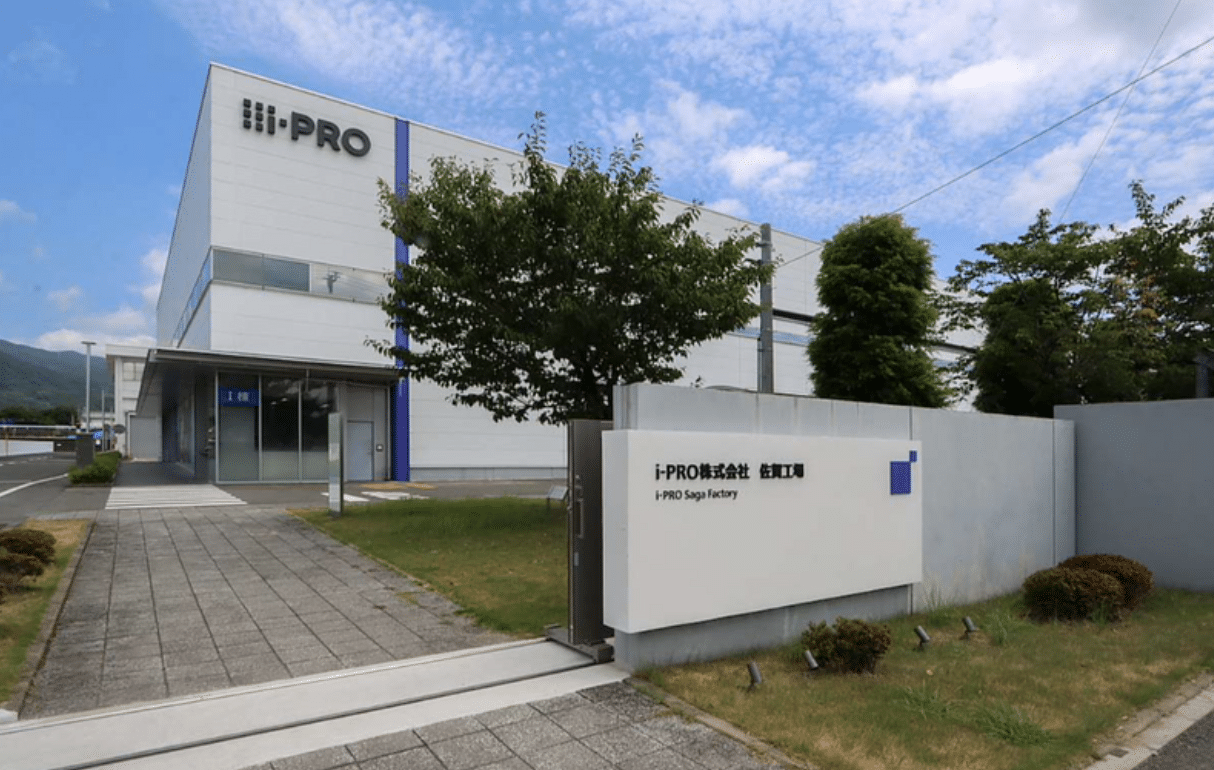
Manufacturing has also become a more visible part of the company’s strategy. Since October 2025, i-PRO has operated its Saga Factory in Japan as a core production facility for professional security cameras.
According to the company, production began at approximately 14,000 units per month, with capacity planned to rise to around 40,000 units per month by fiscal 2028.
A more integrated manufacturing process is also being introduced, extending from component mounting through assembly to final inspection. Digitalisation and automation form part of the development programme.
The Saga facility complements i-PRO’s existing manufacturing capacity in Suzhou and increases the proportion of products produced in Japan.
The relevance of this goes beyond the “Made in Japan” label. Professional network cameras are no longer defined only by optics, image sensors and mechanical engineering. Processor platforms, firmware, analytical capabilities, cryptographic functions and long-term software maintenance increasingly determine the value of a device throughout its operational life.
Closer links between development and production can therefore become important when hardware, firmware and analytical functions need to evolve in shorter cycles. For international customers, manufacturing capability is also closely connected with product continuity, supply reliability and lifecycle support.
Intelligence moves further into the camera
Technologically, i-PRO places particular emphasis on processing video data directly at the edge. In March 2026, the company introduced new X-Series fisheye cameras capable of running generative AI directly on the device. Natural-language search and detection criteria can therefore be processed within the camera without necessarily relying on an external analytics server or cloud service.
The development reflects a broader change in professional video surveillance. The network camera is increasingly moving beyond its traditional role as an image-capture device. It can classify events, interpret information and prepare data before it reaches a central system. For operators, this can reduce bandwidth requirements, shorten response paths and support larger installations without shifting every analytical task to central infrastructure.
i-PRO is also developing AI On-Site Learning, designed to adapt analytics more closely to the conditions of an individual location.
In its anniversary statement, the company identifies both generative AI and locally adaptable analytics as important elements of its technology development since becoming independent.
Interoperability becomes a system issue
The second major technology theme is integration. i-PRO has positioned its cameras and analytical functions for use with different video management systems, cloud platforms and third-party applications. For Genetec Security Center and Milestone XProtect, for example, the company provides configuration plug-ins that allow camera functions and AI applications to be managed within the respective environments. This matters because professional video systems are rarely built in a single step. Large installations in industry, transport, public infrastructure, retail and critical facilities frequently evolve over many years. Cameras, video management software, analytics and other security components may come from different suppliers. Replacing an entire architecture every time one part reaches the end of its lifecycle is rarely practical. Interoperability, documented interfaces and integration tools therefore influence not only technical flexibility but also the economic life of an installation.
For manufacturers, this means that product performance can no longer be assessed in isolation. The ability to operate reliably within wider security environments increasingly becomes part of the product proposition itself.
Regional organisation gains importance
i-PRO has also continued to develop its international organisation. In July 2026, Steve Riley was appointed President EMEA, with responsibility for regional strategy, organisational development and governance. Jose Riolobos continues as Vice President of Sales EMEA, focusing on customers, partners and commercial development. The company describes the structure as a response to growth and increasing organisational complexity within the region. The broader point applies internationally. Professional security technology is often specified, integrated and maintained through distributors, system integrators, consultants and specialist installers. Local market presence therefore matters alongside global product development. Technical capability alone is rarely enough to secure long-term market relevance. Manufacturers must also provide training, pre-sales support, project assistance and reliable technical service across different regions.
Cybersecurity becomes a lifecycle responsibility
Cybersecurity represents another major shift. Professional IP cameras are now complex network devices. They contain processors, firmware, communication protocols, user management, cryptographic functions and, increasingly, their own analytical software.
Their security therefore cannot be treated as a one-time product characteristic. In July 2026, i-PRO announced its Security Update Initiative. Around 200 existing camera models are intended to move progressively towards an enhanced security architecture in future product versions. The company has cited stronger cryptographic protection, expanded secure-boot functions, additional physical protection and secure-by-default communications among the measures involved. The new versions are planned for introduction during 2026 and 2027, while installed products will, according to i-PRO, continue to receive support.
The company explicitly links the initiative to changing security requirements in major international markets, including the EU Cyber Resilience Act, FIPS 140-3 in the United States and Japan’s JC-STAR framework. This illustrates how the competitive landscape for professional video is changing. The relevant question is no longer simply how secure a camera is when it enters the market.
Customers increasingly need to know how vulnerabilities will be handled, how long security updates will remain available and how the manufacturer intends to maintain the product throughout its expected operational life. Cybersecurity is therefore moving from an additional technical feature towards a long-term manufacturer responsibility.
Knowledge becomes part of the product
Increasing technological complexity also changes the demands placed on integrators and users. Through i-PRO University, the company offers technical and commercial training in areas including edge-based AI, cybersecurity, network configuration and consultative sales. The emphasis on education is notable because professional video technology has become increasingly dependent on software and networks. Correct configuration, cybersecurity, analytics and network architecture now matter as much as traditional questions of camera placement, optics or image quality. Manufacturers are therefore increasingly expected not only to provide hardware and software, but also to help their partner networks understand how those technologies should be deployed.
Sustainability moves into corporate governance
Sustainability has also become more formally embedded within the organisation. Shohei Ozaki serves as Representative Director and Chief Sustainability Officer, bringing sustainability responsibilities directly into senior management. i-PRO is also a member of the United Nations Global Compact and has increasingly incorporated environmental, social and governance considerations into its corporate strategy. As the company expands its own manufacturing capabilities, these issues become more directly relevant to operations. Production, supply chains, energy use and product lifecycles increasingly sit within areas over which the company has greater direct control – and greater responsibility.
Editorial assessment: Where i-PRO still has to prove itself
The following section is an editorial assessment and does not represent statements made by i-PRO in its anniversary release.
Seven years after independence, i-PRO has a more clearly defined corporate and technology profile than it did during the early transition period. The integration of key business functions, the expansion of its manufacturing base and the focus on edge analytics, interoperability and cybersecurity form a coherent strategic direction. That does not, however, establish a particular market position or prove market leadership. The areas in which i-PRO is investing are also areas of intense international competition. Edge-based analytics, interoperable system architectures and lifecycle cybersecurity are major priorities for several established manufacturers across the professional video market. The key test will therefore not be whether i-PRO can announce individual technologies, but whether those technologies translate into measurable advantages in real projects. For consultants, integrators and end users, that includes consistent product support, broad interoperability, dependable cybersecurity maintenance and a partner structure capable of supporting projects throughout their lifecycle. The anniversary can therefore support a positive assessment of i-PRO’s organisational development. It should not yet be read as evidence that the company has already secured the international market position to which it aspires.
From transformation to performance
President and CEO Masato Nakao describes the seventh anniversary as the beginning of the company’s next phase of growth.
The description fits the current stage of development. Independence in 2019 was the starting point. Since then, key organisational functions have progressively been brought under i-PRO’s own control. The Saga Factory has strengthened the company’s manufacturing base in Japan. Domestic wholesale and marketing functions are now integrated directly into the organisation. Regional management in EMEA has been expanded. At the same time, i-PRO has sharpened its focus on intelligent video analytics, interoperability and cybersecurity. In important respects, the build-up phase is now complete. The next stage is more demanding.
i-PRO must demonstrate that organisational independence, technological focus and regional market structures can together create a durable international position. Seven years after becoming independent, the company no longer needs to define itself primarily by where it came from. Its future position in the global security market will depend on what it can deliver under its own name.

