
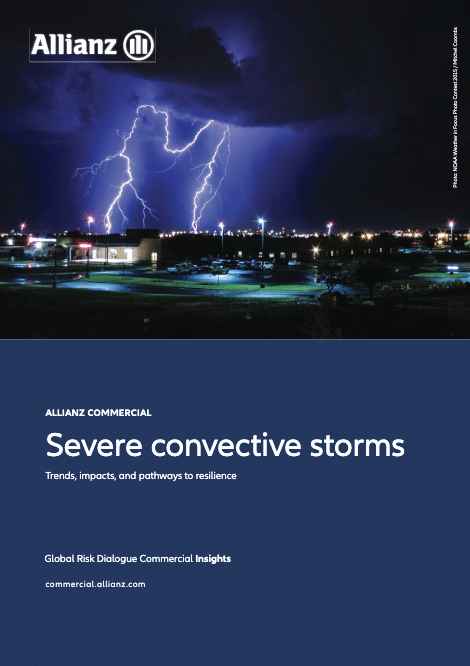
Why severe thunderstorms are moving from a marginal issue to a management priority
Extreme weather events are increasingly becoming a strategic risk for businesses. In particular, so-called Severe Convective Storms – or SCS for short – are coming under the spotlight of insurers, risk managers and operators of critical infrastructure. These refer to locally confined but highly intense weather events such as severe thunderstorms, hail, tornadoes, heavy rain, downbursts or large-scale storm fronts.
They often develop at short notice, strike locations with little warning and can cause significant property damage, business interruptions and supply chain disruptions.
In a recent report, Allianz Commercial describes SCS as a growing driver of claims for the insurance industry and the real economy.
According to the report, globally insured losses from SCS totalled US$208 billion in 2023, 2024 and 2025; in 2025, these events accounted for around US$60 billion. This means that a hazard long classified as a ‘secondary peril’ is no longer a minor issue in the claims reality of many companies.
From “secondary peril” to core operational risk
The traditional classification of severe convective storms as a secondary natural hazard is increasingly looking outdated.
Whilst hurricanes, earthquakes or floods are traditionally regarded as major primary risks, the cumulative losses from SCS reveal a different trend: many individual events together generate a high annual loss burden. This logic is particularly challenging for companies because they must be prepared not only for rare extreme events, but also for more frequent, locally intense loss events with a high probability of recurrence.
According to Allianz Commercial, SCS can be associated with wind speeds exceeding 100 km/h, hailstones measuring 2.5 centimetres in diameter or more, or tornadoes.
Added to this are secondary effects such as lightning strikes, heavy rain, flash floods, power cuts and damage to building envelopes. It is precisely this combination that makes the risk so difficult to manage: a single hailstorm can damage roofs, allow water to penetrate production areas, contaminate stock, disrupt cold chains and simultaneously affect IT or power supply systems.
Hail as a key driver of damage
Hail plays a significant role within SCS claims. According to Allianz Commercial, estimates suggest that 50 to 80 per cent of SCS losses are attributable to hail events. The damage affects not only vehicles or glass surfaces, but increasingly also industrial roof surfaces, photovoltaic systems, HVAC systems, skylights, data centres, warehouses and production sites.
Hail is therefore particularly critical for businesses because the damage is often not immediately fully visible. Micro-cracks in roofing membranes, damaged waterproofing or deformed drainage systems may initially go unnoticed. It is only during the next heavy rainfall that isolated roof damage turns into widespread water damage. In modern industrial and commercial buildings, this can quickly lead to consequential damage to machinery, electronics, sensor systems, security technology and stock.
Sectors with large outdoor areas or sensitive equipment are particularly at risk. These include car manufacturers and dealers with vehicle storage areas, airports and maintenance facilities, logistics centres with large-scale roof structures, food and pharmaceutical companies with high hygiene standards, data centres with sensitive cooling and power supply systems, and operators of solar parks and photovoltaic roofs.
Why damage is on the rise
The increasing damage caused by SCS cannot be explained by weather changes alone. The Allianz report highlights several factors which, taken together, create a significantly greater risk environment: urbanisation, economic development in vulnerable regions, ageing infrastructure, building regulations that do not always align with today’s risk profiles, inflation, supply chain issues, and a shortage of skilled labour for repair and reconstruction.
Particularly relevant is the increasing concentration of value at individual locations.
Logistics centres are growing larger, production facilities are becoming more automated, buildings are becoming more technical, and roof areas are increasingly occupied by equipment. What used to be building damage quickly becomes system damage today: if a roof is damaged, it is not only the building structure and the interior that are affected, but also technical systems, energy supply, data infrastructure, goods flows and customer obligations.
Added to this is cost inflation in the construction and renovation sector. The Allianz report cites roof renovations as an example: since 2000, the cost of replacing asphalt roofs has risen by around 250 per cent, and by about 45 per cent in the past five years alone.
Such developments not only increase the immediate repair costs but also prolong the economic recovery phase following a loss event.
Business interruption as the actual loss dynamic
For companies, the greatest loss often lies not in the destroyed component but in the interruption of value creation.
Business interruption is also listed among the most significant global business risks in the Allianz Risk Barometer 2026, ranking third. Allianz Commercial also points out that supply chain disruptions continue to pose a significant risk and that only a very small proportion of respondents consider their own supply chains to be highly resilient.
SCS acts as a multiplier in this context. A damaged roof can halt production lines.
A power cut can affect data centres, cold stores or automated warehouses. Water ingress can destroy stock or trigger regulatory issues. Delayed repairs can jeopardise delivery dates and result in contractual penalties. Particularly in just-in-time supply chains, locally limited weather events can have a nationwide impact.
For security officers and facility managers, this means that SCS risk management must not be viewed solely as building protection. It must be regarded as part of operational continuity planning, site strategy and supply chain resilience.
New areas of risk: data centres, solar parks and logistics
The digitalisation of the economy is increasing exposure. Data centres are springing up rapidly in many locations. They require a reliable power supply, cooling, fire protection, access control, physical security and robust building envelopes. Hail or storm damage to the roof can not only allow water to enter the building, but also lead to IT disruptions, data loss or reputational damage via cooling and power failures.
Solar parks and photovoltaic systems also increase vulnerability. The Allianz report cites a hailstorm in Texas in March 2024, in which thousands of solar panels at a 350-MW plant were damaged. Such events demonstrate that the energy transition also brings with it new physical protection requirements.
The same applies to warehouses and logistics centres. Large roofs, lightweight structures, high-value goods and time-critical delivery processes lead to an increased potential for damage. If the roof cladding, skylights or technical roof structures are damaged, water ingress, power cuts and operational downtime can occur simultaneously.
Focus on Europe: Hail risks are growing in significance
Although the US is particularly hard hit in regions such as Tornado Alley and Hail Alley, SCS is not exclusively an American risk. The Allianz report points out that in Europe, a significant proportion of the rise in weather-related insured losses is attributable to SCS.
Hail events in northern Italy, south-western France, north-eastern Spain and other regions near mountain ranges are described as particularly relevant hotspots.
This is significant for the European business context because many industrial, logistics and infrastructure facilities were not historically designed to withstand today’s hail and strong wind profiles.
Added to this are older building stocks, varying building regulations and a growing number of rooftop installations. The result is a risk profile that is changing faster than many maintenance and investment cycles.
Seven steps towards greater SCS resilience
The Allianz report sets out seven fundamental steps to strengthen resilience.
The first step is the systematic analysis of vulnerabilities. Companies should assess which sites, buildings, facilities, outdoor areas, supply chains and processes are particularly exposed. For an automotive site, this might mean protecting vehicle storage areas with hail nets or canopies. For a data centre, on the other hand, the focus is on roof integrity, power supply, cooling and water protection.
Secondly, a written contingency plan for severe weather events is required. Responsibilities, communication channels and escalation procedures must be clearly defined. This also includes appointing a person or role to monitor reliable weather information and inform relevant decision-makers at an early stage.
Thirdly, emergency equipment, damage mitigation materials and contacts for service providers, construction firms, waste disposal companies, cleaning firms, security providers and authorities should be prepared in advance. Following a regional storm event, many companies compete simultaneously for the same resources. Those who only then begin to look for service providers lose valuable time.
Fourthly, a regularly reviewed business continuity plan is required. This should not only take into account IT failures or cyberattacks, but also physical weather events, restricted site access, damaged goods, staff availability and alternative supply routes.
Fifthly, the building envelope must be protected. Roofs, windows, doors, façades, skylights and technical roof installations form the first line of defence against hail, wind and water. Impact-resistant materials, additional fixings, protective grilles for HVAC systems and robust sealing systems can significantly reduce damage.
Sixthly, companies should review their energy supply and critical utilities. Emergency power systems, alternative energy sources, redundant cooling or robust communication channels can be crucial if storm events lead to power cuts.
Seventhly, the building’s surroundings must be considered. Trees, branches or loose objects can become additional hazards during storms, damaging buildings, blocking access routes or striking power lines.
Roof hardening as an effective measure
A particular focus is on so-called roof hardening. Roofs are often the most vulnerable components during severe convective storms. Allianz Commercial points out that reinforced roofing materials, improved fastening systems and additional protective measures can significantly reduce vulnerability to hail, wind and water ingress.
These include, among other things, reinforced roof edges, more durable roofing membranes, more robust roof drainage, impact-resistant underlays, protective devices for HVAC systems, and secure fixings for roof structures. Corners and edge areas are particularly important because high suction forces can occur there in strong winds.
Another key point is the sealing of the roof deck. The Insurance Institute for Business & Home Safety has demonstrated in studies that sealed roof deck systems can significantly reduce water ingress when the roof membrane is damaged. IBHS points out that a sealed roof deck can reduce water ingress by up to 95 per cent compared to unprotected structures.
For businesses, this is a crucial finding: even if the outer roof membrane is damaged, a second layer of protection can prevent damage to a building from leading to disruption of production, storage or IT systems. Roof hardening is therefore not merely a structural measure, but a tool for limiting business interruptions.
AI is reshaping the risk landscape
Alongside structural measures, data-driven risk management is gaining in importance. Allianz Commercial has launched Climate Adaptation and Resilience Services (CAReS), a platform enabling companies to assess physical climate risks at their sites.
The platform models risks across various time horizons and climate scenarios and is based on scenarios from the Intergovernmental Panel on Climate Change (IPCC).
For companies, this can bring a new level of quality to site assessment. Instead of extrapolating historical averages, future exposures can be analysed on a site-by-site basis. This is particularly important because risk zones can change.
A site that has experienced little hail damage in the past may be more exposed in future if atmospheric conditions and regional weather patterns shift.
AI-powered models can combine satellite data, radar information, damage histories, building data, roof geometries, material ageing, vegetation and local climate data. This results in more granular assessments of physical vulnerability. The benefits lie not only in insurance pricing, but above all in prevention: vulnerabilities in roofs, facades, power supplies or critical outdoor installations can be identified before damage occurs.
HAR-CC: Better understanding European hail risks
The Allianz report also refers to the HAR-CC project – Managing European Hail Risk under Climate Change. This is a joint project between the Karlsruhe Institute of Technology and Allianz Re. The aim is to gain a better understanding of hail formation, hail intensity and regional variability in Europe.
The project combines, among other things, radar data on hail tracks, satellite detections, high-resolution weather analyses and claims data from Allianz’s portfolios.
Such approaches are relevant to safety and risk management practice because they bridge the gap between climate science and operational risk modelling. For insurers, this means more precise models for underwriting, pricing and reinsurance.
For businesses, it means a more robust basis for investments in structural protective measures, site selection and business continuity plans.
Implications for security management and operators of critical infrastructure
For the security industry, SCS resilience is more than just a building management issue.
It affects access control, video surveillance, control centre operations, perimeter protection, emergency communications, energy supply and the physical availability of critical systems. If a site is damaged by a storm or hail, security processes must continue to function: doors must remain under control, alarms processed, evacuations coordinated and sensitive areas protected.
KRITIS operators are under particular pressure in this regard. Energy supply, water management, transport, healthcare, IT services and food supply rely on stable infrastructure. SCS incidents can strike precisely those interfaces that are crucial for operational continuity: power, cooling, communications, access, building envelope and staff availability.
Resilience therefore means integrating physical security and operational continuity more closely.
Contingency plans should not only define how a site is evacuated, but also how security functions are maintained in the event of a power cut, water ingress or restricted building access. Redundant systems, protected control centres, mobile security processes and clear escalation procedures thus become part of a weather-resilient security architecture.
From damage response to a culture of prevention
The key shift in perspective lies in treating severe weather not as an unavoidable natural event, but as a manageable risk area. Companies cannot prevent severe storms, but they can reduce their vulnerability. This includes robust building envelopes, resilient roofs, protected roof systems, redundant power supplies, prepared service provider chains, resilient emergency plans and data-driven site analyses.
The key lies in the integration of technology, organisation and management. A reinforced roof structure is of little use if damage is not inspected. An emergency plan remains ineffective if roles are not practised. A climate risk analysis yields no benefit if it does not lead to investment decisions.
SCS resilience should therefore be integrated into existing risk management systems: into Enterprise Risk Management, Facility Management, Business Continuity Management, insurance strategy, ESG reporting and site planning. This is becoming a competitive factor, particularly in the context of growing regulatory requirements for resilience and risk transparency.
Conclusion: SCS is becoming a management discipline
Severe Convective Storms mark a shift in corporate risk understanding. It is not only large-scale catastrophic events that threaten business continuity, but also locally confined, more frequent and highly intense weather events. Hail, strong winds, tornadoes and water ingress can cause damage within a short time that extends far beyond the building envelope.
The Allianz report makes it clear: the boundaries between primary and secondary natural hazards are blurring. For businesses, the operational impact matters more than the underwriting category. If a hailstorm disrupts production, logistics, IT or the energy supply, it is not a side issue but a strategic business risk.
The answer lies in a new approach to resilience. Companies must identify their vulnerabilities, update their emergency and business continuity plans, reinforce roofs and building envelopes, secure critical supply systems and utilise AI-supported risk analyses. Those who do this at an early stage not only reduce potential damage but also strengthen the long-term stability of their business model.
In an environment of volatile weather conditions, resilience thus becomes a management priority. Severe convective storms exemplify how physical safety, climate adaptation and business continuity will be more closely intertwined in future than ever before.
Download in English: https://commercial.allianz.com/content/dam/onemarketing/commercial/commercial/grd/commercial-severe-convective-storms.pdf?bid=-1586160092
[1]: https://commercial.allianz.com/news-and-insights/commercial-insights/severe-convective-storms.html? utm_source=chatgpt.com ‘Severe convective storms’
[2]: https://commercial.allianz.com/content/dam/onemarketing/commercial/commercial/grd/commercial-severe-convective-storms.pdf?utm_source=chatgpt.com ‘Severe convective storms’
[3]: https://commercial.allianz.com/news-and-insights/expert-risk-articles/allianz-risk-barometer-2026-business-interruption.html?utm_source=chatgpt.com ‘Allianz Risk Barometer 2026 – Business interruption’
[4]: https://ibhs.org/10-year-anniversary/a-brief-history-of-ibhs-sealed-roof-deck-research/?utm_source=chatgpt.com ‘A Brief History of IBHS Sealed Roof Deck Research’
[5]: https://commercial.allianz.com/news-and-insights/news/cares.html?utm_source=chatgpt.com ‘Climate Adaptation & Resilience Services (CAReS)’

