
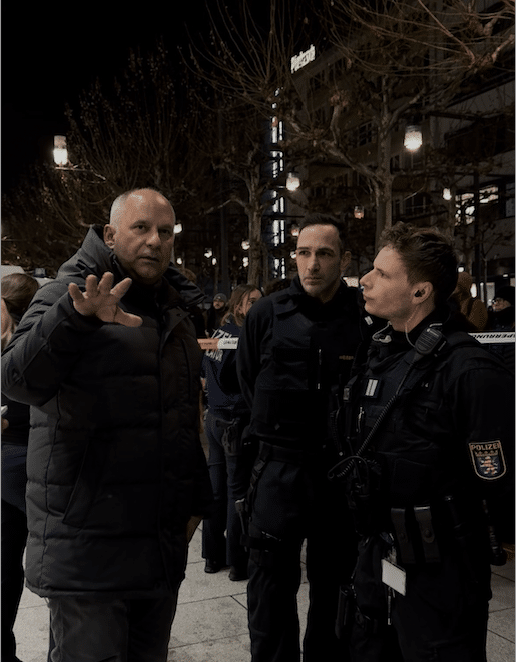
Frankfurt’s Zeil in focus: Police enforce zero tolerance in the city centre – but behind the operations lies a warning sign of years of political failure. Shoplifting, violence and drug-related incidents have turned the popular shopping street into a hotspot. With the newly founded BAO Zeil, the police want to restore order and security – visibly, consistently and with the use of massive resources.
Presence: The police response to escalating inner city problems
Frankfurt’s Zeil, one of Germany’s most iconic shopping streets, is both the economic heart of the city centre and a social hub for residents and visitors. Yet in recent years, it has also become a symbol of a wider urban challenge: rising crime, loss of public control, and a growing sense of insecurity among the population. In response, the state of Hesse has introduced the Special Organisational Structure Zeil (BAO Zeil), a highly visible policing initiative aimed at restoring order.
On Saturday evening, Interior Minister Roman Poseck and Frankfurt Chief of Police Stefan Müller accompanied a deployment of approximately 120 officers as part of a large-scale operation. The initiative, a collaboration between the Frankfurt Police Headquarters and the Hessian Police Headquarters, is designed to ensure presence, enforce law, and prevent escalation, particularly during high-traffic weekend evenings.
Zeil as a Criminal Hotspot
Statistics paint a stark picture. In 2024, over 5,000 crimes were recorded in the Zeil and surrounding streets. Shoplifting was the most common offense, followed by bodily harm and narcotics violations. The temporal concentration is notable: more than half of these incidents occurred between Thursday and Saturday, predominantly in the evenings and at night.
The demographic and social patterns are equally striking. Around 80 percent of suspects are male, mainly aged 21 to 29. A significant share is not registered in Frankfurt, and approximately 70 percent do not hold German citizenship. Many incidents are associated with alcohol and drug use, often accompanied by aggressive behaviour toward passers-by and emergency personnel. The cumulative effect is a perceptible climate of insecurity among the public.
Zero-Tolerance Policing
BAO Zeil follows an explicit zero-tolerance approach. Minor infractions are treated as potential precursors to more serious crimes. Enforcement is comprehensive, covering public urination, traffic violations in pedestrian zones, weapons and drug offenses, and breaches of youth protection regulations.
The latest large-scale inspection demonstrates this approach in practice. Officers checked around 280 individuals and multiple vehicles, issued expulsion orders, and initiated criminal and administrative proceedings. Among the findings were drug and weapons violations and a five-figure sum of cash seized from a gaming arcade on suspicion of money laundering. According to officials, police acted visibly, professionally, and with measured communication, helping maintain a largely positive public perception of the operation.
Police Achievements Highlight a Political Alarm
While the establishment of BAO Zeil is both necessary and effective, it also exposes a deeper problem. That one of Germany’s central shopping streets requires a permanent, highly resourced police presence to remain safe is not a sign of law enforcement strength—it is a sign of long-standing political shortcomings.
Police forces can stabilize areas, respond to incidents, and manage risk, but they cannot address structural causes: shortcomings in integration policy, inconsistent law enforcement, overstretched municipal oversight, and political tendencies to downplay or avoid contentious issues. When city centres must be “recaptured” through zero-tolerance operations, the systemic failure becomes evident.
Beyond Operations: The Need for Political Action
The BAO Zeil demonstrates the capability and professionalism of modern policing. It also underscores that true urban security requires more than tactical interventions. Lasting safety depends on coordinated policy measures that integrate prevention, social integration, urban planning, and consistent enforcement of the law. Without this political backbone, police remain in a constant firefighting mode.
Backing by the Home Secretary and police leadership is correct and necessary. Yet an honest public debate is equally essential: why did conditions deteriorate to the point that such measures became unavoidable? The Zeil should not be a legal vacuum; the troubling reality is that this must even be articulated today.
In conclusion, BAO Zeil serves a dual role: as a vital tool for restoring security and as a stark reminder that state authority cannot wait until law and order visibly falter. It is a success for policing—but an indictment of political inaction.

