
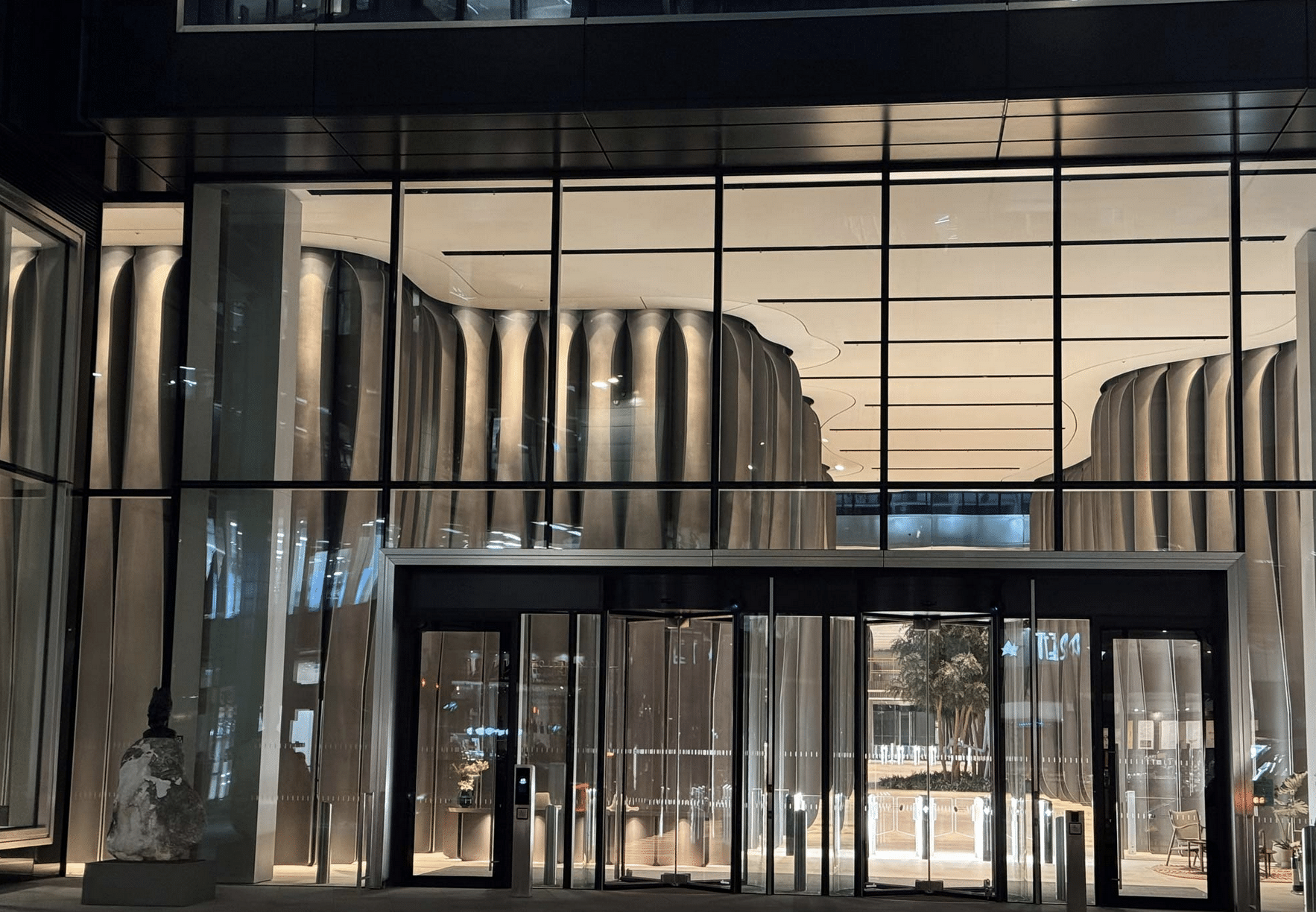
Modern office buildings are increasingly evolving into highly interconnected digital ecosystems. Security systems no longer perform solely traditional protective functions, but are becoming an integral part of smart building control, user interaction and operational resilience. This transformation is particularly evident in the major London project 40 Leadenhall, one of the largest development projects ever approved in the City of London.
Located in the insurance district of the British capital, the building comprises more than 900,000 square feet of office, retail and communal space and is designed to accommodate up to 10,000 users. The operators made a conscious decision to adopt a fully unified security platform as early as the planning phase. The aim was to merge traditional security functions with intelligent building management, automated processes and digital user convenience.
The implementation of Genetec Security Center and Genetec Mission Control has resulted in a security architecture that goes far beyond traditional video surveillance or access control. The project exemplifies how modern smart buildings are increasingly evolving into data-driven, automated and highly integrated operational environments.
Security is becoming a digital building function
Large-scale properties such as 40 Leadenhall now face a dual challenge: On the one hand, demands for physical security and cyber resilience are constantly rising; on the other, users increasingly expect seamless digital services and interactions within the building that are as frictionless as possible.
Traditional siloed solutions are increasingly reaching their limits. Operators need systems that bring together video surveillance, access control, alarm management, sensor technology and building automation within a single platform.
This is precisely where modern unified security platforms come into play. In the case of 40 Leadenhall, more than 200 cameras, over 250 doors and around 2,600 data points are managed centrally via Genetec Security Center. The entire infrastructure runs on Streamvault servers and digital archives.
The crucial difference, however, lies less in the number of components and more in their integration. Instead of isolated individual systems, a networked security architecture is created that connects different building functions and automates central decision-making processes.
Automation becomes the key to operations
Of particular interest is the use of Genetec Mission Control as a higher-level orchestration and automation layer. Modern security platforms are increasingly evolving from pure monitoring systems into active decision-making and response platforms.
Mission Control standardises response processes and automates procedures in the event of security-related incidents. By integrating additional building systems, automatic workflows can be triggered, for example, in the event of power cuts, water damage or extreme weather conditions.
Depending on the situation, the system can send notifications, initiate defined escalation chains or trigger targeted measures. This enables security and building teams to obtain a complete overview of the situation much more quickly.
This form of automation is becoming particularly significant in large building complexes. The rising number of networked systems generates enormous volumes of data that can hardly be monitored efficiently by manual means. Automated event management is thus increasingly becoming a central tool for modern security control centres.
Mobile Identity is transforming building operations
Another key focus is on user interaction. Access control is increasingly moving away from traditional plastic cards towards mobile and digital identity solutions.
At 40 Leadenhall, mobile wallet credentials are used, allowing users to access the building directly via their smartphones. Visitors receive QR code-based access passes, eliminating the need for temporary plastic cards.
This development is fundamentally changing building operations. Access systems are no longer isolated security components, but part of comprehensive digital user platforms.
The integration of the building app based on VTS Activate illustrates this trend particularly clearly. Users can create visitor invitations digitally, receive arrival notifications and access various building services – such as wellness areas, cycling facilities or fitness facilities.
As a result, security functions are increasingly merging with convenience, service and workplace applications.
Security control centres are becoming data-driven control centres
At the same time, the role of traditional security control centres is also changing. Modern platforms enable role-based access for different user groups within the building.
Reception staff can register and manage visitors, whilst security teams can view live video, reports or event analyses both at fixed workstations and on the move via tablets.
The use of interactive building plans is particularly relevant. Operators can locate devices, cameras or sensors directly within digital floor plans and access live data at the click of a button.
This significantly reduces training times. At the same time, situational awareness within complex building structures improves considerably.
This is becoming increasingly important, particularly in large-scale multi-tenant properties. Today, security managers must assess a wide variety of events simultaneously – from access events and technical faults to operational incidents.
Open architecture becomes a strategic factor
Also striking is the strong focus on open system architectures. The platform integrates technologies from various manufacturers, including HID Global, Mercury Communications, STid and Axis Communications.
This approach is becoming increasingly important within modern security architectures. Operators of large properties are increasingly reluctant to commit to closed, proprietary systems in the long term.
Open platforms, by contrast, enable the flexible integration of specialised technologies and facilitate future expansions or modernisations.
This is of particular strategic importance for long-term property projects. Buildings such as 40 Leadenhall will be operated for decades. Security platforms must therefore remain technologically adaptable.
Smart buildings are becoming resilience platforms
The project also highlights a fundamental shift in modern property strategies. Smart buildings are increasingly viewed as resilient digital infrastructures.
Physical security, cybersecurity, building automation and user experience are becoming ever more intertwined. Security systems no longer merely perform protective functions, but are becoming part of operational building management.
This is becoming particularly significant in the context of growing regulatory requirements. Today, operators must not only manage security risks but also meet requirements for data protection, traceability, operational stability and cyber resilience.
At the same time, user expectations are rising. Modern office properties are increasingly competing on the basis of digital services, convenience features and workplace experience.
As a result, security infrastructure is becoming a central component of modern building value creation.
London as a pioneer of smart high-rise infrastructure
It is hardly surprising that a project like 40 Leadenhall is being developed in London. For years, the City of London has been evolving into an international testing ground for highly integrated smart building technologies.
Large multi-tenant properties, in particular, are increasingly relying on unified security and management platforms to reduce operating costs, automate processes and, at the same time, improve the user experience.
The increasing integration of AI, automation and real-time data is likely to further accelerate this trend. Security platforms are increasingly evolving into central data and control hubs for smart buildings.
40 Leadenhall exemplifies the direction in which modern security architectures are heading: away from isolated security solutions, towards fully connected digital operating platforms that combine security, comfort, automation and resilience.

