
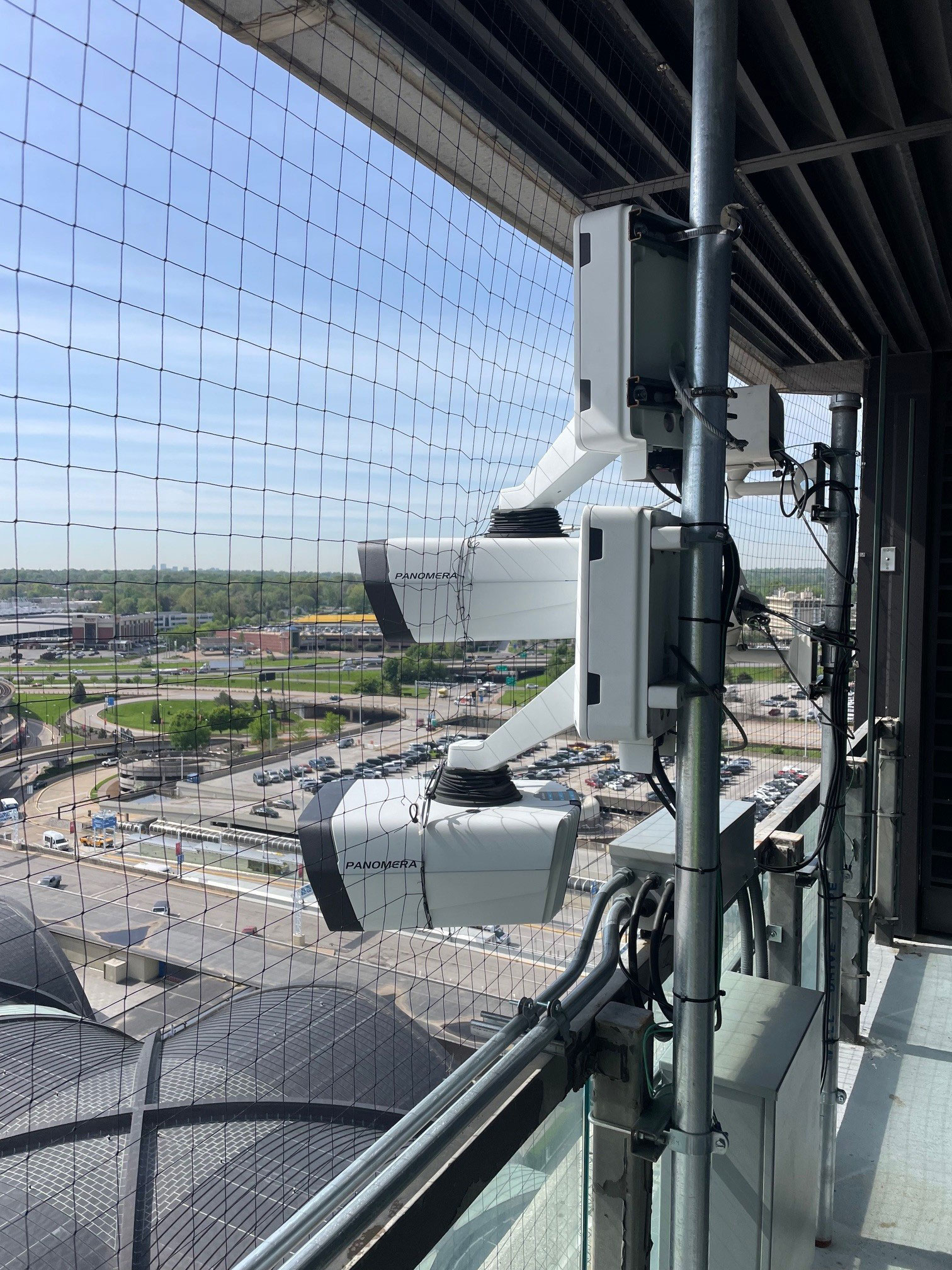
St. Louis Lambert International Airport has deployed Dallmeier’s Panomera multifocal sensor technology to secure more than 6.5 million square metres of airport infrastructure. The new architecture provides high-resolution coverage of extensive airside and landside areas while reducing the number of cameras required by around 90% and infrastructure requirements by approximately 75% compared with the original design.
Securing a major international airport is as much a question of scale as it is of image quality. At St. Louis Lambert International Airport, the largest and busiest airport in the US state of Missouri, that challenge extends across more than 6.5 million square metres of infrastructure. The airport handled more than 15 million passengers in 2025 and requires continuous visibility across environments ranging from passenger parking areas to terminal buildings, runways, taxiways and other airside operations.
Against a background of continued passenger growth, the airport’s operations and security teams decided in June 2018 to modernise video surveillance in two principal areas. The first objective was to improve coverage of parking facilities in order to enhance passenger security and help prevent incidents such as vandalism and theft. The second was considerably broader: the airport wanted to monitor its four runways, taxiways and terminal buildings in order to provide reliable visual coverage of aircraft movements, ground vehicles and airport personnel.
The scale of that requirement quickly exposed the limitations of a conventional camera architecture. STL commissioned systems integrator Tech Electronics to design and implement the modernisation programme. The initial concept combined PTZ and single-sensor IP cameras and would have required more than 130 cameras, together with over 42 additional camera poles and the associated power, network and cabling infrastructure. Particularly across the airside environment, achieving the required level of coverage through such an architecture would have created considerable technical complexity. STL and Tech Electronics therefore began evaluating a more economical alternative.
Multifocal Technology Changes the Surveillance Architecture
The search led the project team to Dallmeier’s Panomera multifocal sensor technology, which has been developed specifically for monitoring large areas while limiting the number of cameras required.
For STL, the decisive factor was the ability of individual Panomera systems to cover extensive areas at high resolution while replacing several conventional single-sensor cameras and parts of the associated infrastructure. David Kulinsky, Deputy Director of Operations & Maintenance at STL Airport, says the economic case became clear once the airport saw the area that could be covered by a single Panomera system.
“When we discovered Panomera and saw that just one Panomera camera could capture large areas in high resolution and replace multiple single-sensor cameras together with the associated infrastructure, it quickly became clear that Panomera was the more economical solution for STL, with higher image quality and lower overall costs.” (David Kulinsky)
A test installation subsequently confirmed the suitability of the technology for the airport environment. Kevin Hubble, Services Manager at Tech Electronics for STL, highlights both the reduction in hardware and the way operators can interact with the resulting video.
Using Dallmeier’s SeMSy Compact video management software, operators can view a single high-resolution overview of a scene and use digital PTZ functions to zoom into individual areas. This allows personnel to examine details while retaining access to the wider recorded scene.
For an airport, that capability has clear operational relevance. Conventional PTZ cameras provide detail in the direction in which they are currently pointing, whereas the Panomera concept allows the broader monitored area to remain recorded. Operators can therefore investigate a specific section without losing the wider overview.
Around 90% Fewer Cameras and 75% Less Infrastructure
More than 27 Panomera cameras are now installed at St. Louis Lambert International Airport. Several IPS 10000 recording appliances and five operator workstations equipped with SeMSy Compact VMS client software complete the video system.
According to the project figures, the resulting architecture reduced the number of cameras required by around 90%compared with the original planning, while the associated infrastructure requirement fell by approximately 75%.
The significance of that reduction extends beyond the number of cameras themselves. A conventional expansion based on more than 130 units would also have required additional poles, power supplies, network connections and cabling. By reducing the number of required camera positions, STL was able to reduce the broader technical infrastructure required to support the surveillance system.
This is particularly relevant in large airport environments, where the installation and operation of surveillance equipment across extensive airside areas can create considerable complexity. The project therefore places total cost of ownership alongside video quality as a central consideration in surveillance design.
Ten Cameras Provide a Digital 360-Degree Airside Overview
One of the most distinctive elements of the deployment is STL’s digital 360-degree surveillance concept. Using only ten Panomera cameras, the airport achieves broad situational awareness across major airside areas, including runways, taxiways and apron zones.
Instead of creating this overview with a large number of PTZ and single-sensor cameras, the multifocal architecture delivers a continuous high-resolution view of the monitored areas. Operators can oversee airport activity across large distances while retaining the ability to examine individual sections in greater detail.
The permanent recording of the wider scene also creates an operational advantage over conventional PTZ surveillance. As Kulinsky explains, airport personnel can zoom into a particular area without sacrificing the overall view or the recording of the complete scene.
That distinction is particularly relevant where incidents need to be reviewed retrospectively. A conventional PTZ camera records the area towards which it is directed at a given moment. If activity takes place elsewhere, the relevant scene may not be available afterwards. By maintaining the wider high-resolution recording, the STL system gives operators access to visual information beyond the section that may have been the immediate focus of attention.
For an environment characterised by simultaneous aircraft, vehicle and personnel movements, maintaining that wider context can support both live situational awareness and subsequent investigation.
From Video Security to AI-Assisted Airport Operations
STL is also examining how the same surveillance infrastructure could support operational applications beyond conventional security monitoring.
A planned project in the airport’s ticketing area is expected to use a Panomera V8 system for AI-supported video analytics. Potential applications include the analysis of passenger flows and waiting times.
The objective is to improve operational efficiency, optimise check-in processes and enhance the passenger experience using the same high-resolution video infrastructure that already supports security operations across the airport.
This represents a logical extension of the existing system. Rather than deploying video solely for surveillance, STL is considering how image data and AI-supported analytics could provide additional information for airport operations.
The planned application nevertheless remains a future development. The current deployment is centred on high-resolution monitoring and situational awareness, while the use of AI-based analytics in terminal areas is being evaluated as the next stage of the project.
A Smaller Technical Footprint for Large-Area Surveillance
For St. Louis Lambert International Airport, the modernisation has fundamentally changed the scale of the surveillance infrastructure required to achieve broad visual coverage.
Instead of the more than 130 PTZ and single-sensor cameras envisaged in the initial concept, the airport has implemented a Panomera-based system that provides extensive high-resolution coverage with a substantially smaller number of camera positions. According to STL, this has improved overall airport coverage while reducing the technology and infrastructure required.
Kulinsky identifies efficiency, resilience and long-term performance as central requirements for any airport technology project. The ability to examine individual areas in detail while preserving both the overall view and the recording of the complete scene has become a particularly important operational advantage.
The St. Louis deployment demonstrates how the design of large-area video surveillance can move away from a simple equation of greater coverage requiring greater numbers of cameras. By combining high-resolution multifocal imaging with centralised video management, STL has created a surveillance architecture designed to cover large operational areas with fewer devices and less supporting infrastructure.
For airports and other large sites, the project illustrates a broader principle: the effectiveness of video security is not determined by camera numbers alone. The more important measure is whether the system can deliver the required combination of coverage, image detail, operational usability and infrastructure efficiency across the area that needs to be secured.

