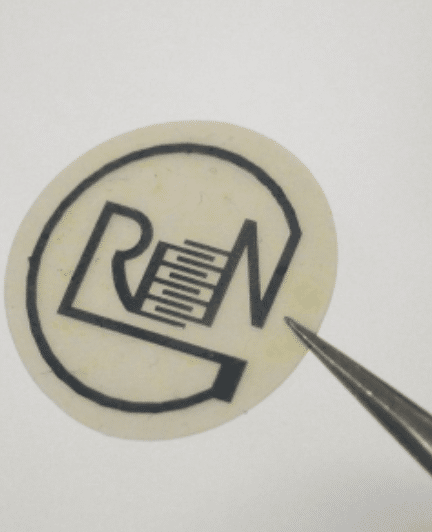
A low-cost sticker will soon make it possible to check whether sensitive goods such as food and medicines have overheated during transport and thus become unusable. It was developed by researchers at the Swiss Federal Institute of Technology in Lausanne (https://www.epfl.ch/de/ ), the Swiss Federal Laboratories for Materials Testing and Research (https://www.empa.ch/ ) and the Swiss Innovation Centre CSEM (https://www.csem.ch/de/ ). Unlike previous systems, which relied on an energy supply and had to be recycled or disposed of as waste, the new label dissolves over time and breaks down into biodegradable particles.
Oil as a temperature gauge
The core of the sensor is a conductor track printed on a composite substrate made of biopolymer and cellulose fibres. This is an electrical resonator made of highly conductive and stable zinc particles protected by a natural wax. When this circuit is exposed to an external electromagnetic field emitted by a reader, a resonance is created that is registered by the reader.
When the threshold temperature is exceeded, a solid bio-based oil melts over the circuit and changes its resonance. The reader then registers an incorrect resonance or there is no reaction at all – sure signs that the limit temperature has been exceeded during transport. The oil is collected by the substrate.
Reduced electronic waste
The researchers use different oils, such as olive, jojoba and coconut oil, which melt at different temperatures and trigger resonance frequency shifts. A common limit temperature is 25 degrees Celsius. James Bourely and Nicolas Fumeaux, founders of Circelec (https://circelec.com/ ), which markets temperature protection and also offers RFID tags for product labelling, hope to combat the environmental problem of electronic waste.
‘In 2022, 62 megatons of electronic waste were produced worldwide – equivalent to 16 Eiffel Towers per day – of which only 22 per cent was properly recycled. Our development is a green technology platform for manufacturing sustainable printed circuit boards and thus reducing electronic waste,’ the young entrepreneurs conclude.