Airports of Thailand is deploying Rohde & Schwarz millimetre-wave security scanners across five airports, including Bangkok Suvarnabhumi, as aviation security increasingly balances detection performance with passenger flow
Airports across Asia are under growing pressure to reconcile two objectives that have traditionally been difficult to combine: stronger security controls and faster passenger processing. Thailand is now taking another step in that direction. Airports of Thailand (AOT) is introducing QPS201 advanced imaging technology scanners from Rohde & Schwarz at passenger checkpoints across five of its airports, including Bangkok Suvarnabhumi Airport, one of the region’s major international hubs.
The deployment reflects a broader shift in aviation security. Passenger screening is increasingly moving away from systems that simply detect anomalies towards technologies designed to deliver higher levels of automation, faster assessment and more consistent alarm handling. For high-volume airports, the issue is no longer security performance alone. Screening technology must also support throughput, accessibility and operational resilience.
Bangkok Suvarnabhumi is a particularly relevant environment for such systems. The airport handles around 60 million passengers annually and processes domestic and international traffic within a large terminal complex. At that scale, even minor delays at security checkpoints can quickly translate into congestion and longer queues.
The QPS201 scanners are intended to support a more streamlined screening process while maintaining regulatory requirements for the detection of prohibited items.
Millimetre-wave screening moves further into the mainstream
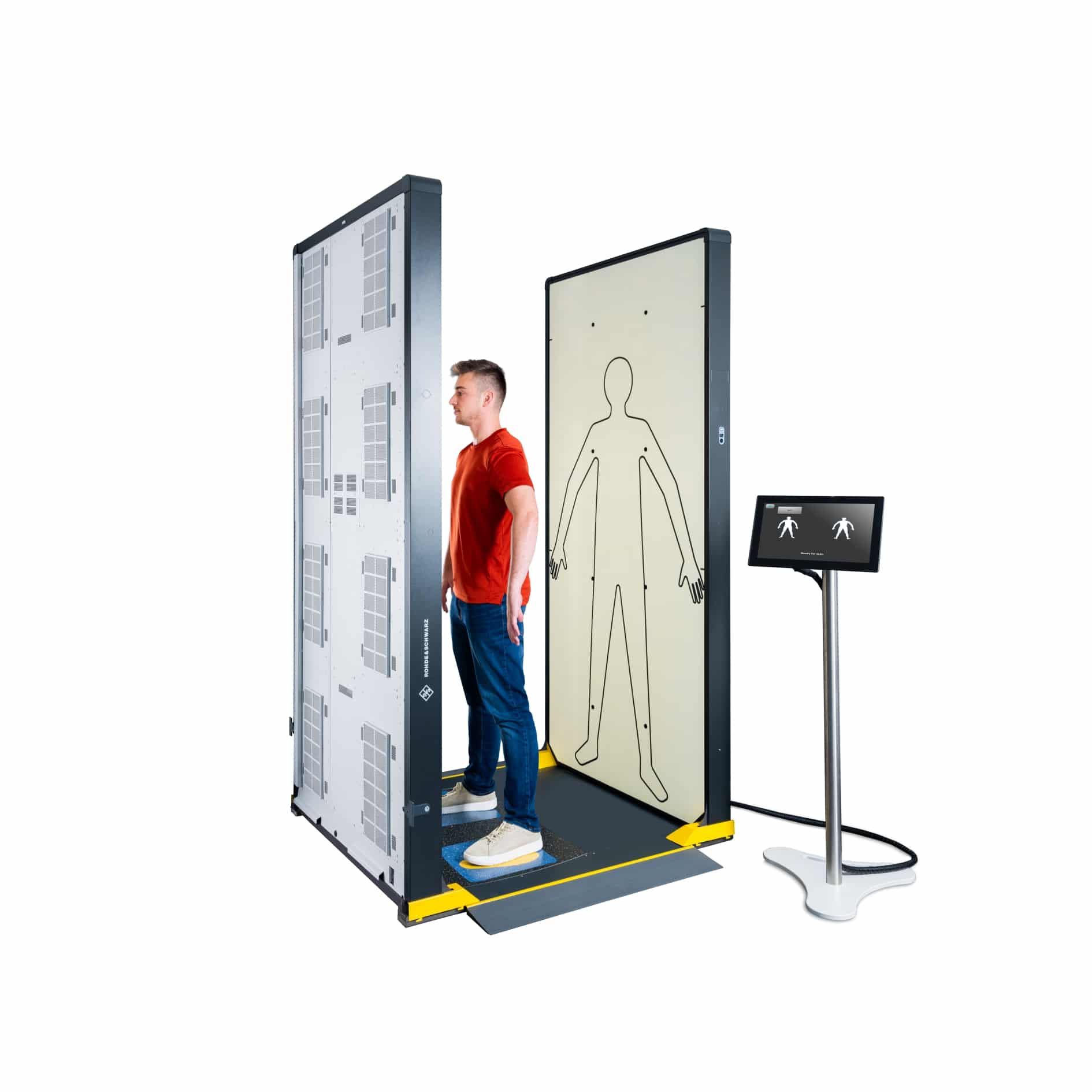
The QPS201 uses millimetre-wave technology combined with algorithmic analysis to detect potential objects concealed on or beneath a passenger’s clothing. Rather than producing a detailed image of the person being screened, the system indicates areas requiring additional inspection on a standardised digital avatar.
For passengers, the procedure is designed to be relatively simple. Travellers stand in an open scanner in a natural posture with their arms lowered, rather than adopting the raised-arm position associated with some earlier generations of body scanners. The analysis is completed within milliseconds.
This seemingly small change in posture is operationally relevant. Simplifying the passenger interaction with security equipment can reduce confusion, shorten processing times and make screening easier for elderly passengers or travellers with reduced mobility.
For checkpoint operators, the central challenge remains the balance between detection performance and false alarms. Excessive alarms increase the number of secondary searches and can undermine much of the efficiency gained through automated screening. Rohde & Schwarz says its combination of millimetre-wave sensing and AI-based algorithms is designed to maintain high detection capability while keeping false-alarm rates low.
That combination is becoming increasingly important as airports seek to move more passengers through existing infrastructure without compromising security standards.
Certification becomes increasingly important in global procurement
The deployment also highlights the role of international certification in airport security procurement.
The QPS201 is qualified by the US Transportation Security Administration for use at passenger checkpoints and has also been certified under requirements established by the European Civil Aviation Conference. Such approvals are particularly significant for airport operators and screening authorities that need to demonstrate compliance with recognised security standards while retaining flexibility in technology procurement.
For manufacturers, certification across multiple regulatory environments is becoming a competitive requirement rather than a differentiator. Airport operators increasingly expect systems to meet recognised European, US and other international standards, particularly when equipment may remain in service for many years.
More than 2,000 QPS systems are already in use at airports worldwide, according to Rohde & Schwarz. The latest AOT deployment therefore represents less a technological experiment than a further expansion of a screening technology that is becoming established at major passenger checkpoints.
Passenger experience becomes part of the security equation
Aviation security was once largely evaluated through a single lens: whether a system could detect prohibited items. That remains the fundamental requirement, but airport operators increasingly assess technology against a broader set of operational criteria.
Passenger throughput, accessibility, staffing requirements, false-alarm rates and the ability to integrate new equipment into existing checkpoint layouts all influence procurement decisions.
This is particularly important at large hubs, where security checkpoints have a direct impact on overall terminal performance. A scanner that improves detection but substantially slows passenger flow can create operational pressure elsewhere in the airport. Conversely, faster screening only has value if detection standards remain robust.
For AOT, the deployment of advanced imaging technology therefore sits within a larger challenge facing airports globally: how to modernise security without turning checkpoints into increasingly complex bottlenecks.
The use of a standardised avatar rather than a passenger-specific image also reflects the growing importance of privacy considerations in screening technology. Modern security systems need not only to detect potential threats, but also to demonstrate that they handle passenger information proportionately.
Asia’s airport security market continues to modernise
The Thai deployment also illustrates the continuing modernisation of aviation security infrastructure across Asia. Rapid passenger growth, large-scale airport expansion and increasingly internationalised regulatory expectations are driving investment in technologies that can support both security and capacity.
For major hubs such as Suvarnabhumi, screening systems form part of a broader operational architecture that includes automated border control, baggage screening, biometric processing and increasingly integrated passenger management.
Advanced imaging systems are likely to remain an important element of that architecture. Their value lies not merely in replacing older screening equipment, but in allowing airport operators to redesign the checkpoint itself: reducing unnecessary manual intervention, improving consistency and creating a smoother transition between security and the wider passenger journey.
The strategic question for airports is therefore no longer whether security screening should become more automated. It is how far automation can be introduced without reducing the ability of security staff to assess unusual situations and intervene where technology reaches its limits.
Security and throughput are converging
The deployment of QPS201 scanners across five AOT airports reflects a wider trend in aviation security: detection capability and passenger processing can no longer be treated as separate objectives.
Airports are expected to identify threats reliably, comply with increasingly demanding regulatory frameworks and at the same time process large passenger volumes with minimal disruption. Screening technology is therefore becoming part of a wider operational performance strategy.
For airports in Asia and beyond, the future checkpoint will be judged not simply by how well it detects prohibited items, but by how effectively it combines security, speed, accessibility and privacy.
The Thai deployment shows how that transition is already taking shape.