
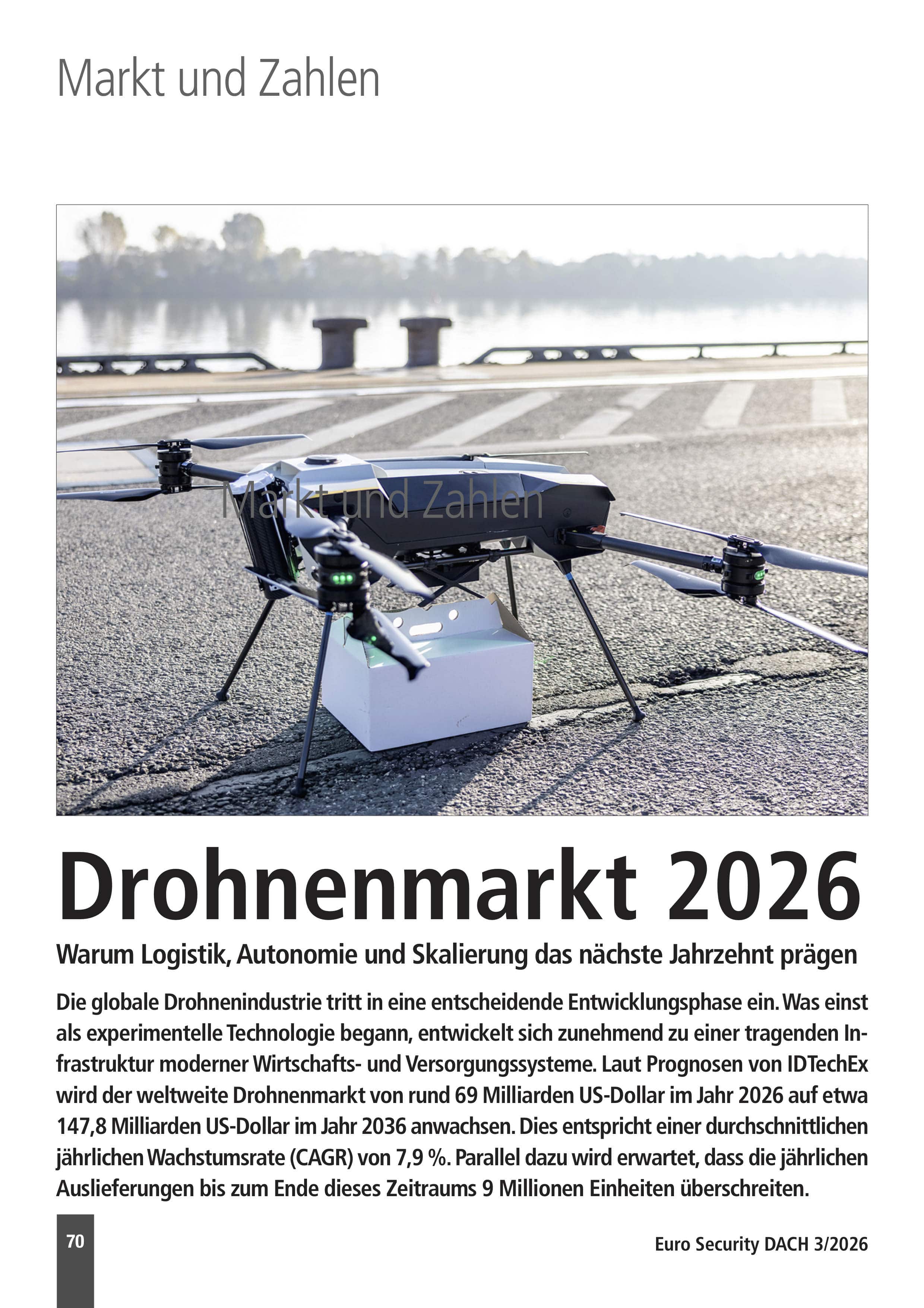
Why Logistics, Autonomy and Scalability Will Shape the Next Decade
The global drone industry is entering a crucial phase of development. What once began as an experimental technology is increasingly becoming a key infrastructure for modern economic and supply systems. According to forecasts by IDTechEx, the global drone market is set to grow from around US$69 billion in 2026 to approximately US$147.8 billion in 2036. This corresponds to a compound annual growth rate (CAGR) of 7.9%. In parallel, annual shipments are expected to exceed 9 million units by the end of this period.
This growth is no longer driven primarily by consumer applications such as aerial photography. Instead, the focus is shifting towards industrial and commercial applications: logistics, inspection, public safety and autonomous operational processes. Drones are thus evolving from isolated tools into integral components of supply chains, infrastructure management and business-critical processes.
From Experiment to Infrastructure
Over the past ten years, the use of drones has undergone a fundamental transformation. Instead of isolated pilot projects, coordinated systems now dominate, being deployed in sectors such as agriculture, energy, port logistics, security and healthcare. The decisive factor here is not hardware development alone, but the interplay of autonomy, regulatory frameworks and data integration.
Advances in BVLOS (Beyond Visual Line of Sight) operations, as well as the introduction of UTM and U-Space concepts, are significantly expanding commercial opportunities.
At the same time, falling hardware costs are lowering barriers to entry, whilst requirements for safety, cybersecurity and governance are rising. Competition is thus shifting from pure flight capability to the ability to organise scalable operations efficiently.
Logistics as a key growth driver
Drone logistics is considered one of the clearest examples of this structural shift. After years of pilot projects, the sector is increasingly establishing itself as a scalable business model. Particularly in North America, Europe and parts of the Asia-Pacific region, dense networks are emerging for:
- Last-mile deliveries in e-commerce
- Medical transport (e.g. blood samples, medicines)
- Offshore and island supply
- Intra-plant logistics in industrial facilities
In the medical sector, studies show time savings of 50–70% compared to ground-based transport, whilst offering greater reliability.
A key advancement lies in system integration: drones are linked directly to ERP systems, warehouse management solutions and automated dispatch systems. This creates standardised, repeatable processes – a prerequisite for economic scaling.
Inspection and maintenance overtake agriculture
Particularly dynamic growth is evident in the inspection and maintenance segment. Applications include, amongst others:
- Wind turbines
- Power grids
- Pipelines
- Port infrastructure
According to forecasts, this sector will account for over 25% of commercial drone revenue by 2030, thereby overtaking agriculture.
The advantages are clear: reduced risks for personnel, lower costs, continuous condition monitoring and minimised downtime.
Automated ‘drone-in-a-box’ systems and standardised data pipelines are increasingly enabling fully autonomous inspection processes.
Autonomy, AI and the end of manual scaling
A key obstacle to scaling up has traditionally been the classic ‘one pilot – one drone’ control model. This accounts for up to 60–70% of operating costs. The industry is therefore moving towards ‘one-to-many’ models, in which a single operator monitors multiple missions simultaneously.
Artificial intelligence supports this transition through:
- Predictive maintenance (reducing unplanned downtime by 20–30%)
- Automated anomaly detection
- Accelerated mission approvals
However, the key lies in the end-to-end automation of workflows – from approval through planning to documentation. Without standardised processes, the potential of AI remains largely untapped.
Investment dynamics: Focus on operational ecosystems
Capital flows are increasingly shifting from individual drone platforms towards integrated system solutions. Technologies are particularly in demand for:
- Fleet management
- Airspace coordination (UTM)
- Cybersecurity
- Integration into enterprise systems
Investors are making a clearer distinction between technological maturity and operational scalability. Companies that can demonstrate secure and compliant multi-site operations have a clear advantage.
The year 2026 as a turning point
Drones are no longer assessed in isolation, but as part of complex operational systems. One indicator of this is the increasing integration of sensors: by 2036, industrial drones are expected to carry 10–15 sensors per platform. The volume of data generated makes manual post-processing practically impossible.
What is decisive here is not just growth, but the shift in demand: the drivers are no longer consumer applications, but professional fields of application such as logistics, inspection, public safety and autonomous industrial processes. Drones are thus increasingly becoming integrated systems within complex value chains.
From aircraft to system infrastructure
Over the past ten years, the role of drones has changed fundamentally. Isolated applications have evolved into networked systems operating in sectors such as energy, agriculture, port logistics and security management. Technological progress is evident not so much in pure flight capability as in the integration of autonomy, data processing and regulatory frameworks.
In particular, advances in BVLOS (Beyond Visual Line of Sight) operations, as well as the introduction of UTM and U-Space concepts, are significantly expanding commercial application possibilities. At the same time, falling hardware costs are lowering barriers to market entry, whilst requirements for safety, cybersecurity and governance are rising. The market is thus increasingly defined by the ability to scale – not by individual flights.
Logistics as a growth driver
A key area of application is drone logistics. After years of pilot projects, the market is evolving towards scalable, regional networks with high route density. In the US, thousands of BVLOS delivery flights are already being carried out daily as part of regular operations – a clear sign that scaling is no longer a theoretical concept.
Applications range from the ‘last mile’ in e-commerce and medical supply chains to the provision of goods to remote regions or offshore locations. In the medical sector in particular, initial implementations are demonstrating significant efficiency gains: delivery times on critical routes can be reduced by up to 70 per cent – whilst reliability is simultaneously improved.
A key development step lies in integration with existing corporate systems. Drones are increasingly being connected directly to ERP, warehouse management and planning systems.
This creates predictable, repeatable processes – a fundamental prerequisite for economically viable scaling.
Inspection overtakes agriculture
In parallel, the inspection and maintenance sector is emerging as the fastest-growing segment in the commercial drone market. According to forecasts, this sector will account for more than 25 per cent of total revenue by 2030, thereby overtaking agriculture.
The drivers are both economic and safety-related factors. Drones enable continuous, automated monitoring of infrastructure such as wind turbines, power lines, pipelines or port facilities. Compared to manual inspections, they reduce costs, minimise risks and simultaneously deliver consistent, data-driven results.
Automated systems such as ‘drone-in-a-box’ solutions are increasingly being used, enabling continuous data collection and remote monitoring. The focus is thus shifting from carrying out individual flights to orchestrating complete data and operational processes.
Autonomy as the key to scaling
As operations scale up, the traditional model – a pilot controlling a drone – is reaching its economic limits. Studies show that this approach can account for up to 70 per cent of operating costs. Consequently, the market is shifting towards ‘one-to-many’ models, in which a single operator monitors multiple missions simultaneously.
Artificial intelligence supports this transition, for example through predictive maintenance, automated anomaly detection or accelerated approval processes. However, the decisive factor remains the standardisation of processes. Companies that automate approvals, planning, monitoring and reporting derive the greatest value from their drone operations.
Investments follow orchestration
A clear trend is also evident from an investor’s perspective: capital is increasingly flowing into platforms and systems that enable coordination – such as fleet management, airspace monitoring, cybersecurity or integration into existing corporate systems. In this context, the focus is shifting not only to technological maturity but, in particular, to operational scalability. Companies that can demonstrate secure, compliant and cross-site operations gain decisive competitive advantages.
HHLA Sky: Orchestration as a strategic approach
Against this backdrop, HHLA Sky is positioning itself specifically in the area of operational scaling. At the heart of this is the ability to operate drones not as individual devices, but as part of integrated infrastructures.
With the Integrated Control Centre (ICC) combined with UTM functionalities, HHLA Sky enables the control and monitoring of over 100 parallel BVLOS missions. Planning, authorisation, execution and documentation are consolidated within a single system.
This architecture takes account of the increasing complexity of modern drone operations. Particularly in logistics and inspection scenarios, where multiple missions run simultaneously, the ability to coordinate in a structured manner becomes a decisive factor for success.
Data as a bottleneck and value driver
Another key aspect is the growing importance of sensor data. According to forecasts, by 2036 industrial drones will be equipped with 10 to 15 sensors per platform – ranging from optical cameras and thermal sensors to LiDAR and radar systems. Data volumes are thus rising exponentially.
HHLA Sky addresses this development through automated data processes that enable structured collection, processing and integration into existing systems. Without such approaches, the potential for data utilisation remains limited – particularly with scaling fleets.
Regulation as an enabler
In parallel with technological development, regulatory harmonisation is also progressing. BVLOS approvals and U-Space initiatives are laying the foundations for the routine operation of commercial drone fleets. At the same time, requirements for traceability, safety and compliance are increasing.
HHLA Sky’s UTM solutions support this development through automated clearances, real-time situational awareness and coordinated airspace use. This makes drone operations not only more efficient but also robust from a regulatory perspective.
Conclusion: Scalability is key
The development of the drone market clearly shows that the future belongs not to the most powerful aircraft, but to the systems that enable scalability. Drones are becoming integral components of industrial processes – from logistics and inspection to public safety.
In a market set to grow to nearly 150 billion US dollars by 2036, success no longer depends on who owns the technology, but on who can operate it safely, efficiently and in an integrated manner. Suppliers such as HHLA Sky are focusing precisely on this point – and are thus positioning themselves at the heart of the next phase of development in the drone economy.
From page 38 in this issue, you will find a detailed overview of the offerings in the relevant markets: XPONENTIAL Europe 2026: Autonomy as a strategic game-changer for security architectures – from technology demonstration to systemic capability.
You will also find a flip-PDF of this editorial section in Euro Security DACH 3-2026: https://www.tinyurl.com/ybcjtnyd


