
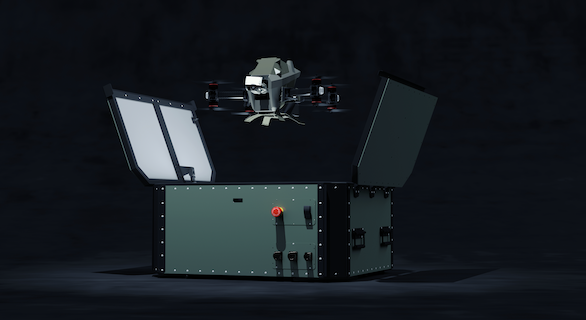
New interception drone is part of Securiton Germany’s perimeter management system
Drone sightings in NATO airspace and near critical infrastructure are on the rise. Unauthorised unmanned aerial vehicles are appearing with increasing frequency, especially over large cities, airports and military bases. In a time of geopolitical tension, it is crucial to take action against potential threats from the air before serious incidents occur.
Unidentified flying objects can be detected early, assessed and controlled, disrupted or landed using the ‘SecuriDrone Fortress’ multilayer system. The new autonomous and powerful ‘SecuriDrone Interceptor Iron Drone’ interceptor drone complements Securiton Germany’s proven perimeter protection concept: it tracks its flying target independently of GPS or radio connections and safely captures it with a net. A parachute prevents collateral damage and the destruction of evidence.
When the ‘iron’ interceptor rises from its ‘POD’, foreign drones are at a disadvantage. The powerful SecuriDrone Interceptor Iron Drone interception system secures the airspace within a radius of up to 2,500 metres around the clock and completely autonomously. It is the latest component of Securiton Germany’s SecuriDrone Fortress multi-layer system, which combines various sensor and active components in multiple stages to form an insurmountable airspace protection concept. To do this, it must detect threats in the airspace at an early stage, evaluate them reliably and defend against them in a manner appropriate to the situation.
Multiple security components complement each other
Securiton Germany relies on a multi-level, dynamic and holistically networked detection and defence system for air surveillance, in which various sensors, analysis methods and defence measures interact seamlessly. First, radar and radio frequency scanners (cRF) detect suspicious activity in the air and on the ground to locate drones and pilots. Detected objects are then evaluated with the help of AI based on flight behaviour, signal profiles and visual characteristics. If a threat is detected, defence measures are initiated: The foreign drone is jammed by radio, taken over and forced to land, or intercepted by the patented Iron Drone system.
Compact interceptor Iron Drone
The interceptor drone operates completely autonomously, transmitting real-time video during its mission without causing any radio interference – around the clock and in all weather conditions. The four-kilogram aircraft from Airobotics, part of Ondas Holdings, can take off from stationary locations or moving vehicles. It flies up to 600 metres high and can reach a speed of 180 kilometres per hour. With a capture net and recovery parachute, it safely retrieves unauthorised flying objects from the air without damage. The interception drone itself lands automatically at its designated landing position and is quickly ready for its next mission.
The result is a modular, adaptive system that can be easily integrated into existing operational and command structures. Securiton Germany’s multilayer system monitors the airspace continuously and effectively prevents dangers – both preventively and reactively.

