
How integrated multi-view concepts are redefining control rooms
There comes a point at which additional information no longer automatically leads to greater safety. On the contrary: if too much data is processed at once, the risk increases that crucial clues will be overlooked or misinterpreted. It is precisely this tension that characterises everyday life in modern control centres today.
Whether it is the security control centre of an industrial company, a traffic control centre, an airport, a data centre or a critical infrastructure control centre – the number of information sources is growing continuously everywhere. High-resolution video cameras, access control systems, intrusion and fire detection technology, sensor systems, building automation, process control systems and cybersecurity platforms provide data round the clock. Added to this are situational maps, communication systems and, increasingly, AI-supported analyses.
Technological developments are thus creating a paradoxical situation: never before have security managers had access to as much information as they do today. At the same time, it is becoming increasingly difficult to draw the right conclusions from this flood of data in the shortest possible time.
The real challenge facing modern control centres has therefore long since ceased to be about providing as much information as possible. Rather, the key is to reduce complexity, structure information in a meaningful way and provide operators with exactly the data they actually need in a specific situation.
People remain the decisive factor
This insight is by no means new. For many years now, science and standardisation bodies have been addressing the question of how control centres must be designed so that people can work safely even under high pressure. International standards such as ISO 11064 on the ergonomic design of control centres, as well as findings from human factors research, all point to the same conclusion: The performance of a control room is not determined solely by its technical equipment, but largely by the way in which information is presented.
In this context, security managers often refer to situational awareness – that is, the ability to fully grasp a situation, correctly assess its significance and make appropriate decisions based on it. However, this situational awareness does not arise automatically from more technology. On the contrary: a cluttered display or constant switching between different applications can significantly increase cognitive load and impair responsiveness.
Particularly in time-critical situations, it is therefore often not the number of available cameras or sensors that determines the success of a measure, but rather how quickly an operator can identify the relevant information and link it together.
From screen to decision-making platform
This development is also changing the role of professional displays. For a long time, monitors were regarded primarily as passive output devices. Their role was to display information that had been processed by other systems.
However, with increasing digitalisation, this understanding is undergoing a fundamental shift. Today, displays are increasingly taking on functions that were previously distributed across external hardware. They can display multiple signal sources simultaneously, provide different layouts, centrally manage workstations or adapt flexibly to various operational scenarios.
As a result, monitors are increasingly becoming an integral part of control centre architecture. They no longer merely collate information – they help to organise this information effectively and reduce complexity for the user.
Less technology – greater clarity
At the same time, the requirements for the technical infrastructure are also changing. In many existing control centres, a workstation consists of a multitude of different components. External signal switchers, multiview processors, splitters and additional control units ensure that various data sources can be displayed on multiple monitors.
Whilst this architecture offers great flexibility, it also has its drawbacks. Every additional hardware component increases the installation effort, takes up space in the rack, requires additional cabling and represents a further potential source of error. At the same time, maintenance and operating costs rise, as does the complexity involved in expansions or modernisations.
Against this backdrop, a clear trend has been emerging for several years: functions that were previously spread across several devices are increasingly being integrated directly into professional displays. Multiview displays, multiple video inputs and centralised management functions make it possible to set up workstations more efficiently without sacrificing flexibility.
This approach follows a fundamental principle that can now be observed in many areas of security and information technology: It is not additional technology that creates a better overview – but intelligently integrated technology.
Situation awareness does not begin with the software
In modern control centres, discussions often centre on more powerful video analytics, artificial intelligence or new sensor technology. Far less attention is paid to a factor that ultimately determines the success or failure of an operational decision: people.
After all, even the most powerful control centre software only delivers its full benefit if information is presented in such a way that operators can grasp it intuitively. Studies in the fields of human factors and cognitive engineering have shown for years that it is not the volume of available data that is decisive, but rather its structured presentation. If information is presented in a confusing manner or if operators have to constantly switch between different applications, the cognitive load increases – and with it the likelihood of incorrect decisions.
Particularly in critical situations, where seconds can determine the course of an incident, clarity therefore becomes a key safety factor. Situational awareness does not arise from more information, but from the ability to perceive relevant information at the right moment, interpret it correctly and derive the appropriate course of action from it.
For planners of modern control centres, this means a shift in perspective. Whilst the focus used to be primarily on the technical performance data of individual components, attention is now increasingly turning to the design of the entire workplace. Ergonomics, visual guidance, standardised operating concepts and a consistent presentation of different information sources are becoming essential components of modern control centre planning.
From hardware to workplace design
This development is also fundamentally changing the role of professional displays.
For a long time, monitors in control centres were selected primarily on the basis of traditional criteria: screen size, resolution and brightness were the main considerations. Today, these features alone are no longer sufficient. What is needed are displays that actively help to simplify workflows and reduce technical complexity.
This is precisely where a fundamental shift over recent years has become apparent. More and more functions that previously had to be implemented using additional hardware are now being integrated directly into the display unit. Multiple video inputs, integrated multiview displays and centralised management capabilities turn a monitor into a functional component of the entire control centre architecture.
The advantage lies not merely in these additional functions. Rather, it enables the elimination of numerous external components. Signal switchers, separate multiview processors or additional control units become – depending on the specific project – partly redundant. This reduces the amount of cabling required, simplifies installation and maintenance, and at the same time creates a more streamlined technical infrastructure.
For operators, this is about more than just costs. Less hardware also means fewer potential sources of error, lower maintenance costs and greater availability during operation – factors that play a crucial role, particularly in 24/7 control centres.
A real-world example
One manufacturer that consistently pursues this philosophy of integration is AG Neovo. With its new QX series, the company exemplifies how professional displays are evolving from traditional display devices into multifunctional components of modern control centres.
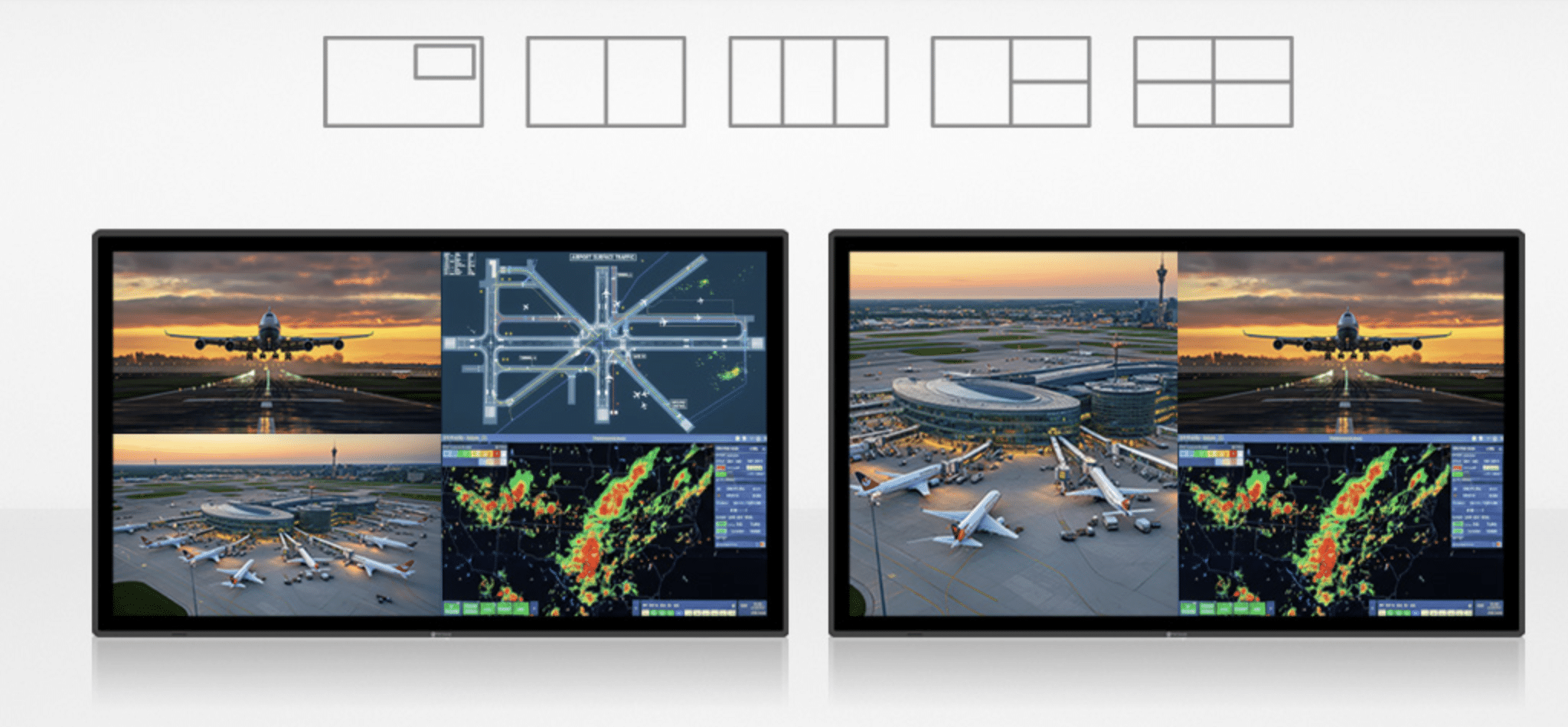
The displays feature four HDMI inputs and one DisplayPort, enabling the simultaneous display of multiple signal sources on a single screen. Different display modes such as Quad-View, Picture-in-Picture or Picture-by-Picture allow workstations to be flexibly adapted to different operational scenarios. Instead of constantly switching between different inputs, operators can keep an eye on several sources of information at the same time.
This can make it easier to navigate, particularly during routine monitoring. In the event of an alarm, on the other hand, individual content can be specifically highlighted without completely hiding the rest of the information. In this way, the technology adapts to the actual workflow of a control centre – rather than the other way round.
Equally important is the ability to save individual display profiles. Different configurations for day and night shifts, various workstations or specific operational situations can be accessed in just a few simple steps. This not only simplifies operation but also supports consistent standards within larger control centres.
Displays become part of system management
Finally, with increasing connectivity, the operation of professional monitors is also changing. Displays are no longer isolated end devices, but part of a comprehensive IT and security infrastructure.
The QX series supports, amongst other things, DisplayPort daisy chain, RS232 and LAN interfaces. This allows multiple displays to be configured and managed centrally. Settings such as input signal, brightness or operating status can be adjusted simultaneously for several devices.
This concept is complemented by the Neovo Controller management software. It enables centralised monitoring of connected displays and provides information on, for example, signal losses or temperature deviations. Maintenance measures can thus be planned more effectively and potential failures detected at an early stage.
Particularly in control centres, where round-the-clock operation must be guaranteed, this continuous monitoring contributes significantly to operational reliability. At the same time, it demonstrates just how much the role of professional displays has changed: today, they are no longer merely output devices, but an active component of the technical infrastructure.
Control centres are becoming smarter – and simpler at the same time
The transformation of professional control centres is far from complete. On the contrary: with increasing digitalisation, more powerful sensors and the use of artificial intelligence, the volume of available information will continue to rise. At the same time, the demands on operators of critical infrastructure, industrial companies, transport operators and public institutions to identify risks at an early stage and make decisions more quickly are growing.
Against this backdrop, the role of the operator’s workstation is also changing. In future, the focus will be less on displaying as much information as possible simultaneously. Instead, the key will be to prioritise information intelligently, link it automatically and present it in such a way that it supports people in their decision-making. Modern control centres are thus increasingly evolving into decision-making hubs where people and technology work closely together.
This development does not only affect large security centres. Smaller control centres in industrial companies, energy suppliers, hospitals, logistics centres and transport operators also face the same challenges. With every additional camera, every new sensor and every further software application, the need for a clear, integrated working environment grows.
Integration is becoming a planning principle
At the same time, the planning of new control centres is also changing. Whilst in the past the focus was often on individual components, planners today are increasingly thinking in terms of complete systems. The primary question is no longer which additional hardware can be installed, but rather which functions can be usefully combined.
This approach not only reduces the technical effort involved. It also improves maintainability, scalability and long-term operational reliability. Fewer interfaces mean fewer potential sources of error, lower integration costs and higher availability – factors that are becoming increasingly important in light of the skills shortage and rising demands on operational reliability.
Against this backdrop, the QX series from AG Neovo exemplifies the direction in which professional display solutions are developing. The combination of multiple video inputs, integrated multiview technology and centralised management functions represents not so much a single product as a fundamental trend within control centre technology: functions are consolidated, complexity is reduced and the workstation is aligned more closely with the operators’ actual workflows.
It is precisely this shift in perspective that is likely to shape developments in the coming years. In future, control centres will not be judged by how much information they can display, but by how effectively they support people in making the right decisions in complex situations.
Technology serves people – not the other way round
The demands placed on control rooms and security control centres are undergoing a fundamental shift. Whilst the volume of available information is growing continuously, people’s capacity to process and make decisions remains unchanged. The real challenge for modern control centres therefore no longer lies in providing additional data, but in structuring information flows in such a way that clarity, orientation and confidence in taking action are maintained.
In this context, professional displays are evolving from mere display devices into active components of control centre architecture. Multiview technologies, centralised management functions and integrated operating concepts help to reduce technical complexity and make workstations more efficient. What is crucial, however, is not the individual function, but its contribution to better human-technology interaction.
AG Neovo’s QX series exemplifies this development. It demonstrates how modern display technology can be integrated into overarching control centre concepts and what opportunities this presents for planners and operators. At the same time, it highlights the direction in which the industry as a whole is moving: away from isolated components, towards intelligently networked workstations that simplify technology and put people at the centre.
Ultimately, the success of future control centres will not be measured by how many monitors are mounted on a wall or how high their resolution is. What matters is whether information is presented in a way that provides clarity rather than creating complexity. For in a world where data is available in almost unlimited quantities, clarity is becoming one of the most important resources in modern security technology.
At a glance | AG Neovo QX Series
Designed for professional control centres and control rooms
Typical applications
- Security control centres
- Control rooms in industry and critical infrastructure
- Traffic control centres
- Maritime applications
- Broadcast and IT environments
Concept
The QX Series combines multiple video inputs, integrated multiview functions and centralised management capabilities in a single display. This allows different signal sources to be displayed and managed simultaneously without the need for additional multiview hardware.
Key features
- 4K UHD resolution
- Models available in 27, 32 and 65 inches
- Four HDMI inputs and DisplayPort
- Quad-View, Picture-in-Picture and Picture-by-Picture display
- DisplayPort daisy chain
- RS232 and LAN interfaces
- Remote management via Neovo Controller
- Individual user profiles
- Blackout and dimming functions
- Robust metal housing with NeoV™ Optical Glass for 24/7 operation

