
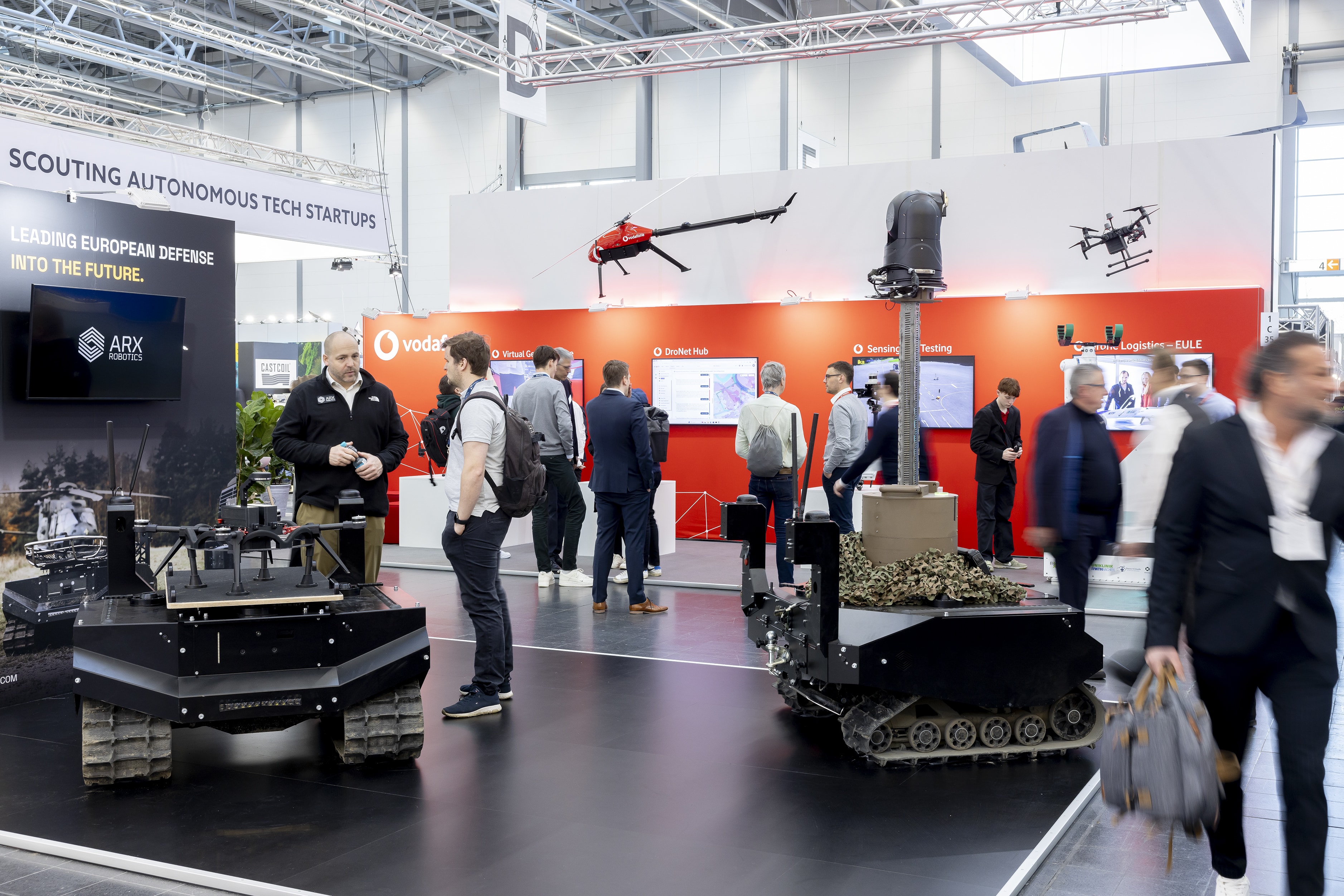
The new threat landscape is the subject of a Bundeswehr conference and high-level strategic dialogue
Hybrid threats, drone attacks and cyber operations are changing the requirements for defence and the protection of critical infrastructure. Against this backdrop, autonomous systems, artificial intelligence and robotics are of security relevance. They are the focus of XPONENTIAL Europe, which takes place from 24 to 26 March 2026. The theme of defence and dual-use is on the agenda of the trade fair and supporting programme.
The centrepiece is a specialist conference organised by the Bundeswehr, which will examine the operational, technological and political perspectives of an increasingly unmanned operational environment. It will take place on 25 March 2026 in the Defence Theatre in Hall 1 of the Düsseldorf Exhibition Centre and is open to all visitors to XPONENTIAL Europe. It will be complemented by a curated, bilateral dialogue format organised by the British Chamber of Commerce in Germany (BCCG), which will bring together political decision-makers, the armed forces and industry in an exclusive setting in the auditorium at CCD Süd, by invitation only.
Unmanned systems in the spotlight of security and defence
Under the title “Operational and Innovative Security and Defence Perspectives of an Unmanned Environment”, the Bundeswehr Conference examines the operational role of unmanned systems in the context of security and defence policy, linking operational reality, capability development and technological innovation. The conference is aimed at a specialist audience from politics, the armed forces, procurement, security authorities, industry and research, and is supported by Diehl Defence, one of Germany’s three largest defence companies. Topics for discussion include the current threat landscape in the Euro-Atlantic region, deterrence and defence through unmanned systems across all domains, as well as national security and governance issues within Germany. Other key topics include the protection of critical infrastructure, operational lessons from current conflicts, innovation and procurement processes and their implementation within existing structures, as well as the use of artificial intelligence in the context of automation and the principle of ‘Meaningful Human Control’.
“Unmanned systems are now a central factor in modern security and defence architectures. The Munich Security Conference has once again clearly demonstrated this. It is crucial that operational experience, technological development and the political framework are closely interlinked. With our presence at XPONENTIAL Europe, we aim to engage in direct dialogue with research and industry and look forward to many discussions and contacts. At the same time, together with the ‘Defence meets Economy’ supporting programme organised by our partner, the British Chamber of Commerce Germany, we are sending a strong signal to the public,” says Rear Admiral Christian Bock, Head of the Bundeswehr Innovation Centre in Erding.
In addition to the Bundeswehr, federal ministries, NATO structures, international military representatives, security authorities, academia and industry will be represented.
Strategic Dialogue “Defence meets Economy”
As a significant extension of XPONENTIAL Europe, a bilateral German-British defence and economy symposium for invited guests will take place on 25 March 2026 at 11 am at the CCD Süd. Under the title “Defence meets Economy”, representatives from politics, industry and the military will discuss security policy guidelines for European defence capabilities.
The symposium is organised by the British Chamber of Commerce in Germany (BCCG) in collaboration with XPONENTIAL Europe. The strategic dialogue is being implemented in close cooperation with the British Embassy in Germany and with the participation of representatives from the UK Ministry of Defence. The exchange underscores the United Kingdom’s role as a key security and defence partner for Europe.
“The ‘Defence meets Economy’ symposium is an excellent example of the bilateral dialogue envisaged in the Kensington Treaty and the Trinity House Agreement on defence cooperation. As we mark the 80th anniversary of ‘Operation Marriage’ – the creation of a new federal state, North Rhine-Westphalia, by British allied forces – I can scarcely imagine a better setting in which the United Kingdom and the modern economic powerhouse of North Rhine-Westphalia can honour this anniversary whilst looking ahead to future cooperation in the fields of security, defence and innovation,” explains Andrew Mitchell CMG, British Ambassador to Germany.
“The British Chamber of Commerce in Germany stands for strong and reliable German-British relations. With the strategic dialogue ‘Defence meets Economy’, we are supporting XPONENTIAL Europe and Messe Düsseldorf as an international platform for innovation and cooperation. The aim is to forge even closer links between the United Kingdom and Germany in the fields of security and defence through industry and trade, working in close collaboration with our partners and allies. The dialogue also fits into the historical context of North Rhine-Westphalia’s 80th anniversary,” says Michael Schmidt, President of the British Chamber of Commerce in Germany.
The event takes place against the backdrop of the celebrations marking the 80th anniversary of North Rhine-Westphalia as a key region for security, industry and innovation, and relates to the current German-British defence agreements.
High-ranking political representatives from Germany, the United Kingdom and Europe are expected to attend; nominations are still being finalised at the time of publication. Dr Marie-Agnes Strack-Zimmermann, Member of the German Bundestag and Chair of the European Parliament’s Committee on Security and Defence (SEDE), will provide a European perspective. She will contextualise Europe’s security policy orientation within the interplay between the EU and NATO and will address, among other things, the practical application of European defence budgets as well as issues relating to European defence capabilities. Further topics include the security policy priorities of Germany, the United Kingdom, and European and NATO allies, industrial resilience, defence budgets, and the acceleration of innovation and procurement.


