
Home Secretary Herbert Reul: “We have learnt from the experiences of recent years”
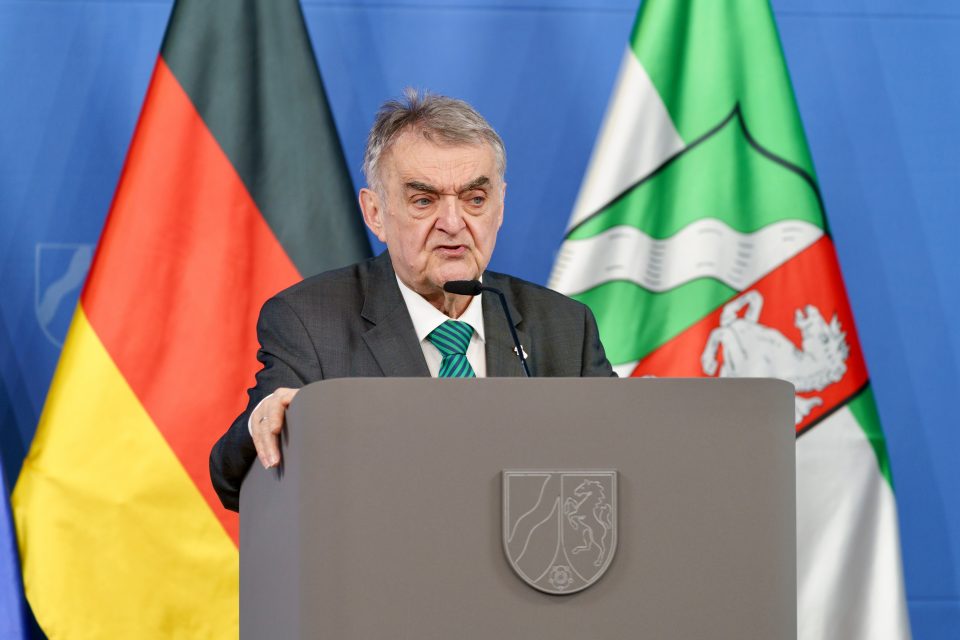
Photo: State of North Rhine-Westphalia / Martin Götz
The state government has approved a draft bill to amend the Act on Fire Protection, Assistance and Disaster Management (BHKG).
The aim is to modernise structures, optimise capabilities, simplify procedures and further improve operational readiness in the event of disasters and fires.
The current version of the Act dates from 2016 and has only been amended in specific areas since then. With this reform, the state government is responding to new challenges such as extreme weather, complex damage scenarios and lessons learned from the 2021 floods. Many of the changes are based on the report ‘Disaster Management of the Future’, which was drawn up by the Disaster Management Expert Team appointed by the Minister of the Interior. Further insights from the practical application of the law have also been incorporated.
Minister for the Interior Herbert Reul: “We have learnt from the experiences of recent years. With this reform, we are finally establishing clear structures, strengthening civil protection and, at the same time, modernising fire safety. The aim is a system that provides rapid, reliable and competent assistance in crises – with the state, districts and local authorities working hand in hand.”
Disaster management: strengthening structures and improving coordination
In view of increasing extreme weather conditions, disaster management is being fundamentally overhauled. A central state office for disaster management is being enshrined in law for the first time. Furthermore, the state is obliged to maintain a disaster management depot so that essential materials are readily available in an emergency. The state will also draw up a state disaster management requirements plan and a framework warning plan in future.
Structures are also being strengthened at local authority level. In future, the start and end of a disaster situation are to be explicitly determined. Furthermore, instruments such as disaster management needs planning and local authority warning planning will be enshrined in law to ensure targeted preparation for potential local emergencies. Inter-municipal cooperation is also being strengthened.
A new compulsory training programme is being introduced for district administrators, mayors and local councillors: within their first year in office, they must undergo training in disaster management to ensure they can make confident decisions in an emergency.
Fire safety is being modernised
In addition to disaster management, fire safety is also being adapted to new requirements. In future, the capacity of fire services is to be geared more closely to actual local conditions. Fire safety needs planning plays a central role in this.
At the same time, procedures for local authorities are being simplified. Until now, municipalities within a district required a special exemption from the district government if their fire safety needs plan did not provide for full-time staff to carry out the tasks. In future, it will suffice to submit a proposal to the next higher supervisory authority – approval will no longer be required. This will significantly streamline the procedure for towns and municipalities.
The regulations governing plant fire brigades are also being further developed and made more flexible. In future, operators of industrial parks are to be more closely involved. Approval procedures are to be consolidated and thus accelerated.
Control centres and digitalisation
The law also ensures that North Rhine-Westphalia will continue to have efficient and modern control centres in the future. These are to make greater use of the opportunities offered by digitalisation to coordinate operations more quickly and efficiently. Furthermore, local authorities are to be able to jointly operate the unified control centre for fire protection, civil protection and rescue services.
Volunteering remains a cornerstone
Volunteering is a central element of fire and disaster protection in North Rhine-Westphalia. The vast majority of emergency personnel volunteer with fire services and aid organisations. The draft bill therefore aims to further improve the framework conditions for voluntary work and explicitly reinforce the importance of this commitment.

