Drones add a capability that conventional site security has so far lacked: they can not only detect suspicious activity, but also track it across large areas. Security service provider autosecure demonstrates how unmanned aircraft can be integrated with sensors, artificial intelligence and control room processes. The decisive factor is not the drone itself, but the security architecture in which it operates.
When industrial and commercial sites become deserted after business hours, the risk of unauthorised access increases. Vehicles, machinery, metals, cables and other valuable assets are often stored across extensive outdoor areas. Conventional cameras can monitor defined zones, but their view remains limited by their fixed position and orientation. Security personnel can respond flexibly, yet covering long distances takes time. This creates an operational gap between stationary surveillance and physical intervention.
Autosecure aims to close this gap with drones that can launch automatically. Rather than replacing cameras or security personnel, the aircraft are intended to reduce the time between an alarm, the assessment of the situation and a targeted response. This changes the role of video surveillance: instead of waiting for an incident to occur within the field of view of a fixed camera, the security system gains the ability to follow an event as it develops.
A mobile camera is not enough
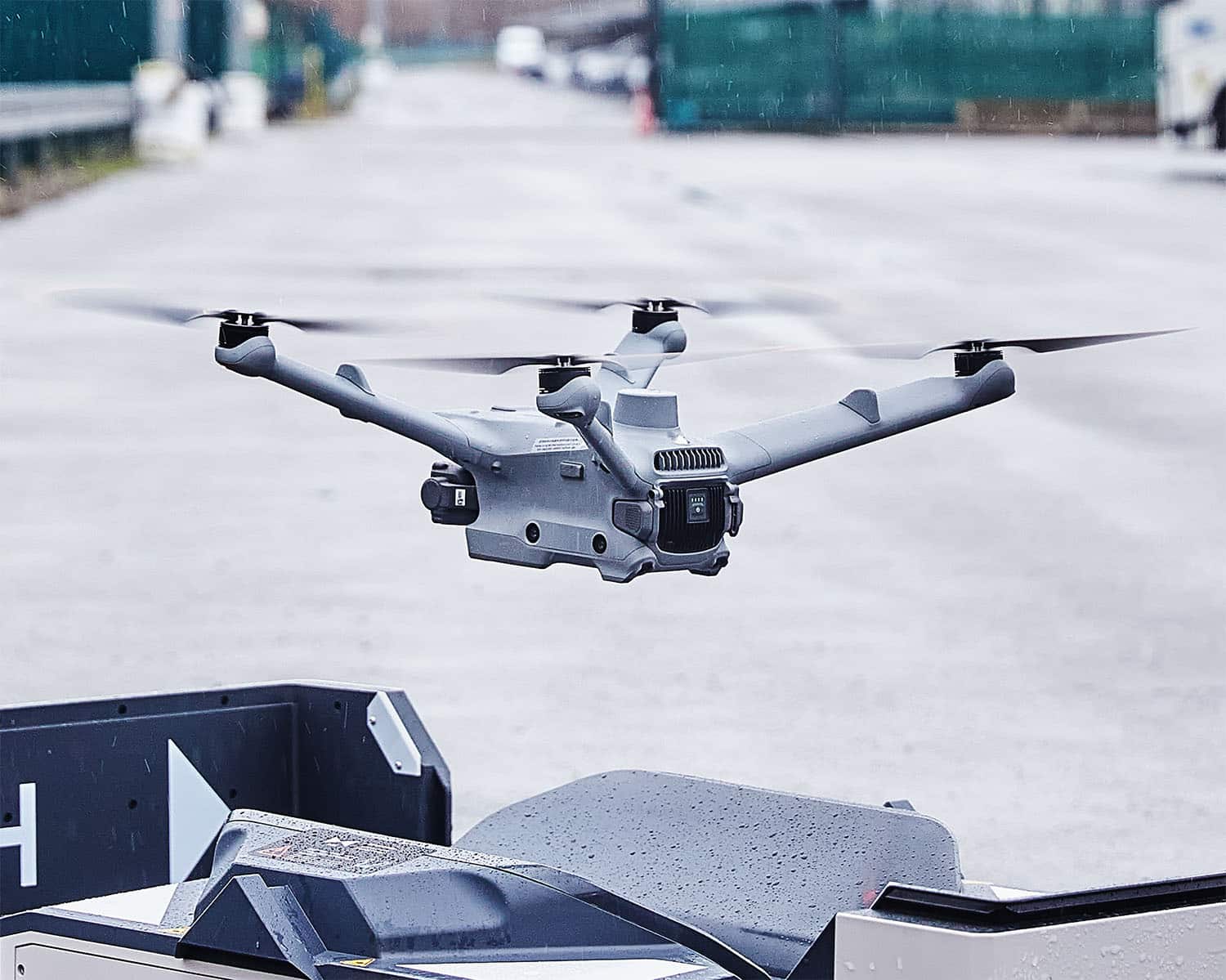
Autosecure deploys the DJI Matrice 3TD. The drone launches from a permanently installed dock, ideally positioned on a rooftop or at another location with an unobstructed take-off and landing area. In addition to power and data connections, the installation requires flight planning, regulatory approval and clearly defined operational responsibilities. According to autosecure, the company also assists with preparing the necessary permits.
The drone can perform two fundamentally different tasks. During scheduled patrols, it follows predefined routes and inspects selected areas of interest. During an intervention, by contrast, it launches in response to a specific alarm triggered, for example, by fence sensors, fixed cameras or other detectors.
This mobile approach is particularly valuable at logistics yards, vehicle dealerships and large industrial or chemical sites. Adding more stationary cameras merely creates additional fixed fields of view. A drone, however, can be directed to the precise area in which suspicious activity has been detected.
Depending on weather and operating conditions, the Matrice 3TD can remain airborne for up to 45 minutes. The manufacturer specifies a maximum flight distance of up to 43 kilometres under defined test conditions. In real-world security operations, however, theoretical maximum values are less important than the planned route, reserve capacity, wind conditions, obstacles and the drone’s ability to return safely to its dock.
Turning an alarm into an operational picture
The operational value of the system stems from the combination of different cameras. The Matrice 3TD is equipped with a wide-angle camera for high-resolution overviews, a telephoto camera with up to 56× hybrid zoom and a thermal imaging camera. This enables it to survey large areas while also examining individual movements from a distance. Thermal imaging extends its usefulness at night and in areas where visibility is restricted.
The footage is transmitted to autosecure’s security system, where artificial intelligence analyses the images for predefined anomalies. The software can, for example, identify people or vehicles and prioritise events. The final assessment, however, remains the responsibility of the control room. Trained operators determine whether the incident represents unauthorised access or whether employees, delivery personnel or other authorised individuals are present on the site.
This division of responsibilities is central to the system’s practical value. AI can pre-screen large volumes of data and filter out obvious false alarms. Whether a situation is harmless, unusual or acutely dangerous, however, often depends on the operational context. Only the combination of automated analysis and human judgement can turn camera footage into a reliable operational picture.
From observing an incident to tracking it
If the control room confirms a critical incident, the drone can be dispatched directly to the affected area. With a maximum speed of 75.6 kilometres per hour, it can reach many parts of a site faster than a security officer travelling on foot or by vehicle.
Its role is not to intervene autonomously. Instead, the drone creates visibility, tracks movements and continuously supplies the control room with information. Its visible presence alone may have a deterrent effect. If intruders do not leave the site, the aircraft can help security personnel or police locate them and document their direction of travel without losing sight of the target.
This also improves the quality of the response. An alarm no longer necessarily requires personnel to search a large site without reliable information. The control room can tell responding officers where a person is located, in which direction they are moving and whether any accomplices are visible. Relevant footage can subsequently be retained for documentation and, subject to the applicable legal requirements, for police investigations or insurance purposes.
The drone is only one component
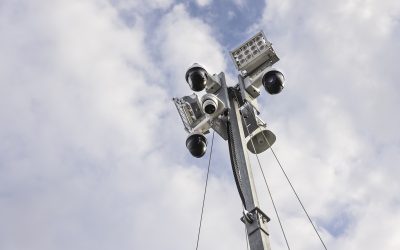
An effective solution emerges only when the drone is connected to the existing security infrastructure. Sensor-equipped fences can detect vibrations or attempted manipulation and trigger a targeted reconnaissance flight. Fixed cameras can continuously monitor particularly sensitive areas such as entrances, gates, machinery and storage zones. Floodlights can illuminate the affected area, while public-address systems enable operators to issue direct warnings to intruders.
Digital access control systems add information about which people and vehicles are authorised to be on the premises. All alerts converge in the control room. It therefore becomes more than a central alarm-receiving point: it functions as an operational decision-making hub in which sensor data, camera footage, access information and drone imagery are combined into a single assessment of the situation.
According to autosecure, the deployed station also includes a function for detecting third-party drones. This is significant because unmanned aircraft are not only security tools. They can also be used for unauthorised surveillance, reconnaissance of operational processes or the transport of small objects. Protecting the low-altitude airspace above a site is therefore becoming an increasingly important element of perimeter security.
New capabilities create new dependencies
The use of automated drones also requires clearly defined limits and resilient fallback arrangements. Strong winds, precipitation, technical faults, temporary flight restrictions and maintenance can all affect availability. Data protection, retention periods, access rights and the permitted use of recordings must also be clearly regulated. Particularly sensitive sites require redundant communication channels and defined procedures for situations in which the drone is unable to launch.
Continuous surveillance of large areas likewise depends on appropriate operational planning. When a drone returns to its dock for charging, coverage must be maintained by fixed systems, security personnel or another available aircraft. A drone should therefore never be treated as an isolated technical solution. It is an additional mobile sensor within a multi-layered protection strategy.
The real advance lies in the response chain
The security value of a drone does not lie in spectacular aerial footage. Its performance should be measured by whether it delivers actionable information more quickly after an alarm and enables a more targeted intervention. An operational advantage emerges only when sensors, AI analysis, the control room and responding personnel work together without interruptions or information gaps.
This points to a new performance benchmark for the security industry: what matters is no longer simply how accurately a system detects an event, but how quickly it can transform data from multiple sources into a reliable assessment and, ultimately, an actionable decision.
The drone therefore adds more than a flying camera to site security. It makes surveillance mobile and can substantially reduce the gap between detection and intervention.