
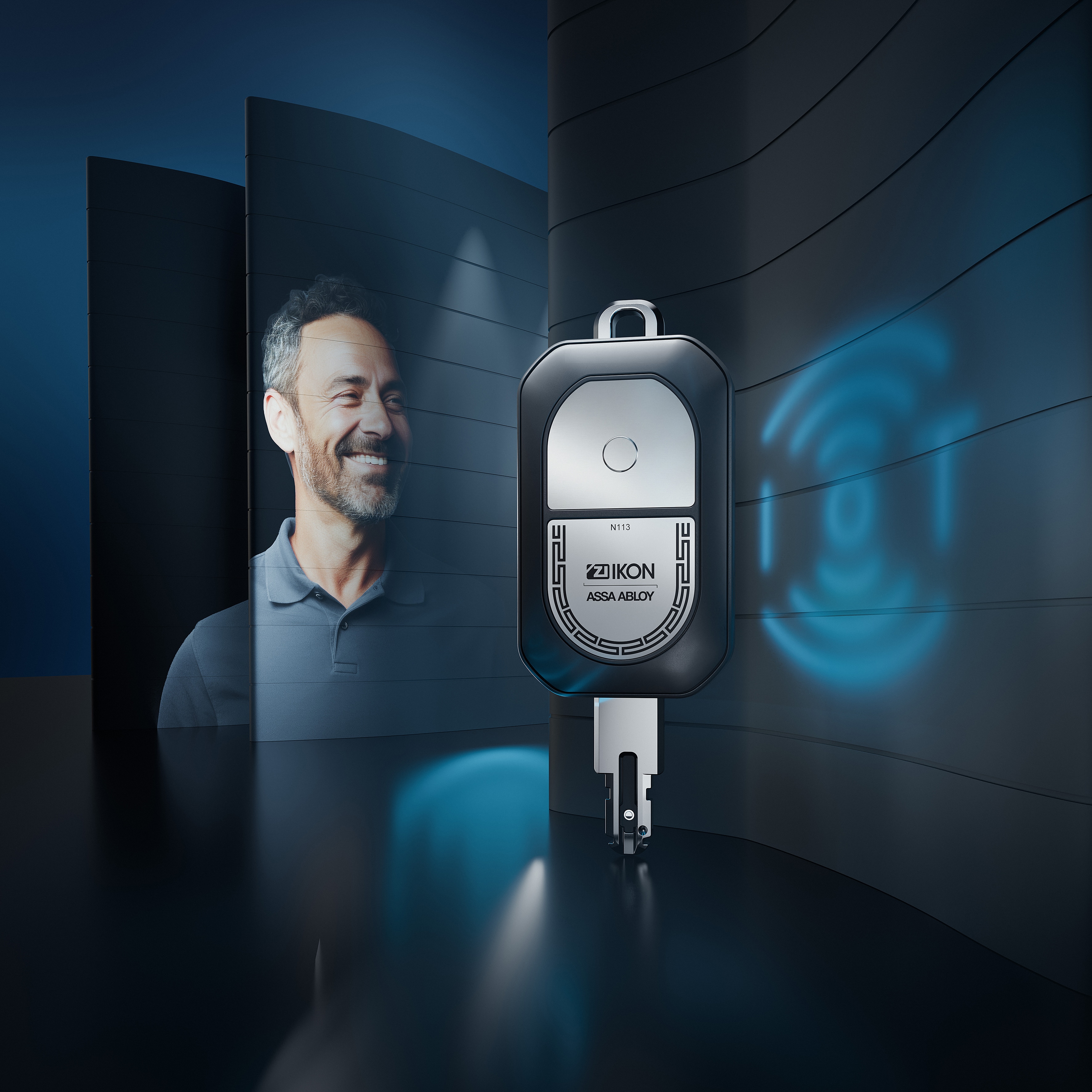
Electronic locking systems have been becoming more mobile, flexible and digital for years. Yet one dependency has usually remained: new access rights still had to be transferred to the key via a stationary updater or a smartphone. ASSA ABLOY is now addressing precisely this gap. With eCLIQ FLASH, the company is introducing an electronic key that retrieves its own authorisations over the mobile network – with no app, no Bluetooth pairing and no additional device required.
To mark the 100th anniversary of the IKON brand, ASSA ABLOY is launching what it describes as the world’s first electronic key with an integrated mobile connection. eCLIQ FLASH uses NB-IoT and LTE-M to transfer updated access rights directly from the CLIQ Web Manager to the key. For the user, the process is reduced to a single press of a button; neither a smartphone nor a stationary updater is required.
This approach is particularly relevant in large or geographically dispersed locking systems. If, for example, a service technician receives an additional assignment while already in the field, an administrator can issue the required authorisation immediately in the CLIQ Web Manager. The technician can then retrieve it directly on the key. There is no need to return to a fixed update point or to rely on a separate mobile device.
Mobile connectivity instead of a smartphone
The key distinction of FLASH lies in the fact that the authorisation update process is moved entirely into the key itself. Smartphone-based access workflows can certainly provide flexibility, but they also introduce additional organisational and technical dependencies. Not every employee or external contractor has a suitable company handset, while private devices may be prohibited in security-sensitive environments. Different operating systems, software versions and Bluetooth connections can also create additional support requirements.
ASSA ABLOY has therefore deliberately separated the authorisation process from the smartphone. Updates and validation processes can be carried out directly through the key’s integrated mobile connection. For operators, this reduces the number of devices and interfaces involved, while users can work with the key without installing an app or preparing another device in advance. In environments with changing personnel, external contractors or widely distributed sites, that can significantly reduce administrative effort.
NB-IoT and LTE-M for distributed sites
For communication, eCLIQ FLASH uses both Narrowband Internet of Things and LTE-M. Both mobile standards are designed for connected devices with comparatively low energy consumption and are intended to complement one another in terms of range and availability. ASSA ABLOY places particular emphasis on the building penetration of NB-IoT, which can support communication in areas where conventional wireless connections may struggle.
This makes the solution especially relevant for operators of large-scale or decentralised sites. Industrial complexes, utilities, technical infrastructure and other security-critical environments are among the most obvious applications. These are precisely the settings in which high availability requirements often coincide with strict physical and digital security policies.
According to ASSA ABLOY, data transmission within the eCLIQ system is protected by end-to-end AES-128 encryption. Access rights are managed in the browser-based CLIQ Web Manager, where administrators can make changes remotely and trace relevant events.
One month of operation per charge
FLASH also differs from existing eCLIQ keys in the way it is powered. Instead of a replaceable battery, the new model uses an integrated rechargeable battery charged via USB-C. ASSA ABLOY states that one charge is sufficient for around one month of use, including up to 800 locking operations, several hundred authorisation updates and additional status messages.
After an 80 per cent discharge, the battery is said to return to full charge within two hours. For outdoor use, the key is protected to IP67 against dust and water, while visual and acoustic signals provide feedback to the user.
Five keys for different operating profiles
With the arrival of FLASH, the eCLIQ portfolio expands to five key variants. Alongside Basic and Professional, the range includes the Bluetooth-enabled Connect, the self-powered SPARK and now the mobile-network-enabled FLASH. Operators can therefore assign different key types to different user groups and operating scenarios while remaining within the same overall system.
All key variants are compatible with more than 60 available eCLIQ cylinder types and can be used together within the same installation. Existing systems can therefore be extended with additional key types without replacing cylinders already in place. For organisations with heterogeneous user profiles, this mixed-mode capability can be an important practical advantage.
SPARK moves into its second generation
Alongside the launch of FLASH, ASSA ABLOY has also further developed the eCLIQ SPARK. Its core principle remains unchanged: the key generates the energy required for the locking process itself and operates entirely without a battery or rechargeable power source. The second generation features a revised design with a plastic slider, while ASSA ABLOY says the internal functional stability has also been improved.
Both FLASH and the updated SPARK are scheduled to become available through specialist distribution channels later in 2026.
The key becomes a connected endpoint
The real significance of eCLIQ FLASH lies less in any single feature than in the shift it introduces to the overall system architecture. Until now, an electronic key has often depended on another medium to receive updated permissions. With FLASH, the key itself takes over that communication function.
The result is a move away from the traditional identification medium towards a connected endpoint within the access control infrastructure. For operators, this is particularly relevant where permissions change frequently, users work remotely or sites are geographically dispersed.
ASSA ABLOY is therefore combining three requirements that have often been treated separately: mobile authorisation management, independent communication and physical access control within a single key. In complex infrastructures in particular, that combination could prove to be the difference between digital flexibility and genuine operational practicality.

