
Intrusion detection is no longer defined by the alarm panel alone. As security systems absorb video verification, environmental monitoring, automation and IP-based interfaces, the technical challenge is shifting from device-level detection to coordinated event processing across the building. SATEL’s BE WAVE platform reflects that transition with a modular architecture combining intrusion and hold-up detection, technical hazard monitoring, visual verification and building automation across wireless, wired and hybrid configurations. For installers and consultants, the relevant question is therefore increasingly not whether a system can generate an alarm, but how reliably it can verify, communicate and translate that event into a controlled response.
The change is being driven by both technology and user expectations. Security systems are increasingly expected to provide context rather than simply signal an event. A smartphone notification, visual verification and predefined building responses can all form part of the same incident workflow. At the same time, operators increasingly want to avoid managing separate applications and isolated subsystems for individual functions.
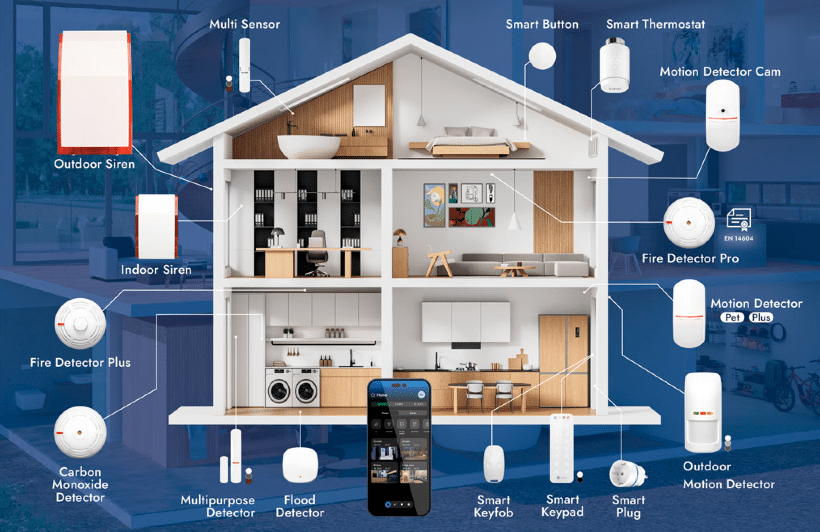
BE WAVE is designed around this broader model. The platform brings together intrusion and hold-up detection, technical hazard monitoring, visual alarm verification and selected building-automation functions. Its architecture can be deployed as a wireless, wired or hybrid system, allowing project design to reflect the physical and operational characteristics of the building.
The more relevant point is therefore not the number of functions available, but how they are combined into a coherent operational architecture.
The building determines the architecture
Security projects rarely begin under identical conditions.
A new commercial development offers different possibilities from an occupied office building, warehouse, villa or refurbished property. In some environments, structured cabling is straightforward and desirable. Elsewhere, additional cable routes may be disruptive, expensive or technically impractical.
SATEL addresses these differences with three configurations.
Fully wireless BE WAVE installations use Smart-HUB controllers and are particularly suited to projects in which new cabling is to be minimised. BE WAVE Wire uses a wired architecture based in part on the RS-485-based SATEL BUS, together with conventional alarm circuits, outputs and expansion modules.
BE WAVE Hybrid combines the two. Wired devices can operate alongside equipment using SATEL’s ABAX 2 wireless technology. Core parts of a site can therefore remain hard-wired while difficult-to-reach rooms, separate buildings or later extensions are connected wirelessly.
For professional system design, this is more significant than a simple choice between radio and cable.
A hybrid architecture allows the installation method to follow the risk profile, building fabric and economic requirements of the project rather than imposing one technical model across the entire site.
From intrusion detection to broader risk monitoring
Intrusion and hold-up protection remain the foundation of the system. Motion detectors, opening contacts and glass-break detectors can be combined with optical and acoustic signalling devices for conventional intrusion applications.
The platform also extends into technical hazard monitoring.
Smoke, gas and water detectors can be integrated alongside sensors for temperature, humidity and atmospheric pressure. The system can therefore monitor conditions that threaten assets or continuity even when no unauthorised access has taken place.
This is particularly relevant in technical rooms, storage areas, archives and smaller commercial facilities.
A water leak or critical temperature rise can disrupt operations or damage assets just as seriously as an intrusion. Once these events are processed within the same architecture, the traditional alarm system begins to assume a broader role in building-risk monitoring.
When one sensor supports several processes
The architectural shift becomes more apparent when security and building functions begin to interact.
A motion detector can identify unauthorised activity but can also contribute to lighting control. A temperature sensor can generate an alert while at the same time supplying information to heating functions.
BE WAVE can integrate devices including thermostatic radiator controls, smart plugs, dimmers, RGBW controllers, shutter modules, switches and universal relay modules. External equipment such as locks, gates or selected HVAC functions can also be controlled through system inputs and outputs.
Automation is based on predefined cause-and-effect relationships.
Arming the security system can, for example, switch off selected loads or reposition shutters. An alarm may activate lighting in addition to acoustic signalling. Schedules, thermostat control, an astronomical clock and presence-simulation functions expand the possible scenarios.
The technical significance is not that an intrusion system can operate a light.
It lies in the ability to make security status, sensor information and building functions interact according to defined logic.
As physical security, smart-building technology and operational systems converge, that coordination becomes increasingly important.
Visual verification changes the value of an alarm
Detection alone does not necessarily provide enough information to make a good operational decision.
A notification stating that movement has been detected may be technically correct, but the recipient still needs to establish what caused the event.
BE WAVE supports visual verification using compatible IP cameras and motion detectors incorporating cameras. Images can be displayed in the BE WAVE application and BE WAVE Soft, with live video from compatible IP cameras also available.
The user or monitoring operator can therefore assess an event with more context than a conventional alarm message provides. Recorded images can also be forwarded to a security service for further evaluation.
Integration can operate in both directions.
An IP camera with motion detection can send an HTTP command to BE WAVE and activate an IP input. A video-detected event can consequently trigger an alarm or a predefined automation sequence.
This changes the role of video within the system.
The camera is no longer solely a source of recorded evidence. It can become an active component of the event-detection and response chain.
Wireless security requires more than range
Wireless security technology is often discussed in terms of installation convenience and transmission distance. In professional applications, however, communications integrity is at least as important.
BE WAVE Hybrid and the Smart-HUB controllers use SATEL’s ABAX 2 radio technology. In the European Union, it operates in the 868 MHz band and uses four independent radio channels. Channel selection can be adapted according to current interference levels, with the system selecting the channel offering the most reliable transmission conditions.
ABAX 2 communication is bidirectional. Transmissions are acknowledged, while loss of communication with a device generates a fault indication. Communication is AES-encrypted to provide protection against interception and spoofing.
SATEL specifies an outdoor line-of-sight range of up to 2,000 metres. Repeaters can extend coverage, while battery-powered components can, under suitable conditions and with ECO mode enabled, achieve operating periods of up to eight years according to the manufacturer.
For system designers, these figures still require project-specific interpretation.
Construction materials, interference sources, device positioning, maintenance strategy and topology will determine actual radio performance. For installations outside the European Union — including Middle Eastern markets — applicable frequency allocations, approvals and national certification requirements must be assessed separately. The technical material supplied specifies the 868 MHz implementation for the EU market.
Wired infrastructure retains its role
The development of reliable wireless systems does not remove the case for wired architecture.
BE WAVE Wire and the wired elements of the hybrid system use the RS-485-based SATEL BUS. According to SATEL, communication is encrypted and designed to support rapid device response. Connected devices are automatically addressed through BE WAVE Soft, eliminating the need to configure addresses manually using DIP switches.
Conventional detectors, sounders and external components can additionally be integrated through inputs, outputs and expansion modules.
Devices connected through the bus or wirelessly can also receive automatic updates without requiring a computer to be connected individually to each unit.
This highlights a broader issue for professional security installations: lifecycle management.
As security systems become more software-dependent, commissioning is only the beginning of the technical lifecycle. Configuration management, software updates, diagnostics and long-term support become part of the security architecture itself.
User simplicity and installer control
A highly capable system can still become an operational weakness if everyday use is unnecessarily complicated.
Depending on configuration, BE WAVE can be operated through the mobile application, touchscreen keypads, conventional keypads and compatible MIFARE readers. Users can arm or disarm defined areas, inspect events and activate authorised automation functions.
For professional installers, BE WAVE Soft provides the configuration environment for devices, users, protected areas, reactions and automation. Diagnostic functions and detailed event logs are intended to support commissioning, maintenance and fault analysis.
This separation between straightforward user operation and deeper engineering control becomes increasingly important as systems grow more interconnected.
Integration creates dependencies. Automation should not inadvertently interfere with security functions, and convenience must not weaken access controls or protected zones. User permissions, security areas and technical relationships therefore need to remain clearly defined even when multiple functions share the same platform.
For commercial, multi-user and mixed-use environments, this distinction is particularly important.
Standards compliance remains a system-level issue
SATEL states that its Smart-HUB controllers and the WIRE 128, HYBRID 128 and HYBRID 128 Plus control panels meet the requirements of EN 50131 Grade 2.
That does not mean that the use of a compliant control unit automatically makes an entire installation compliant.
Planning, component selection, installation, parameterisation and maintenance remain decisive for the conformity and performance of the complete system.
For consultants and installers, the distinction is fundamental.
Certification of individual components is one part of system design. Risk assessment, communications architecture, installation practice and maintenance remain equally relevant to the performance of the finished installation.
Different markets, similar architectural pressures
The underlying architectural trend is relevant beyond a single national market.
In Europe, hybrid systems are particularly attractive in retrofit environments, where existing wired infrastructure may need to coexist with newer wireless devices and IP-based components.
The Middle East presents different project conditions, ranging from high-end residential properties to hospitality, commercial compounds and mixed-use developments. Yet the underlying requirement can be similar: intrusion detection, technical monitoring, visual verification and selected automation functions increasingly need to operate within a coordinated framework rather than as isolated systems.
That does not mean that a European system specification can simply be transferred to another region.
Radio spectrum, product approvals, insurance requirements, local standards and project specifications differ between countries. Environmental conditions and building types may also create different engineering constraints.
The more transferable principle is architectural rather than regulatory: security systems increasingly have to connect detection with verification and controlled response while remaining manageable throughout their operating life.
From alarm panel to operational platform
BE WAVE is most relevant where it departs from the concept of a conventional intrusion panel supplemented by a collection of smart-building functions.
The system combines intrusion detection, technical monitoring, visual verification and automation within a common architecture.
For end users, this can mean fewer isolated systems and more context when an event occurs. For installers, the platform provides wired, wireless and hybrid design options that can be expanded as the building or its security requirements change.
Not every project requires every available function.
Indeed, integration only creates value if it reflects the actual risk profile and operational needs of a site. Complexity added without a clear purpose can create its own maintenance and security problems.
The broader industry trend is therefore not simply towards systems that do more.
It is towards systems in which individual components contribute to a controlled event chain.
A detector can provide more than a binary alarm. A camera can become part of the detection logic rather than merely supplying evidence afterwards. Technical sensors can contribute to operational resilience as well as security. Automation can support the response rather than exist as an independent convenience layer.
The benchmark for modern intrusion systems is consequently changing.
The key question is no longer only whether a system detects an event reliably. It is whether the architecture can convert that event into verified information, an intelligible situation and an appropriate response — without sacrificing system integrity, maintainability or operational control.
BE WAVE reflects that transition. Its significance lies less in any individual detector, controller or automation feature than in the attempt to connect them within a flexible architecture that still recognises the practical realities of installation and lifecycle management. For a security industry increasingly shaped by integration, that is becoming the more relevant technical measure.

