
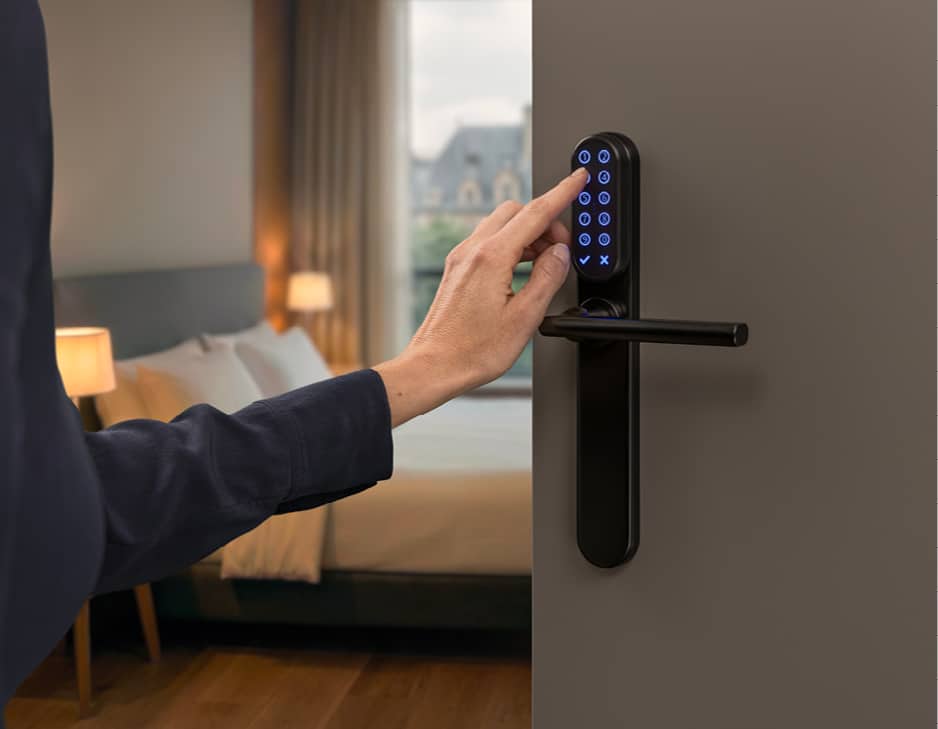
Contactless arrival, round-the-clock access and fewer manual processes at reception: PIN-based locking systems are becoming another building block in the digital transformation of hotels and serviced apartments. TESA Hotel, an ASSA ABLOY brand, is pursuing this approach with time-limited access codes that can be integrated with booking and property-management systems. The technology promises greater convenience and operational efficiency – but it also shifts security requirements far beyond the hotel-room door.
The traditional hotel key has long ceased to be the only way to unlock a guest room. RFID cards and smartphone-based credentials are already commonplace across much of the hospitality sector. Increasingly, however, another option is entering the mix: the temporary PIN code.
The model fits a hospitality industry in which the check-in process is becoming progressively more digital. Travellers – particularly those arriving late, staying for short periods or using serviced apartments and holiday accommodation – increasingly expect flexibility and minimal waiting times. According to the source material, a 2025 survey of 12,000 travellers across 14 European markets pointed to growing demand for seamless, queue-free stays. The Global Hotel Alliance Travel Trends Survey 2026 was also cited as showing that almost 80 per cent of brands were investing in frictionless check-in solutions.
For hotel operators, this creates a delicate balancing act: increasing convenience without sacrificing control over who can enter where, and when.
Replacing the key handover
TESA Hotel’s “Check-In PIN” solution is based on a relatively straightforward process. Before arrival, the guest receives an individual PIN by email. During the booked period, the code provides access to the assigned room and, depending on the permissions configured by the operator, additional areas such as the main entrance, fitness facilities or communal spaces.
There is no need to collect a key or card from reception, nor does the guest have to download an additional app.
That can be particularly relevant for smaller hotels, guest houses, serviced-apartment operators and holiday accommodation, where continuously staffed reception desks may be difficult to justify. Digitally managed access can enable guests to arrive outside conventional reception hours without requiring additional personnel to remain on site around the clock.
Once the scheduled stay has ended, the code automatically expires. If a guest extends the booking, its validity can be adjusted through the hotel management system.
The principle may sound deceptively simple. Yet this simplicity is part of its appeal. Unlike app-based mobile credentials, PIN access does not depend on a compatible smartphone, the installation of dedicated software or the use of a digital wallet.
Access control becomes part of the digital guest journey
The more significant development is not the PIN itself, but the integration of physical access into the hotel’s wider digital infrastructure.
Permissions can be assigned individually and limited in time. A guest could, for example, be authorised to enter an apartment, the main building entrance and a fitness area, while remaining excluded from other parts of the property.
TESA positions the solution as part of a broader hospitality ecosystem. Through application programming interfaces, it can, according to the company, be connected to property-management systems, self-check-in terminals and online booking platforms.
That opens the door to greater automation. A confirmed reservation can potentially trigger the creation of the corresponding access rights without requiring staff to move manually between booking software and a separate locking system. In an optimised environment, booking, access authorisation, stay and check-out become elements of a single process chain.
This is where the real operational value lies. Digitising a single door delivers limited benefits. Integrating access control with the systems that already govern the guest journey can fundamentally change workflows.
Digital credentials create a different security profile
Greater convenience, however, introduces a different set of security questions.
A lost keycard can be disabled. A compromised PIN can likewise be cancelled and replaced. But the characteristics of the credential are different: a numerical code can be copied, forwarded or observed without its legitimate holder immediately becoming aware of the compromise.
Secure implementation therefore depends on more than the electronic lock itself. Codes need to be unique, sufficiently robust and strictly time-limited. Equally important are the procedures used to generate, transmit, store, modify and revoke them.
TESA states that communications between the system and the locks are encrypted and that PIN codes can be revoked immediately if necessary. According to the manufacturer, a lost card or compromised access code can be replaced through the management software while the previous credential is simultaneously disabled.
Compared with conventional mechanical locking systems, digitally managed credentials can therefore avoid situations in which cylinders have to be replaced or an entire locking configuration changed following the loss of a key.
Security no longer ends at the door
For operators, this also means that the security perimeter of a hotel locking system has expanded dramatically.
Once access credentials are sent by email, exchanged through interfaces between different systems and administered centrally, the hotel is no longer dealing only with a physical lock. It is operating an IT-supported access architecture whose security depends on every component in the chain.
Even a highly secure electronic lock offers only limited protection if a guest’s email account has been compromised, staff accounts are weakly protected or vulnerabilities exist in the interfaces linking booking and access-control systems.
Hotels therefore need to consider controls traditionally associated with enterprise IT security alongside physical access protection: strong administrator authentication, clearly defined roles and permissions, reliable audit logging, secure APIs and regular software updates.
Availability is another issue. The more doors and credentials are administered centrally, the more important it becomes to understand what happens when the management platform or communications infrastructure becomes unavailable. Operators need to know which functions continue locally and which contingency procedures apply.
Digital access control is therefore not simply a replacement for a key. It becomes part of the hotel’s business-critical infrastructure.
Wireless technology lowers the retrofit barrier
Security is only one consideration. For existing hotels and apartment buildings, installation costs and operational disruption can be equally decisive.
The compatible electronic fittings offered by TESA are battery-powered and are designed, according to the company, to be retrofitted to many doors without additional cabling. This can be particularly attractive in existing properties where extensive wiring would involve significant construction costs or interruptions to normal operations.
Importantly, the same locking hardware can also support RFID cards and mobile credentials in addition to PINs.
That enables a hybrid model rather than forcing hotels to commit to a single access technology. Some guests may prefer a smartphone key; others may be more comfortable with a traditional card or PIN.
This flexibility is likely to remain important. Digital transformation in hospitality does not necessarily mean eliminating physical credentials entirely. In many cases, the more compelling proposition is a common infrastructure capable of managing several forms of access simultaneously.
PIN access in practice: Harpazul in Galicia
The Harpazul apartment complex in Galicia, Spain, provides an example of how PIN-based access can work in practice.
Guests receive an individual PIN as part of the booking process. It grants access to the complex, authorised communal areas and the relevant apartment, while wireless electronic fittings secure the principal access points.
For the operator, one of the main advantages is the ability to accommodate late arrivals without requiring guests to wait for a physical key handover.
Roi Casal of Harpazul is quoted in the source material as saying that this allows the property to offer guests a better service because they do not have to wait at reception; the access code is simply sent by email.
TESA also notes that the installed devices already support RFID cards and smartphone access, giving the property the option of introducing additional credential types in future.
Harpazul’s strong ratings – 4.7 out of five on Google and 9.5 out of ten on Booking.com, as cited in the source – indicate high overall guest satisfaction. They should not, however, be interpreted as evidence of a direct causal relationship between those ratings and the PIN-based access system.
That distinction matters. Convenience technologies may contribute to the overall guest experience, but hotel satisfaction is shaped by many factors.
Less reception does not mean less responsibility
Automation is sometimes discussed primarily as a means of reducing staffing requirements. From an operational and security perspective, that is too narrow a view.
Digital access does not eliminate work; it changes it. Instead of issuing physical keys, staff must administer permissions, resolve exceptions and respond quickly when technical or security incidents occur.
Alternative processes are also essential for guests. PIN access may eliminate the problem of a forgotten smartphone, but inaccessible email accounts, incorrectly entered codes or technical problems at the door can still require human assistance.
A fully digital check-in process therefore cannot mean leaving guests without a reachable point of contact when something goes wrong.
The strongest digital hospitality concepts will not simply remove the reception desk from the process. They will redefine its role.
From hotel lock to access platform
PIN-based entry ultimately represents a much broader development within hospitality security. Access control is becoming part of a connected digital environment linking reservations, identity, occupancy and building use.
For hotels, the benefits are tangible. Round-the-clock arrivals become easier to organise; physical key and card management can be reduced; and access to different zones of a property can be assigned with far greater granularity. Smaller accommodation providers, in particular, may be able to automate processes that previously required permanent staffing.
Yet convenience and security cannot be considered separately. As access becomes increasingly digital and automated, cybersecurity, protected system interfaces, disciplined credential management and resilient contingency processes become correspondingly more important.
The real innovation, therefore, is not replacing a hotel key with six digits.
It is transforming access into a secure, integrated digital service – one that makes the guest journey simpler without making the operator’s security environment more fragile.

