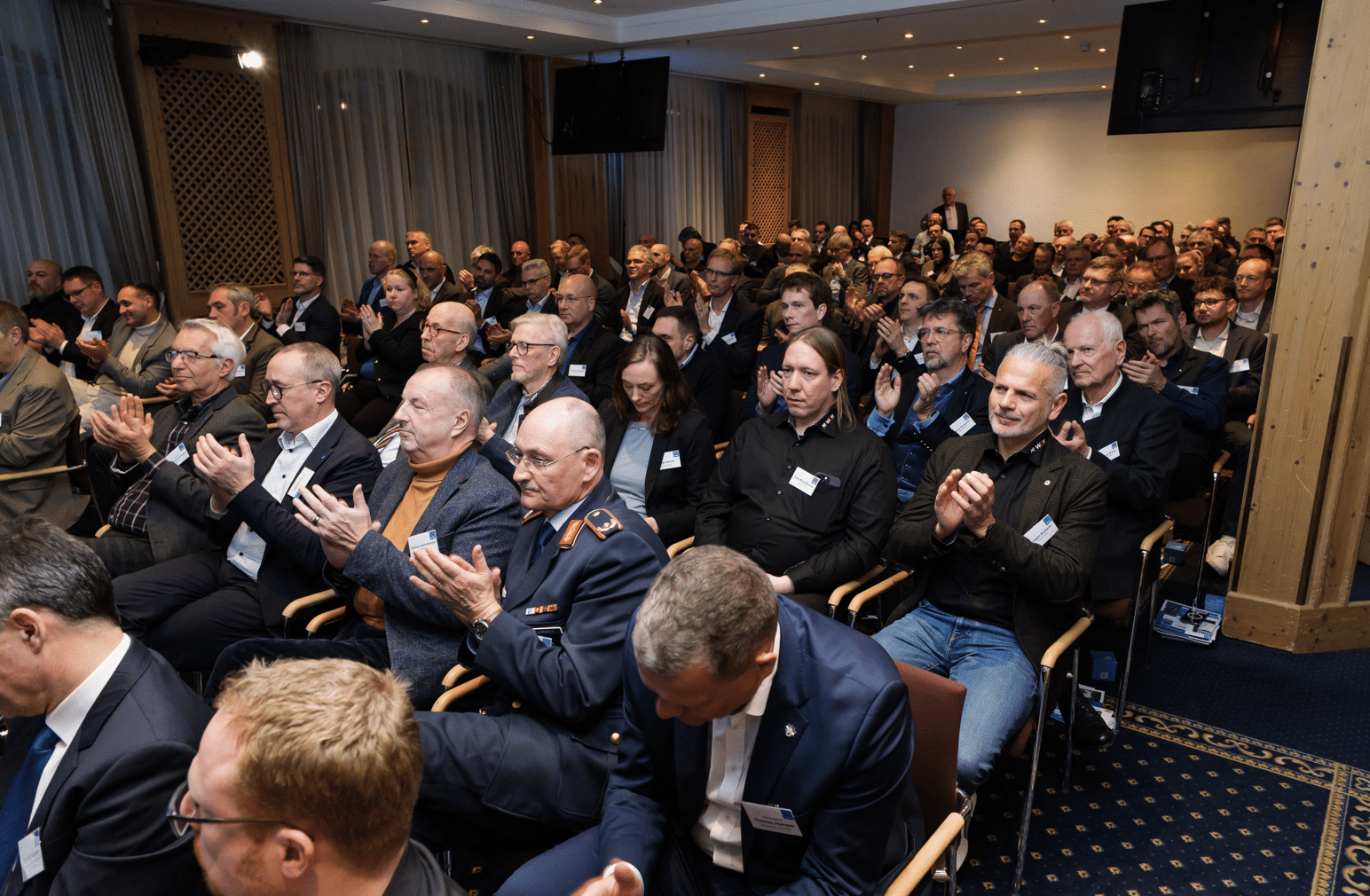
The 14th BVSW Winter Conference took place at Spitzingsee from 11 to 13 March 2026. Over 150 guests from business, government, academia and politics accepted the invitation. The established security congress thus set a new attendance record and, at the same time, highlighted the importance of dialogue and networking in an increasingly volatile security environment.
Hybrid threats, the erosion of strategic alliances and growing geopolitical tensions are currently shaping the security situation in Germany. Every year, the BVSW Winter Conference examines the consequences this has for businesses and society: it brings together different perspectives from government, business and research to provide impetus for potential solutions. “We are delighted that so many outstanding security experts have once again chosen to participate,” says BVSW Managing Director Caroline Eder. “For us, this confirms just how important this format is in times of growing uncertainty.”
A common picture emerged from the twelve presentations: Germany finds itself increasingly caught in the crossfire of rivalry between the US, China and Russia. Hybrid attacks are directed not only against businesses and infrastructure, but increasingly also against democratic processes. Security must therefore be considered holistically today, as an interplay of technological sovereignty, economic resilience and social cohesion.
New challenges arising from the changing security landscape At the start of the conference, Bavarian State Police President Michael Schwald provided an overview of internal security: cybercrime remains one of the greatest threats. However, geopolitical conflicts worldwide also have an impact on security in Bavaria. Although the security situation is objectively stable, subjective unease is on the rise. This is partly attributable to targeted campaigns on social media.
Manfred Hauser, President of the Bavarian State Office for the Protection of the Constitution, confirmed these developments. Germany is increasingly in the crosshairs of foreign powers. He sees growing risks for the scientific community in particular, as cutting-edge technological research is a target of state-sponsored espionage. At the same time, he emphasised the strength of democratic societies: it is crucial to remain aware of this strength and to maintain trust in democratic structures.
Geopolitical power shifts and the consequences for Europe
The second day of the conference began with an overview of the global geopolitical situation by Prof. Dr Gunther Schmid. The world is caught in a systemic conflict between democratic and authoritarian models, according to the political scientist, whilst traditional power structures are eroding. Russia is striving to compensate for the loss of its empire and to be recognised once again as a major power. China is pursuing long-term strategies to redefine the rules of the international order, for example through massive investment in infrastructure and global supply chains. In the US, Donald Trump is increasingly relying on economic pressure to achieve his geopolitical goals. Europe must expand its capacity for action in security policy if it wishes to maintain its role on the global stage, said Dr Schmid.
Vulnerable infrastructure, technological dependencies
Carsten Baeck then demonstrated just how much modern societies depend on functioning infrastructure, using the example of the widespread power cut in Berlin in early 2026. The incident highlighted the far-reaching consequences a single attack on critical systems could have. Companies, too, should therefore identify potential ‘single points of failure’ and ensure redundancies. Clear crisis communication is equally crucial. Furthermore, Baeck called for greater social solidarity in crisis situations, for example through neighbourhood support.
Prof. Dr Timo Kob then turned his attention to Germany’s technological dependencies. Digital sovereignty has so far failed due to a lack of strategies and ambition. Federalism, too, would be an obstacle on the path to cybernation, as would the shortage of skilled workers. Kob advocated for more intensive promotion of STEM subjects in schools, as well as the targeted integration of women into technical professions.
Hybrid threats: a challenge for business and the state
The growing significance of hybrid forms of conflict was the focus of Dr Konstantinos Tsetsos’s presentation. Military conflicts are now increasingly supplemented by other means, such as cyberattacks, disinformation or economic pressure. Resilience is becoming a competitive factor for companies and must be considered holistically. In addition to technical protective measures, organisational and cultural resilience is also required.
Oliver Rolofs built on this analysis and highlighted the structural challenges facing Europe in dealing with hybrid threats. He, too, took a critical view of technological dependencies: instead of digital sovereignty, there is a risk of a kind of “data feudalism”, in which central digital infrastructures are controlled by a handful of players.
Risks in global supply chains
Thorsten Neumann, President and CEO of TAPA EMEA, then spoke about cargo crime, which causes significant damage to the German economy. Perpetrators use a wide variety of methods to steal cargo, ranging from daring attacks on lorries at full speed, to fake delivery addresses and staged police checks. Employees must therefore be made aware of this issue. Companies should also view security measures not merely as a cost factor, but as an investment in their competitiveness.
Security as a task for society as a whole To kick off the third day of the congress, Christina Moritz presented the National Security Council, established in August 2025. The body is intended to facilitate coordinated decision-making on security matters whilst simultaneously improving cooperation between the various ministries. The political scientist argued in favour of involving the business sector more closely, as many security policy challenges can only be overcome through close cooperation between the state and businesses.
Subsequently, Prof. Dr. Nils Goldschmidt, a professor at the University of Tübingen and a member of the German Ethics Council, demonstrated that social cohesion is a prerequisite for economic success. This was empirically proven in a study using data from 171 countries. Social harmony, according to Dr Goldschmidt, is a key economic factor. In the study, Germany ranks 10th in terms of social cohesion and 18th in terms of per capita economic output. A result that is certainly impressive.
This economic success has put Germany in the crosshairs of other nations. Dr May-Britt U. Stumbaum, Director of the Spear Institute, explained how rival major powers are attempting to secure technologies for their own economic success in order to establish a new world order in line with their respective visions. Whilst Germany is dependent in many areas, she noted, it also possesses considerable strengths that must be utilised.
Europe between crises and new responsibilities
Dr Benedikt Franke provided the traditional closing address of the conference with a review of the Munich Security Conference. His analysis painted a picture of an international order in flux. Transatlantic relations will not return to the state they were in before Trump’s second term. Despite many points of criticism, however, Europe possesses considerable potential. What is crucial, however, is the political will to make use of it.
BVSW Winter Conference stands for dialogue and networking
In addition to the fascinating presentations, the BVSW Winter Conference once again offered ample opportunity to discuss and expand one’s network. The date for next year’s summit of the security industry has already been set: the 15th BVSW Winter Conference will take place from 10 to 12 March 2027 – registrations are now open.
Image rights: BVSW e.V.