
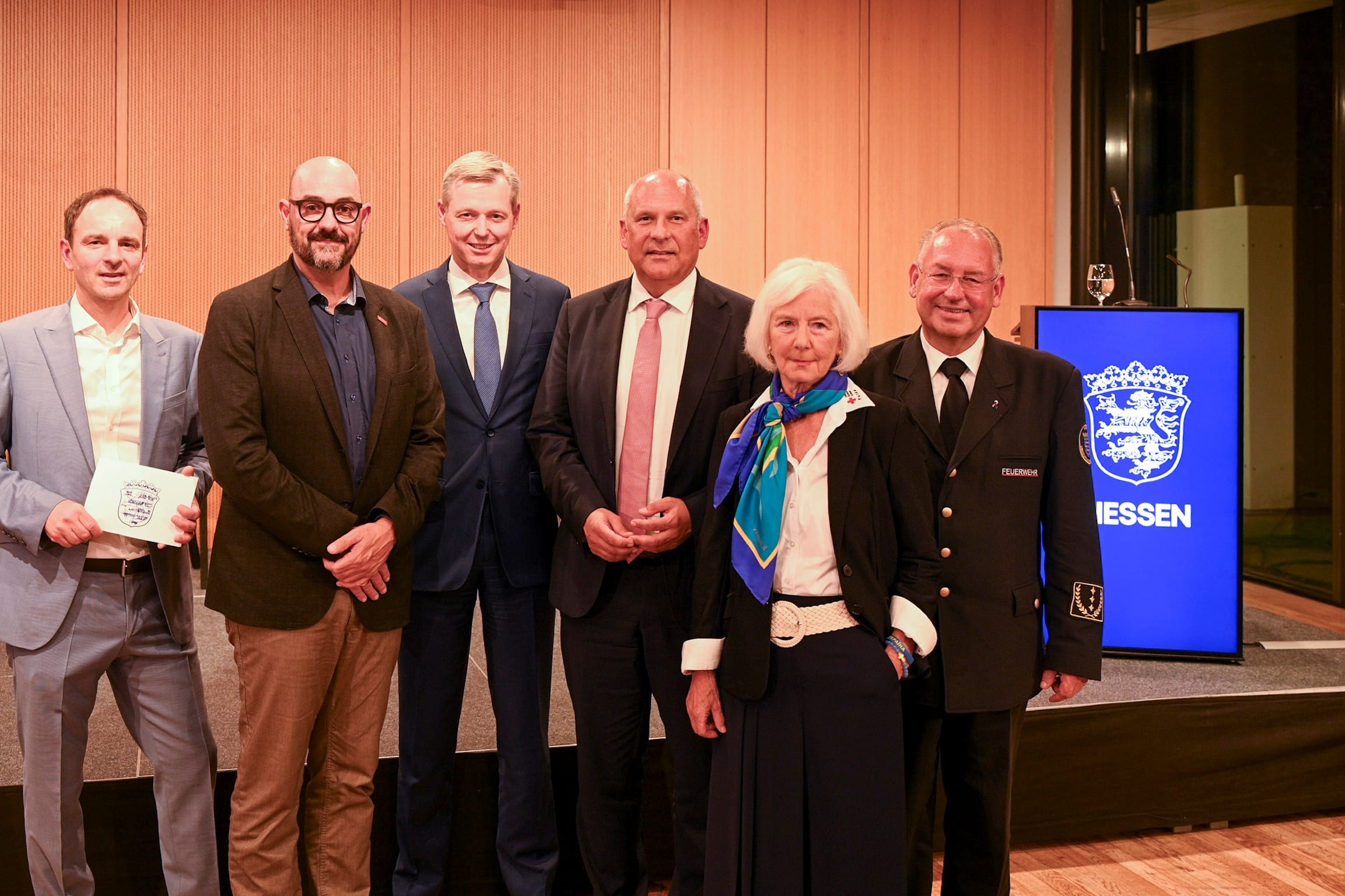
Photo: Civil protection as a shared responsibility: Hesse’s Minister for the Interior, Roman Poseck, together with Donata Freifrau Schenck zu Schweinsberg, former Vice-President of the German Red Cross and President of the Fulda District Association of the German Red Cross, Thomas Silberhorn, Member of the German Bundestag and member of the Bundestag’s Committee on Internal Affairs; Norbert Fischer, President of the Hessian State Fire Service Association; Prof. Dr Lars Gerhold from the Technical University of Braunschweig and Scientific Director of the Public Safety Research Forum; and presenter Gunnar Töpfer from Hessischer Rundfunk.
Hesse is broadening its approach to civil protection: with modern technology, resilient local authorities and greater public involvement, the state aims to further strengthen crisis preparedness. An event organised by the Hessian Ministry of the Interior in Berlin highlighted why civil protection must now be viewed as a task for society as a whole.
Extreme weather, cyber-attacks, power cuts and hybrid threats are changing the demands placed on civil protection. Modern crises rarely follow clear lines of responsibility. A large-scale power cut can, within a short space of time, affect telecommunications, transport, healthcare, water supply, logistics and public administration. Cyber-attacks can disrupt physical infrastructure, whilst extreme weather simultaneously blocks rescue routes and places additional strain on supply systems.
This is also changing the very nature of civil protection. Alongside the immediate response to hazards, the focus is increasingly shifting to the question of how key societal functions can be maintained even under exceptional circumstances.
Under the title “Civil Protection: A Challenge for Society as a Whole”, the Hessian Ministry of the Interior, Security and Home Affairs invited representatives from politics, academia, the fire service and aid organisations to the Hessian State Representation in Berlin on 24 September 2026.
Keynote speeches were delivered by Kai Sauer, the Ambassador of the Republic of Finland in Berlin, and Roman Poseck, Hesse’s Minister for the Interior. The subsequent panel discussion featured Donata Freifrau Schenck zu Schweinsberg, former Vice-President of the German Red Cross and President of the Fulda District Association of the German Red Cross, Thomas Silberhorn, Member of the German Bundestag and member of the Bundestag’s Committee on Internal Affairs; Norbert Fischer, President of the Hessian State Fire Service Association; and Prof. Dr Lars Gerhold from the Technical University of Braunschweig and Scientific Director of the Public Safety Research Forum. The discussion was moderated by Gunnar Töpfer from Hessischer Rundfunk.
Resilience begins before the crisis
The event focused on an understanding of security that goes well beyond traditional disaster response.
For years, Finland has been pursuing a comprehensive approach to societal crisis preparedness. There, state institutions, the business sector and the general public are jointly involved in security and resilience strategies. The approach presented by Ambassador Kai Sauer made it clear: crisis preparedness does not begin only when emergency services are alerted.
Hesse’s Minister for the Interior, Roman Poseck, therefore also emphasised the importance of preparation on the part of the state and society. “The better prepared we are, the stronger we are in an emergency,” he said, summarising the fundamental principle.
For civil protection, this means integrating technical equipment, organisational structures and individual preparedness more closely. Vehicles and emergency generators are just as essential as effective crisis management teams, reliable communication channels and people who know how to respond in the event of an incident.
Hesse expands technical preparedness
Hesse has significantly expanded its fire and disaster response capabilities in recent years. According to the state, more than 100 million euros have been invested in equipment and modernisation since 2008. The number of state-owned vehicles has risen from fewer than 300 to around 900.
The technical equipment is tailored to a range of hazard scenarios. Vehicles with high off-road capability, for example, can be deployed during floods and heavy rainfall events. Mobile emergency generators and large-scale power generators are designed to enable the operation of relief centres, amongst other things, during prolonged power cuts.
The energy supply for the emergency services themselves is becoming particularly important. Every district in Hesse has state-provided emergency power systems. Since 2020, Hesse has also been funding the installation of emergency power systems in fire stations.
This enables fire stations to take on an additional role in a large-scale crisis: as well as maintaining operational readiness, they can serve as contact points for the public.
This development highlights how the requirements placed on emergency services are changing. What is required is not merely their operational capability under normal conditions, but increasingly their ability to function when supply systems are disrupted.
Warning is more than just an alarm
Another key component of resilient structures is a robust warning infrastructure. Hesse was the first federal state to support the conversion of all sirens to TETRA digital radio. The sirens can be triggered within one to two seconds and can, in principle, be controlled from any of the 25 central control centres in every municipality in Hesse.
However, technical speed alone does not guarantee an effective warning.
It is crucial that information reaches the public even when individual communication channels fail. Different warning channels must therefore work together as reliably as possible.
At the same time, a warning must be understood. Citizens must know what warning messages mean, where they can obtain reliable further information, and what measures are required in a specific situation.
As a result, warning is increasingly becoming a communicative task rather than a purely technical one.
80,000 emergency personnel support the system
Technical equipment can only be effective if the necessary personnel structures are also in place. Around 80,000 emergency service personnel are involved in fire and disaster management in Hesse. Some 23,000 people in Hesse serve as volunteers in the state’s approximately 800 disaster management units.
Large-scale or protracted emergency situations, in particular, place special demands on personnel’s ability to sustain their efforts.
It is not solely the number of available resources that determines a system’s effectiveness. Vehicles must be manned, command centres operated, emergency personnel relieved, and logistics and supplies guaranteed over extended periods.
Civil protection therefore relies to a particular extent on resilient voluntary structures. Hesse invests around 3.2 million euros annually in fostering a culture of recognition within fire and disaster response services.
Crisis management teams as a central interface
In complex crises, it is often not the effectiveness of a single organisation that is decisive, but rather the coordination of many different actors.
Fire services, emergency medical services, aid organisations, public authorities and operators of critical infrastructure each have their own areas of responsibility and information. In the event of a crisis, however, this must lead as quickly as possible to a shared understanding of the situation and coordinated decisions.
This is precisely where civil protection and administrative task forces play a central role.
Framework recommendations and special protection plans are designed to support Hessian local authorities in their crisis preparedness. By the end of 2026, the civil protection and administrative task forces of all 21 districts and six independent cities are also expected to have completed the state-wide training programme.
In November 2026, Hesse will also take part as a participating state in the tenth cross-state and cross-departmental crisis management exercise LÜKEX. The ‘drought and heat’ scenario highlights that modern crisis preparedness must increasingly take into account long-lasting and cross-sectoral pressures.
Such exercises test the interfaces in particular: how quickly can a reliable picture of the situation be established? What information do other stakeholders require? Who decides on priorities? And how are decisions subsequently translated into concrete measures?
Resilience is determined at local level
With KOMPASS Resilience, Hesse aims to embed resilience more firmly at local authority level. Local authorities are to be given practical support in further developing their crisis preparedness. According to the Minister for the Interior, six local authorities have already been included in the programme; others have expressed an interest.
The local level is of particular importance for crisis preparedness. It is here that specific decisions must be made regarding which facilities can continue to operate in the event of a power cut, where emergency centres for the public will be set up, and which communication channels will remain available even if regular systems fail.
Municipal resilience is thus increasingly becoming a planning task in its own right.
The focus here is less on having a separate contingency plan for every conceivable scenario. What is crucial, rather, are structures that function under a variety of conditions: emergency power supplies, resilient communication systems, clear lines of responsibility and prepared leadership structures.
Personal preparedness strengthens one’s ability to act
Finally, the general public itself is also part of society-wide crisis preparedness.
Those who can correctly assess warning messages, keep an adequate supply of essentials to hand and know how to respond – for example, in the event of a prolonged power cut – initially increase their own capacity to act. Looking out for people in need within one’s immediate circle can also make an important contribution in an emergency.
Personal preparedness also has a systemic effect.
Even in a crisis, professional emergency services have only limited resources at their disposal. The more people who can initially cope with short-term disruptions to supplies themselves, the more emergency services can focus on acute dangers and on those who are genuinely in need of assistance.
Personal preparedness therefore does not replace state crisis preparedness; it complements it.
Civil protection is becoming a systemic task
The central challenge of modern civil protection increasingly lies between the individual systems.
An efficient fire service alone does not ensure societal resilience. Nor are emergency generators, warning systems or contingency plans sufficient on their own.
What matters is whether authorities, emergency services, local authorities, critical infrastructure and the public can function effectively together, even under difficult conditions. Technical equipment must lead to operational capability; information must result in a shared situational picture; and warnings must prompt concrete action.
This interconnection becomes a decisive factor, particularly in the case of complex and overlapping crises.
Civil protection is thus evolving from a predominantly reactive hazard response into an strategic preparedness task. The measures taken in Hesse demonstrate that technical investments, training, local resilience and individual preparedness cannot be considered in isolation from one another.
Not every crisis can be prevented. However, its consequences depend largely on how well structures are prepared, how long key functions can be maintained, and how quickly a society can respond to disruptions.
Or, as Roman Poseck put it in Berlin: “The better prepared we are, the stronger we are in an emergency.”

