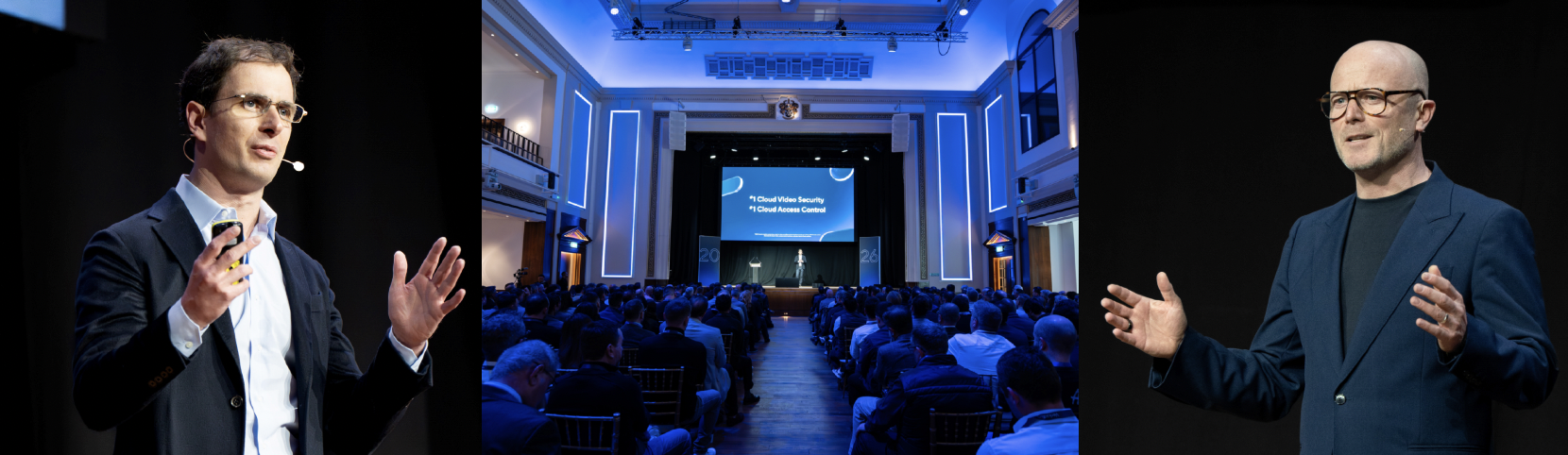
Verkada is driving the transformation of the security industry
From fragmented systems to a data-driven platform: how artificial intelligence is displacing existing security architectures and establishing new market dynamics
The physical security industry is currently not undergoing incremental development, but rather a form of ‘creative destruction’ in Schumpeter’s sense – triggered by advances in artificial intelligence, particularly in the fields of computer vision and data-driven analysis. Whilst traditional systems are based on deterministic rules, isolated data sources and reactive processes, AI-supported architectures enable, for the first time, the continuous, context-based interpretation of physical environments in real time. Security is thus evolving from a downstream control function into a proactive, predictive, data-driven management tool.
By the time of the VerkadaOne event in London in March 2026 at the latest, it will be clear that this transformation is no longer abstract. Rather, a new paradigm is emerging in which platforms, data and AI represent the key value-creating factors – and are gradually displacing existing market structures.
Global expansion: scaling as a prerequisite for AI-driven disruption
Verkada is driving its international expansion at a rapid pace – with new offices in the US and an international hub in Dubai. This development follows not so much traditional expansion logic as the need to meet the growing demands for modern solutions in the areas of safety, security and operational processes.
Verkada serves over 31,000 customers, has more than two million devices in 171 countries and operates a platform that processes hundreds of millions of image data points per hour at peak times.
The direction is also clearly defined from a strategic perspective. “The platform must be open – we want to integrate as many applications as possible, whether from the customer’s environment or from other system ecosystems,” explains Benjamin Krebs. This openness is central to modern systems. A retailer using Verkada no longer needs to switch between separate systems. Instead, video data and alarm information can be linked directly to till transactions. If, for example, a fraudulent chargeback occurs, the relevant video footage is immediately available in the correct context – without the need for time-consuming follow-up research.
This philosophy of openness is also aimed at customers who are not starting from scratch. With the Command Connector – a specially developed hardware solution – third-party cameras can be integrated into Verkada’s cloud-based Command platform. This creates a viable migration path, particularly for large enterprises with established infrastructure, without the need to completely replace existing systems. This is complemented by an extensive library of API interfaces and ready-to-use integrations, which prevent Command from becoming a closed ecosystem. Instead, the platform can work seamlessly with the tools and applications already in place within the organisation.
The financial figures – 30 per cent revenue growth in the last financial year and a valuation of US$5.8 billion – underscore this: security is becoming a data-driven platform economy.
AI as a disruptor: from surveillance to intelligent decision-making logic
The real creative destruction is unfolding at the level of functionality. AI is not only changing processes – it is redefining the role of security systems.
Since its foundation, Verkada has been investing specifically in computer vision and AI. Applications such as semantic search or automated behavioural analysis make it possible to record events not only faster, but in a qualitatively different way. Systems recognise patterns, prioritise risks and provide a basis for decision-making in real time.
For Krebs, it is clear: “The whole AI and computer vision topic is the next step in evolution – and we are currently seeing that this very topic is massively accelerating development.” The figures bear out this momentum: over 170 new AI features in a single year and investments of more than 250 million US dollars show that this is not incremental progress, but a systematic transformation. At the same time, the role of humans is changing. Security managers are increasingly working with pre-structured information rather than raw data. Or, to put it more bluntly: the machine recognises – the human decides.
Platform and Cloud: The infrastructural foundation of disruption
The disruptive impact of AI only unfolds through the right infrastructure. Traditional on-premises systems are structurally unsuitable for this – too complex, too fragmented and too maintenance-intensive.
Krebs sums it up pragmatically: “In the end, you’re often not managing a single system, but a whole zoo of servers, databases and clients – and spending hundreds of hours a year just ensuring everything runs smoothly.”
The answer lies in a cloud-based platform architecture. It reduces complexity, automates processes and lays the groundwork for centralised data aggregation – which in turn is a prerequisite for high-performance AI.
This also redefines the role of IT. “We are a modern security company with strong roots in IT. Our contacts range from security departments right into the heart of IT, and we are seeing an increasingly close integration of both areas. With the growing importance of computer vision, the relevance of IT and specialist end-users continues to rise,” says Krebs.
The integration of various systems – from video and access control to business applications – is thus becoming a strategic necessity. Security is no longer viewed in isolation, but as part of a networked digital infrastructure.
Europe and the DACH region: Between caution and growing pressure to transform
Whilst Verkada is scaling globally, a more nuanced picture is emerging in Europe. The adoption of new technologies is proceeding more slowly – particularly in the DACH region.
Krebs puts it bluntly, yet with nuance: “We Germans aren’t always the quickest to adopt technology – many companies are still working on the first two steps: cloud and platform.”
At the same time, it is clear that AI acts as a catalyst. As soon as concrete use cases become apparent, the willingness to transform increases significantly.
Regulation is an additional driver. Issues such as NIS2 are increasing the pressure on companies to make security processes traceable and audit-proof. “I have to report within 24 hours – and then properly document what happened. That’s hardly feasible with old technology,” says Krebs.
The go-to-market model is also changing. Verkada deliberately focuses on partner structures rather than purely direct business: “We don’t grow simply by hiring more people. We are building an ecosystem that functions sustainably and is profitable for all involved.”
This strategy aims to secure long-term scalability and market penetration – particularly in a market undergoing structural change.
Conclusion: Creative destruction as the new market logic
Developments surrounding the Verkada One clearly demonstrate that the security industry is undergoing a process of creative destruction. Artificial intelligence is displacing existing technologies and establishing new market logics.
Verkada is positioning itself as a driver of this transformation – with a clear strategy of global scaling, platform integration and massive AI investment.
For Europe, and particularly in the DACH region, this results in a clear call to action: transformation is not optional.
Or, as Krebs puts it: “Now that we’ve seen the model works, we’re moving on to the next phase – scaling. And this is precisely where it will be decided who will be among the frontrunners in the future.”
The message is clear: artificial intelligence isn’t just changing the security industry – it’s fundamentally redefining it.