German drugstore chain dm is among the first major retailers in the country to introduce the European payment solution Wero in e-commerce. Payments are processed directly between bank accounts via SEPA Instant Credit Transfers, without the need for a credit card. The move highlights the growing push to establish a European-controlled payment infrastructure for digital commerce.
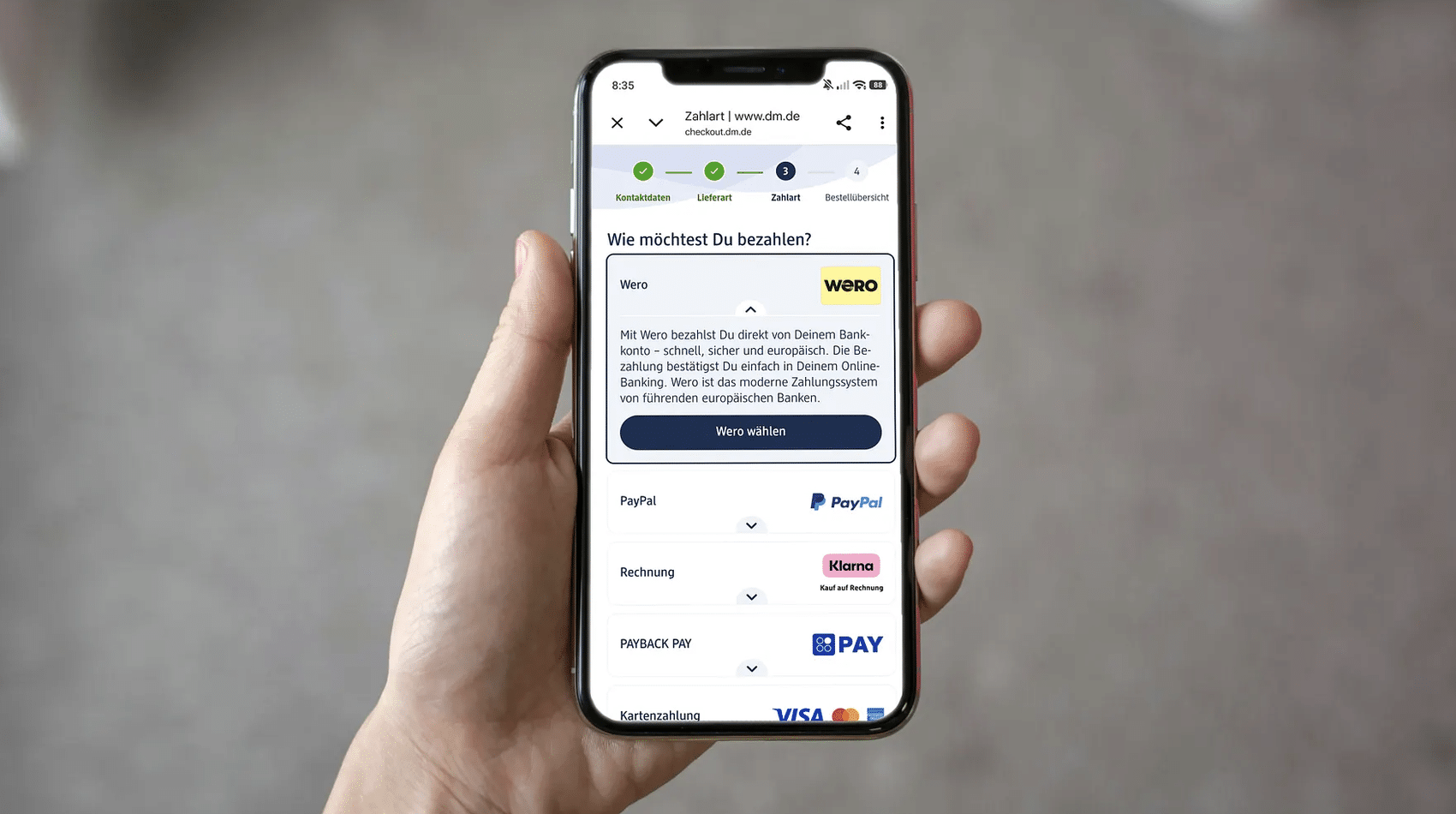
Customers shopping at dm’s German online store can now pay using Wero. The drugstore chain has added the account-to-account payment method to its checkout and says it is among the first major German retailers to deploy the European solution in e-commerce.
Wero is the digital payment service developed by the European Payments Initiative (EPI). The technical integration into dm’s online shop was implemented together with payment service provider Nexi. For Wero, securing a retailer with dm’s market reach represents another step in its development from a peer-to-peer payment service into a broader European payment platform.
“By introducing Wero, we are expanding our existing offering with another modern and European payment option,” said Martin Dallmeier, Managing Director Finance and Controlling at dm. According to Dallmeier, the future of payments will not be shaped by one single solution, but by the interaction of European and international payment infrastructures, digital wallets and AI-supported shopping experiences.
With its early adoption of Wero, dm says it wants to respond to a development that could become increasingly important for European e-commerce over the coming years.
Direct payments between bank accounts
Customers selecting Wero during checkout are redirected to the application of their participating bank, where the transaction is confirmed. No credit card is required. Instead, the amount is transferred directly from the customer’s linked bank account to the merchant.
The underlying infrastructure is based on SEPA Instant Credit Transfers. Transactions therefore take place within the European banking infrastructure and under European data-protection requirements.
The account-to-account approach can also reduce the number of intermediaries involved in the payment chain. For retailers, however, the success of any new payment method depends not only on the underlying technology but also on how smoothly it can be integrated into existing checkout, settlement and accounting processes.
Nexi provides the merchant-side acceptance infrastructure for dm. According to the payment service provider, dm is already the fourth major retailer it has connected to Wero.
“For a new payment method to succeed, it is essential that it becomes available at relevant merchants and is easy for consumers to use in everyday life,” said Thomas Spreitzer, CEO of Nexi DACH. The rollout at dm, he added, demonstrates that Wero is increasingly moving from infrastructure development into practical use in German e-commerce.
European alternative gains commercial relevance
The European Payments Initiative is developing Wero as a unified European payment solution for consumers and businesses. The initiative is backed by 16 European banks and payment service providers, with more than 50 financial institutions now involved in the wider ecosystem.
“The introduction of Wero at dm is another important step in expanding Wero within German e-commerce,” said EPI CEO Martina Weimert. Cooperation between banks, payment providers and merchants would be essential, she said, to establish a competitive European payments ecosystem.
The significance of that effort extends beyond the introduction of another checkout option. Europe’s digital payment market continues to depend heavily on international card schemes and global technology platforms. A successful European account-to-account infrastructure could therefore strengthen competition while giving banks, merchants and consumers an additional payment route operated within the European financial ecosystem.
For security and resilience strategies, the development is also noteworthy because payment infrastructures are increasingly part of the wider discussion surrounding European digital sovereignty. The ability to process transactions through European banking rails, while maintaining interoperability and regulatory compliance, is becoming a strategic consideration alongside convenience and transaction speed.
Wero expands beyond peer-to-peer payments
Wero has been available for payments between private individuals in Germany, France and Belgium since 2024. According to EPI, the service currently reaches around 58 million users.
The payment system entered German e-commerce at the end of 2025, while expansion of online merchant payments in France and Belgium is scheduled to continue during 2026.
EPI also plans to migrate existing national payment solutions into the Wero platform. Payconiq in Luxembourg is due to be integrated by 2026, while the Dutch payment system iDEAL is expected to transition by 2027.
Payments at physical points of sale are also planned for 2026. Further functions on the roadmap include integration with loyalty programmes, recurring payments and subscription management.
The dm rollout therefore marks more than the addition of another payment button. It provides Wero with visibility at a major German retailer and demonstrates how Europe’s emerging account-to-account infrastructure is beginning to move into mainstream digital commerce.
Further information: www.dm.de, www.wero-wallet.eu and www.epicompany.eu