
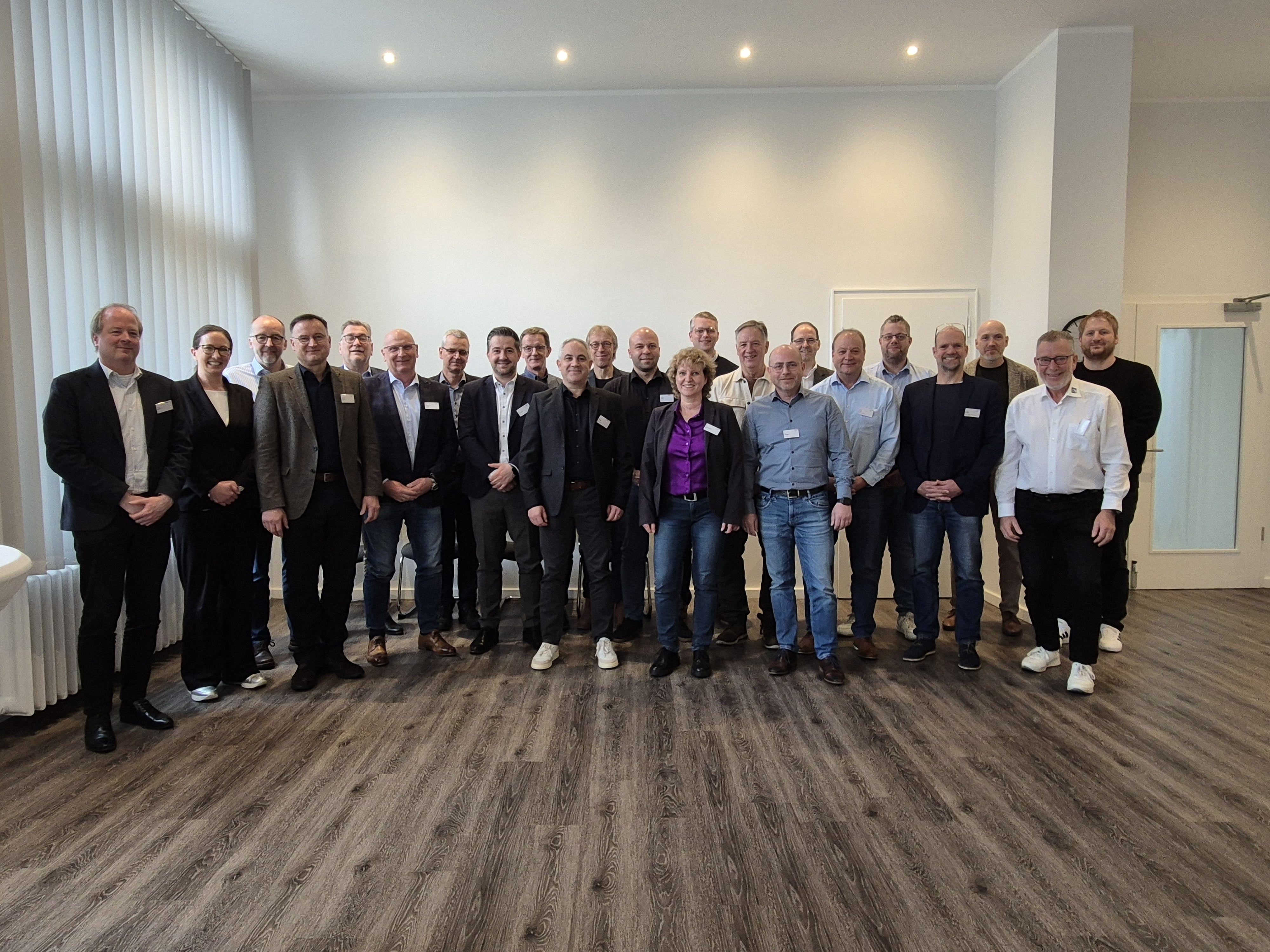
The demands on the construction and supply industries are growing – not least due to increasing regulation at European level. Against this backdrop, the Technical Committee of the Association of the Wood-Based Materials and Interior Doors Industry (VHI) and door hardware manufacturers from the Professional Association of the Lock and Hardware Industry (FVSB) met on 13 March 2026 for a joint discussion. A total of 22 representatives from both associations gathered at the FVSB’s headquarters in Velbert – naturally in compliance with all relevant regulations.
The meeting focused on key regulatory issues that currently affect both sectors equally and will have a significant impact in the future. These include, in particular, the Construction Products Regulation (CPR), the Digital Product Passport and the planned EU Packaging Regulation (PPWR). These regulations exemplify the increasing demands for transparency, sustainability and traceability throughout the entire value chain.
It became particularly clear here that the challenges cannot be viewed in isolation. Rather, they affect both interior door manufacturers and the hardware industry in a comparable manner. Accordingly, a central focus of the discussion was on how closer cooperation can unlock synergies – for example, in the interpretation of regulatory requirements, the development of common positions, or practical implementation within companies.
There was agreement that, in future, national and European regulatory initiatives can only be efficiently tackled by working in close cooperation. The increasing complexity of requirements – from digital product information to sustainable packaging solutions – calls for coordinated strategies across the entire sector. The discussion made it clear that both sectors not only share similar challenges but can also benefit from stronger networking.
Furthermore, the meeting underscored the importance of direct dialogue within the value chain. It is precisely at the interfaces between door systems and hardware technology that key requirements regarding functionality, safety and compliance with standards arise. Personal dialogue enables a better understanding of these interfaces and the joint development of solutions that meet both technical and regulatory requirements.
The meeting in Velbert thus marks more than just a one-off exchange. It is seen as the start of closer cooperation between VHI and FVSB, which is set to be further expanded in the future. The aim is to make the industry as a whole more resilient and to find joint responses to the challenges of transformation.
The key insight from the meeting can be succinctly summarised as follows: cooperation is no longer an optional approach, but a strategic necessity. Or, as it was put by the participants: together, we can achieve more.

