Roman Poseck: “The Conference of Interior Ministers in Hamburg has adopted important resolutions for a safe and resilient Germany.”
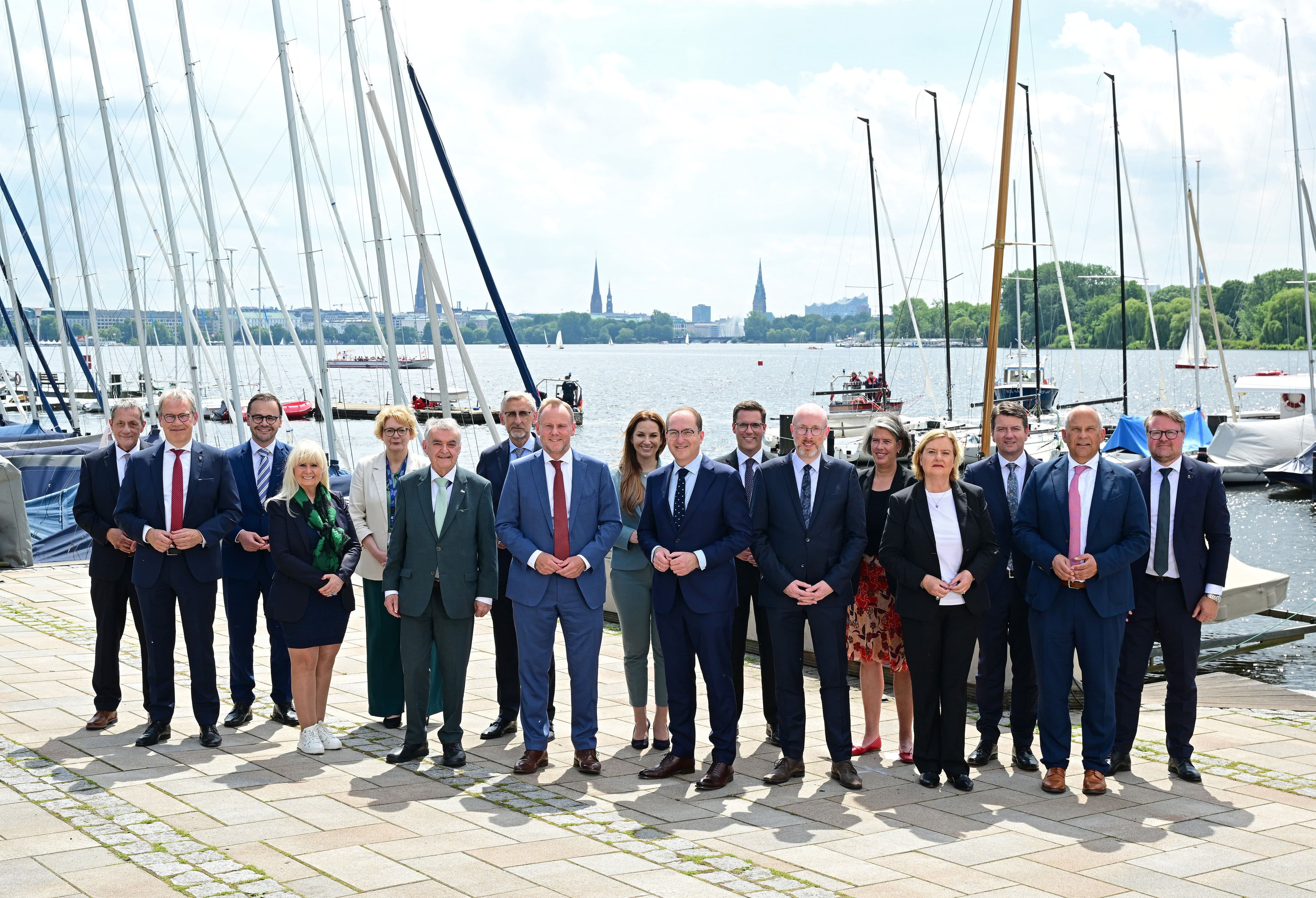
The Conference of Interior Ministers met in Hamburg from 17 to 19 June. Following the conference, Hesse’s Interior Minister Roman Poseck commented on the decisions as follows:
“The initiatives put forward by Hesse at the Conference of Interior Ministers were overwhelmingly successful. This applies, for example, to stepping up the fight against left-wing extremism. We agree in our assessment that left-wing extremism is becoming more widespread and dangerous. Attacks on the electricity supply in Berlin and Reutlingen are prime examples of this. We have agreed that all legal options for a complete ban on the left-wing extremist portal “indymedia.org” are to be examined and implemented. The security authorities are to cooperate closely with their international partners to combat left-wing extremist networks operating across borders, and the instrument of entry and exit bans is also to be utilised. Furthermore, the IMK has asked the BMI to present an up-to-date “Federal Assessment of Violence-Oriented Left-Wing Extremism”, which sets out, in particular, current developments, networking structures and mobilisation potential within the scene.
The Hessian initiative to track the mobile phones of individuals required to leave the country but who cannot be deported because they have gone into hiding has also met with approval. We agree that this instrument can be a suitable means of enforcing departure obligations more effectively. Specifically, the BMI is to establish a legal basis for special surveillance and search measures.
The Conference of Interior Ministers also discussed the future handling of Syrian refugees. The discussions were characterised by a fundamental consensus that, in the long term, deportations to Syria should once again be made possible – particularly for criminals and individuals posing a threat – and that, in addition, voluntary repatriation should be encouraged even with modest financial support. Differing views emerged regarding the treatment of well-integrated Syrian refugees who do not yet have a permanent right of residence. I am sceptical about residence permits that go beyond the scope of current law. These, in turn, can create false incentives. The protection granted to Syrian war refugees was, in principle, intended to be temporary and certainly not designed to facilitate immigration.
The Conference of Interior Ministers also reaffirmed its critical stance on the effects of the partial legalisation of cannabis and, following a motion by Hesse, resolved that the high thresholds for cannabis possession should be reduced. In addition, we agreed that partial legalisation has led to significant restrictions within the framework of criminal law and criminal procedure. The Federal Ministry of the Interior (BMI) and the Federal Ministry of Justice and Consumer Protection (BM-JV) should therefore now swiftly examine a legislative amendment to restore effective criminal prosecution in relation to cannabis offences.
Furthermore, landmark decisions were taken on civil protection. The Pact for Civil Protection underlines the federal government’s financial responsibility. All Ministers of the Interior welcome the fact that the federal government is investing 10.2 billion euros for the period 2025 to 2029. In addition, there is 3 billion euros for the Federal Agency for Technical Relief. Equally, further efforts – including financial ones – are required to tackle the major challenges. To complement the 10 billion euros, a further 20 billion euros must be earmarked for cross-departmental tasks in civil defence. Looking ahead, the IMK is aiming for a target allocation of up to 10 per cent of all investment made for military defence purposes to be directed towards civil defence, including civil protection.
In my view, we have struck the right balance with our decisions on football. We are unequivocally committed to ensuring that football matches are free from violence and pyrotechnics. In doing so, we continue to seek dialogue with the clubs and the governing bodies. For example, I have spoken out against personalised tickets as the norm. In my view, the benefits and the effort involved are not in the right proportion. On the one hand, this leads to delays in gaining access to the stadium; on the other hand, criminal offences in stadiums generally take place after individuals have already covered their faces. Personalised ticketing appears to be a measure worth discussing only as a targeted measure for individual matches, particularly in connection with sanctions and conditions imposed by sports tribunals. It is unsuitable as a blanket tool for ensuring safe football matches.
Overall, I view the outcomes of the Hamburg conference very positively. The Conference of Interior Ministers has once again taken important decisions to ensure a safe and resilient Germany.”
Next year, Hesse will take over the chairmanship of the Conference of Interior Ministers. A spring meeting in Wiesbaden and an autumn meeting in Marburg are planned.