
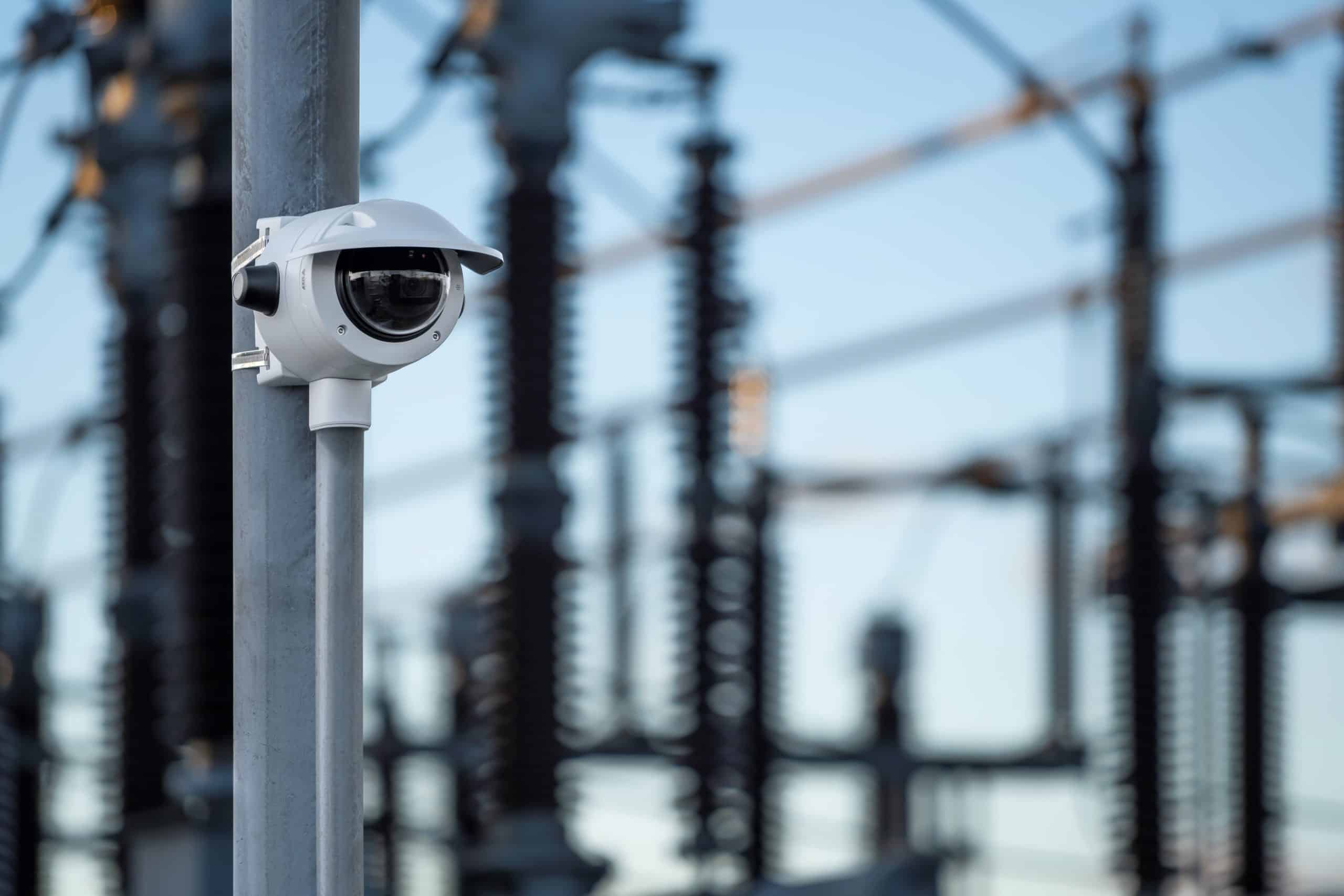
Axis Communications is extending the reach of network video into private 4G and 5G environments with the new AXIS TP3604-E Cellular Back Box. Designed for selected AXIS P32 and AXIS P14 cameras, the solution enables organisations to deploy high-performance video surveillance wherever private cellular coverage and power are available – without the cost and complexity of extending conventional wired network infrastructure.
Ismaning, 18 August 2026 – Private cellular networks are emerging as an increasingly important component of digital infrastructure across industrial sites, logistics hubs, transport environments, healthcare facilities and smart-city applications. Their appeal lies not simply in wireless connectivity, but in the degree of control they offer organisations over coverage, bandwidth, latency, device authentication and network access.
Axis Communications is now targeting this infrastructure layer with the AXIS TP3604-E Cellular Back Box, a new solution for connecting compatible network cameras directly to private 4G and 5G networks, or Private Cellular Networks (PCNs).
The concept addresses a persistent challenge in large-scale and geographically complex security installations: cameras are often required precisely where conventional network connectivity is difficult or expensive to provide. Extending fibre or Ethernet connections across industrial compounds, ports, logistics yards or other outdoor environments can involve substantial civil engineering work, trenching and additional installation costs.
By moving the network connection into the cellular domain, the TP3604-E allows system designers to position cameras according to operational security requirements rather than the limitations of existing cabling.
Private 5G as an infrastructure layer for physical security
The growing relevance of private cellular networks has significant implications for video surveillance. Unlike public mobile networks, PCNs are operated for a defined organisation or site and can provide dedicated network capacity, controlled device access and predictable performance characteristics.
Devices are authorised to access the network via SIM-based authentication, enabling organisations to maintain tighter control over which endpoints communicate within the infrastructure. In environments where video, IoT sensors and AI-enabled devices generate large volumes of data, this combination of dedicated bandwidth and controlled connectivity can become particularly valuable.
For security operators, private 4G and 5G networks can therefore provide an alternative transport layer for high-resolution video and edge analytics in locations where traditional LAN infrastructure is impractical.
The AXIS TP3604-E is designed to bridge these two worlds. Compatible AXIS P32 and AXIS P14 cameras can be mounted directly onto the unit and connected to an existing private cellular network through a PCN SIM card.
Extending edge intelligence beyond the wired network
The significance of the approach extends beyond wireless video transmission. Axis has designed the TP3604-E to integrate with its wider technology ecosystem, including AXIS OS and cameras based on the company’s ARTPEC-9 system-on-chip.
This means that functions normally associated with wired IP-camera installations – including high-quality video processing and AI-supported analytics at the edge – can also be deployed in private cellular environments.
Processing analytics locally on the device is especially relevant for bandwidth-intensive security applications. Instead of relying exclusively on centralised processing, selected data can be analysed close to the point of capture. This can reduce unnecessary data transmission while enabling security systems to respond more rapidly to relevant events.
The result is a deployment architecture in which cellular connectivity does not necessarily mean sacrificing the capabilities expected from an advanced network-video platform.
Installation without extensive network construction
One of the principal advantages of the TP3604-E is its potential to reduce the physical infrastructure required for camera deployment.
Where private cellular coverage is available, the primary remaining requirement is power. The unit supports both Power over Ethernet (PoE) and DC power, giving installers additional flexibility when adapting the system to existing site infrastructure.
Deployment itself is deliberately straightforward. A PCN SIM card is inserted into the back box to authenticate the device within the private cellular network. The compatible camera is then installed directly onto the unit, creating a compact and protected assembly.
This architecture opens up deployment possibilities in areas where running additional network cabling would otherwise be disproportionately expensive or disruptive. Typical environments could include extensive industrial premises, transport infrastructure, logistics areas, perimeter zones and other remote outdoor locations.
For organisations expanding existing surveillance systems, this may also change the economics of adding individual cameras. Instead of extending the physical network to every new surveillance point, cameras can be introduced wherever private cellular coverage already exists.
Keeping video traffic inside the private network
Wireless connectivity inevitably raises questions about cybersecurity and data sovereignty. Axis therefore emphasises that communication through the TP3604-E takes place within the organisation’s private cellular infrastructure rather than via a public mobile network.
The solution also incorporates the company’s Axis Edge Vault hardware-based cybersecurity platform. Edge Vault is designed to protect device integrity and secure cryptographic operations and credentials. According to Axis, cryptographic keys can be stored and managed in an environment certified to FIPS 140-3 Level 3.
This combination of SIM-based network authentication and hardware-supported device security is particularly relevant for critical and security-sensitive environments, where connectivity itself forms part of the overall security architecture.
The approach reflects a broader development within physical security: cameras, analytics platforms and communication infrastructure can no longer be considered as isolated system components. As video systems become increasingly software-defined and interconnected, cybersecurity has to be designed into the complete architecture from device identity to network transport.
Fibre-like performance without fibre deployment
For professional video surveillance, wireless flexibility is only useful if network performance can support demanding video workloads. Axis says the TP3604-E provides high uplink performance, low latency and sufficient bandwidth to deliver video quality comparable with fibre or Wi-Fi-based connections, depending on the underlying private cellular infrastructure.
This is particularly significant because surveillance applications are unusual from a mobile-network perspective: cameras continuously generate substantial upstream traffic. Reliable uplink capacity is therefore often more important than the high downstream speeds commonly associated with consumer 5G services.
Private cellular networks can be engineered around precisely these requirements. Dedicated spectrum resources, controlled device populations and site-specific network planning can help organisations design connectivity around the actual operational workload.
For large security installations, this may make private 5G an increasingly credible complement to wired infrastructure rather than merely a backup communication channel.
Designed for demanding outdoor environments
The TP3604-E has also been engineered for outdoor deployment. Its enclosure is rated IP66 for protection against dust and water ingress and IK10 for resistance against mechanical impact.
These characteristics broaden its potential use in industrial and exposed environments where both network availability and physical durability are critical.
“Private 5G mobile networks are increasingly becoming essential infrastructure for security applications that require maximum control and data security,” says Benjamin Körner, Manager Strategic Accounts and A&Es DACH at Axis Communications.
“With the AXIS TP3604-E, we are significantly lowering the barriers to adopting this technology. We enable our customers to extend their security networks wherever this is strategically necessary, rather than where the existing infrastructure makes deployment easiest. This not only saves time and installation costs, but also provides a future-proof and scalable foundation for video analytics across multiple locations.”
A new degree of freedom in camera placement
The broader importance of the AXIS TP3604-E lies in the flexibility it introduces into surveillance-system design.
Traditionally, decisions about camera positioning have often been influenced by the availability of network infrastructure. Private cellular connectivity has the potential to weaken that dependency. If secure 4G or 5G coverage already exists, network video can follow the operational requirement rather than the cable route.
For industrial operators, logistics providers, transport organisations and other users managing extensive sites, that distinction can be significant. It allows existing private mobile infrastructure to serve not only operational communications and IoT applications, but increasingly physical-security systems as well.
The launch also illustrates how the boundaries between network infrastructure, video surveillance and edge computing are continuing to converge. Private 5G is becoming more than a connectivity technology: in suitable environments, it can form part of the underlying architecture on which distributed, intelligent security systems are built.
AXIS TP3604-E Cellular Back Box at a glance
- Designed for operation within private cellular networks
- Supports integration of selected AXIS P32 and AXIS P14 cameras
- Compatible with private 4G and 5G infrastructure
- SIM-based authentication for controlled network access
- High uplink performance for video transmission
- Support for edge-based video analytics
- Power via PoE or DC
- Axis Edge Vault hardware-based cybersecurity
- IP66-rated weather protection
- IK10-rated impact resistance
The AXIS TP3604-E Cellular Back Box is available immediately.

