
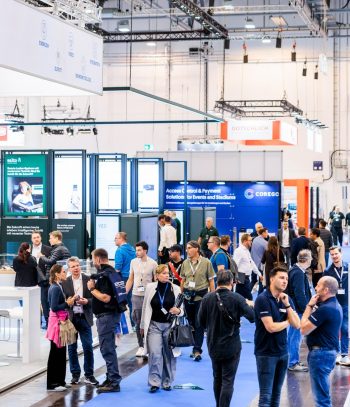
How Security Essen 2026 is repositioning itself as a reflection of an industry in transition
Just a few years ago, the security industry was primarily associated with burglar alarm systems, video surveillance and access control. Today, the scope of the sector has expanded significantly. Geopolitical crises, hybrid threats, the protection of critical infrastructure, new regulatory requirements and the increasing use of artificial intelligence are fundamentally transforming the security industry. The demand is no longer just for high-performance individual products, but for holistic security strategies that intelligently combine physical and digital protective measures.
Security Essen 2026 addresses this development. From 22 to 25 September, it will present itself not only as an international trade fair for security technology, but increasingly as a platform for the industry’s strategic issues of the future. The focus will be less on individual product launches and more on the question of how security can be organised in future under the changed social and geopolitical conditions.
The themes of this year’s event alone demonstrate this ambition. Alongside access control, video surveillance and burglary protection, artificial intelligence, robotics, control centres, cybersecurity, the protection of critical infrastructure, as well as civil protection and resilience, are coming more sharply into focus. In doing so, the trade fair reflects a profound transformation that is currently affecting almost all areas of the security industry.
An industry caught between digitalisation and resilience
Recent years have shown just how closely economic stability and security are now intertwined. Attacks on energy suppliers, data centres and transport networks, increasing cyberattacks, and the consequences of international conflicts have permanently altered many companies’ understanding of security. Added to this are regulatory requirements such as the NIS2 Directive, the Cyber Resilience Act and the planned KRITIS umbrella law, which present security managers with new organisational and technical challenges.
Against this backdrop, Julia Jakob, project manager for Security Essen, describes the exhibition as a reflection of an industry whose remit has changed significantly. Topics such as artificial intelligence, robotics, KRITIS, civil protection and the greater interconnection of physical and digital security systems are now shaping discussions just as much as traditional security technology. This makes it clear that security can no longer be viewed in isolation, but is increasingly becoming part of a comprehensive resilience strategy.
This development can now be observed in almost all market segments. Whilst individual systems were often planned independently of one another in the past, operators today expect integrated security solutions that link different systems and make information centrally available. Security is thus increasingly becoming a management task that encompasses organisational processes as well as technical systems.
Physical security is experiencing a renaissance
Particularly striking is the shift in the perception of physical security. For years, digitalisation and cyber security dominated public debate. Today, buildings, production sites, data centres and critical infrastructure are once again taking centre stage.
The reasons for this are obvious. Acts of sabotage, hybrid threats and the increased requirements for protecting sensitive facilities have significantly heightened awareness of physical security measures. At the same time, companies are increasingly recognising that cyber and physical security cannot be viewed in isolation from one another. An attack on a digital infrastructure can have just as serious consequences as an act of physical sabotage – and vice versa.
This development has also been observed by Jens Hartmann, Vice President of Sales for Continental Europe, Africa and Global Accounts at Advancis. In his view, physical security is now increasingly being discussed at a strategic corporate level. Regulatory requirements and geopolitical developments have meant that security control centres no longer merely monitor individual incidents, but coordinate company-wide security processes and consolidate various sources of information into a single, integrated situational picture.
This is also changing the understanding of modern control centres. Instead of isolated alarm handling, the focus today is on integrated platforms that link intrusion detection technology, access control, video analytics, building automation and organisational processes. The aim is to provide security managers with a sound basis for decision-making whilst simultaneously managing complex processes more efficiently.
The market remains on a growth trajectory
Economic trends confirm these changes. According to figures from the BHE Federal Association for Security Technology, the electronic security technology sector continued to grow in 2025. The access control and video security sectors showed particularly dynamic growth, whilst fire detection technology and voice alarm systems also recorded steady growth. At the same time, numerous specialist firms are planning to take on additional staff – an indication that demand for professional security solutions remains high.
For Christian Becker, Managing Director of the BHE, this development reflects a fundamental structural shift. The protection of critical infrastructure, the expansion of data centres and increasing regulatory requirements have meant that security is now taken into account much earlier in planning and investment decisions. At the same time, the importance of holistic security concepts continues to grow. Although European regulations such as the Cyber Resilience Act, the Construction Products Regulation and the Digital Product Passport increase the workload for manufacturers and installers, they strengthen quality, transparency and trust in security-related systems in the long term.
This development is also likely to shape Security Essen 2026. This is because the trade fair not only showcases new technologies but also highlights how the security industry as a whole is changing: away from isolated, stand-alone solutions, towards networked security ecosystems in which technology, organisation and regulatory requirements are becoming increasingly intertwined.
Integration rather than stand-alone solutions
One term ran like a common thread through almost all the presentations at the press conference: integration. This refers to far more than the technical interconnection of individual systems. Rather, the understanding of modern security architectures is undergoing a fundamental shift. Whereas burglar alarm systems, access control, video surveillance and fire alarm systems used to be operated largely independently of one another, integrated platforms are now emerging where information is centralised and analysed collectively.
This development is driven, on the one hand, by the increased requirements for the protection of critical infrastructure and complex corporate sites, and, on the other, by the growing digitalisation of operational processes. Security managers today require a comprehensive overview of the situation in order to assess incidents quickly and make well-informed decisions. Isolated, stand-alone solutions are increasingly reaching their limits in this regard.
The fact that this transformation now encompasses almost all areas of the security industry was also evident from the contributions made by industry representatives. Although the companies serve different market segments, they ultimately described the same trend: security solutions today must be open, networkable and flexible so that they can be integrated into existing processes and remain scalable in the long term. Products therefore no longer stand alone, but become part of comprehensive security ecosystems.
For Axel Schmidt, Chairman of the Security Essen Advisory Board and CEO of the BHE, it is precisely this development that characterises the current transformation of the sector. Issues such as KRITIS, integrated security processes and a holistic understanding of security are increasingly shaping operators’ requirements and will therefore also be a defining feature of this year’s trade fair.
Artificial intelligence is becoming a tool
Hardly any term is currently used more frequently in the security industry than artificial intelligence. Nevertheless, it was noticeable that the discussion at Security Essen is being conducted in a much more matter-of-fact manner than just a few years ago. AI is increasingly no longer seen as a standalone innovation, but rather as a tool within existing security processes.
Its greatest benefit lies not so much in spectacular applications as in relieving security managers of routine tasks. Modern algorithms can analyse large volumes of data from various sources, detect anomalies or prepare recommendations for action. The actual decision, however, remains with humans.
This requires high-quality data as well as interoperable systems capable of consolidating information from different disciplines. Only when video surveillance, access control, sensor technology, building automation and control centre platforms communicate with one another can AI truly realise its potential. This makes it clear that it is not artificial intelligence alone that determines the success of future security concepts, but rather its integration into end-to-end processes and a high-performance system architecture.
This perspective marks an important stage in the industry’s maturation. Following a phase of high expectations, practical benefits are now coming to the fore. For operators, what ultimately matters is not whether a solution is based on AI, but whether it measurably improves security processes, reduces false alarms or speeds up decision-making.
Security is becoming a management task
At the same time, the organisational significance of security is also changing. Whilst investments were previously often initiated by individual specialist departments, today’s management teams and executive boards are increasingly addressing issues of security strategy. This is driven not only by heightened threats, but also by extensive legal requirements and liability issues.
Operators of critical infrastructure, in particular, must demonstrate that risks are systematically assessed and appropriate protective measures implemented. Security is thus increasingly becoming a cross-functional corporate task that encompasses technology, organisation and compliance in equal measure. This development also explains why topics such as governance, resilience and business continuity are now just as prominent at Security Essen as traditional security technology.
Between civil security and defence
However, the most striking innovation at Security Essen 2026 does not concern individual technologies, but rather the strategic focus of the event itself. For the first time, the trade fair will be complemented by the Euro Defence Expo (EUDEX), which is taking place in parallel. In doing so, the organisers are responding to a trend that has been becoming increasingly apparent in Europe for several years: the boundaries between civil security, civil protection and defence-related issues are becoming increasingly blurred.
From the trade fair’s perspective, this step is a logical one. The protection of critical infrastructure, resilience, crisis preparedness and the safeguarding of logistical supply chains have long since ceased to concern exclusively civil institutions. Many technologies can be used in both civilian and military contexts. Dual-use applications are therefore becoming increasingly important.
At the same time, this development marks a profound shift in the exhibition’s profile. For decades, Security Essen was regarded as the leading international trade fair for the civilian security industry. It is now deliberately opening up to related subject areas that, just a few years ago, would scarcely have been part of a traditional security trade fair.
However, this is precisely where the challenge lies. The security industry is traditionally a comparatively conservative sector. Many trade visitors still associate Security Essen with mechanical security technology, access control, video surveillance or control centre technology. The new concept therefore also requires a shift in mindset on the part of visitors. The connection between civil security, resilience, civil protection and defence-related topics is not necessarily obvious at first glance – it needs to be explained and placed within a technical context.
Nevertheless, this step ultimately reflects the reality of security policy. Ever since the start of Russia’s war of aggression against Ukraine, at the very latest, security in Europe has been viewed in a more comprehensive light. The protection of critical infrastructure, the resilience of the economy and public administration, and cooperation between civilian and state actors are steadily gaining in importance. It therefore seems logical that these topics will be brought together more closely at trade fairs in future – even if this change takes time to become fully established in a traditionally oriented sector.
Acceptance takes time
However, the further development of Security Essen’s content is changing not only the range of offerings at the trade fair but also the expectations of its visitors. The security industry is traditionally regarded as innovative, yet at the same time as a comparatively conservative sector. New technologies are often only widely accepted once their practical benefits have been clearly demonstrated. This applies not only to products but also to new event and trade fair concepts.
Security Essen is taking this development into account. Rather than presenting as many topics as possible side by side, in 2026 it will adopt a clearer thematic structure and focus more strongly on the issues that are currently of real concern to the industry. The emphasis is on quality rather than quantity – both in terms of content and target audiences.
For many long-standing visitors, however, this will initially mean an adjustment. For decades, the trade fair was primarily synonymous with traditional security technology. Today, resilience, KRITIS, digitalisation, artificial intelligence, control centres, cybersecurity and civil protection form a common thematic area. The fact that defence-related issues are also being integrated more closely for the first time through the Euro Defence Expo (EUDEX), which takes place in parallel, further underlines this shift.
It is precisely this reorientation that will take time to become fully established in the market. Visitors must first familiarise themselves with the new concept and understand why the boundaries between physical security, cybersecurity, civil protection and defence are becoming increasingly blurred. The organisers are not seeking to break with the past, but are responding to an understanding of security that has changed fundamentally in business, government and politics in recent years.
Quality over record figures
This development inevitably also changes the yardstick by which a trade fair is measured. As recently as around ten years ago, Security Essen was regarded as the undisputed world’s leading trade fair for the security industry. The sector was more broadly based, international competitors focused more heavily on Essen, and visitor numbers were often the focus of media coverage.
Today, the trade fair deliberately presents itself in a more compact format. At the same time, the security industry has become significantly more specialised. Alongside Security Essen, other specialist events have established themselves across Europe, whilst digitalisation and virtual communication formats facilitate professional exchange all year round. Success is therefore no longer measured exclusively by visitor numbers.
What matters far more is whether the right people come together. Operators of critical infrastructure, security managers from industry and public administration, planners, integrators, installers, manufacturers and representatives of public authorities are now seeking professional exchange on an equal footing. For many exhibitors, therefore, it is likely to be the quality of the discussions, the number of concrete projects and the opportunity to make contact with the relevant decision-makers that are more decisive than the absolute visitor numbers.
Particularly in an increasingly specialised market, the quality of these encounters is becoming ever more important. Security Essen is therefore increasingly positioning itself as a business-focused trade fair and networking platform – a place where strategic partnerships are forged, regulatory developments are discussed and joint solutions for complex security challenges are developed.
More than just a trade fair
What was particularly striking about this year’s press conference was not so much the presentation of individual innovations as the broad consensus among the various stakeholders. Although representatives from the trade fair organisers, associations and companies addressed different topics, they ultimately described the same trend: security is being approached in a more holistic, interconnected and strategic manner than ever before.
This is precisely the core message of Security Essen 2026. It not only showcases new products and technologies, but also documents the transformation of an entire sector. Physical security, cybersecurity, resilience, artificial intelligence, regulatory requirements and the protection of critical infrastructure can no longer be viewed in isolation from one another. Together, they form the foundation of modern security concepts.
Conclusion
Security Essen 2026 increasingly sees itself as a reflection of a security sector in transition. Digitalisation, resilience, integrated security platforms and new regulatory requirements are bringing about lasting change to the sector. At the same time, the greater integration of civil protection and defence-related issues demonstrates that security is now viewed in a more comprehensive light than it was just a few years ago.
The real challenge here lies not merely in presenting new technologies, but in conveying a changed understanding of security. In a traditionally oriented sector in particular, such a transformation takes time. However, anyone who follows developments closely will recognise that Security Essen is not abandoning its identity, but is consistently developing it further.
Perhaps this is precisely where its greatest strength lies. In future, it will not be the number of products on display or new visitor records that determine the success of the trade fair, but its ability to highlight the crucial issues facing an industry whose challenges are more complex than ever before in the face of geopolitical tensions, growing regulatory requirements and new technological possibilities. In this sense, Security Essen 2026 is likely to be remembered less as a traditional product showcase – and more as a platform for strategic discussion on the future of security. [DCM]

