Bridges, tunnels and heavily used motorway sections are increasingly becoming data-driven systems for transport operators. Sensors are intended not only to detect incidents more quickly, but also, in the long term, to provide a more accurate picture of how infrastructure is actually used and stressed. A pilot project by Rijkswaterstaat on the Dutch A50 motorway demonstrates how radar and video work together to automatically detect broken-down vehicles – and what opportunities this presents for traffic management and infrastructure planning.
Modern road infrastructure must do far more than simply accommodate traffic. Operators must detect accidents and breakdowns as early as possible, guide traffic flows safely and, at the same time, operate structures economically whilst they are under increasing strain. Bridges, tunnels and stretches of road without hard shoulders are particularly sensitive points in a transport network. If a vehicle comes to a standstill there, what is initially a relatively harmless breakdown can quickly turn into a dangerous traffic situation.
With increasing digitalisation, the focus is therefore shifting from mere observation towards automated incident detection. Radar, video technology and algorithmic analysis can continuously monitor road surfaces and report anomalies to control centres. The key advantage lies not so much in replacing human operators as in identifying relevant situations earlier and more precisely. This approach becomes particularly interesting where traditional camera surveillance reaches its limits – for example, in the dark, in bad weather, over large surveillance areas or in heavy traffic.
A Rhine bridge as a real-world laboratory
The Dutch infrastructure authority Rijkswaterstaat is investigating how such an approach might work in practice on the A50 bridge over the Nederrijn near Heteren. The motorway there crosses the river with three lanes in each direction. There is no regular hard shoulder on the bridge structure. A broken-down vehicle therefore comes to a halt directly in the flow of traffic and can force following vehicles to brake abruptly or swerve.
Before Rijkswaterstaat selected a technical solution for practical use, various systems were tested in 37 consecutive test scenarios. Up to 20 vehicles were used to simulate different traffic and disruption scenarios. According to the manufacturer, Ogier Electronics, its system achieved a detection probability of over 97 per cent during this evaluation, whilst maintaining a low false alarm rate. The solution was subsequently selected for a nine-month field trial on the Rhine bridge.
Reliably distinguishing a stationary vehicle from normal traffic
The task appears simple at first glance: a vehicle has come to a standstill and must therefore be detected. For an automated system, however, the situation is considerably more complex. A sensor must distinguish whether a vehicle is travelling normally, braking briefly, stationary in slow-moving traffic, or has actually come to an unexpected standstill.
At the same time, crash barriers, road signs, bridge components and other fixed objects continuously generate radar reflections. In heavy traffic, vehicles can cast shadows over one another, whilst in a traffic jam numerous vehicles are stationary at the same time, without any single one being permitted to trigger an alarm. The bridge structure itself also poses particular challenges, as structures move slightly due to temperature, wind and traffic loads, and expansion joints can create additional reflection patterns.
In addition to a high probability of detection, the false alarm rate therefore plays a key role. A system may be technically very sensitive yet remain unsuitable for day-to-day operation if it regularly burdens the traffic control centre with irrelevant alerts.
Radar for multiple lanes
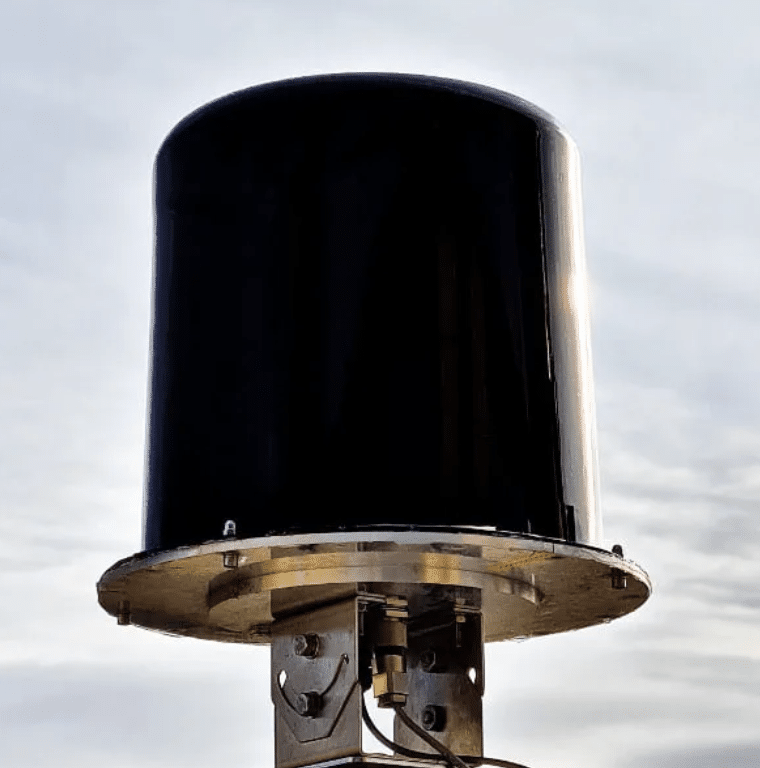
The SVR-500 from Ogier Electronics is in use on the A50. The 360-degree radar was developed specifically for detecting stationary vehicles and operates in the frequency range from 24.05 to 24.25 GHz using the FMCW (Frequency Modulated Continuous Wave) method. This involves the continuous transmission of a high-frequency signal, the frequency of which is deliberately varied. The distance to an object can be determined from the difference between the transmitted and reflected signals.
By combining distance measurement with a rotating radar beam pattern, the system can simultaneously determine the direction in which an object is located. Reflections can thus be assigned to individual lanes or defined monitoring zones. The radar rotates 360 degrees once per second and has a nominal range of 250 metres in every direction. This enables a single unit to monitor a road section totalling around 500 metres and detect multiple lanes simultaneously.
However, distance measurement alone is not sufficient for actual stationary object detection. The SVR-500 processes the radar data directly within the sensor and compares newly appearing stationary objects with the recorded background. This allows persistent reflections to be filtered out, whilst a vehicle that comes to an unexpected standstill within a defined lane is recognised as a relevant event. Operators can define individual detection zones and exclude areas where stationary vehicles should not trigger an alarm.
According to the manufacturer’s published data, stationary vehicles are typically detected within around eight seconds. Ogier cites a detection probability of more than 90 per cent for general operation and a typical false alarm rate of less than one false alarm per radar every two days. By contrast, the figure of more than 97 per cent from the Rijkswaterstaat evaluation relates specifically to the test scenarios carried out there.
Three radars monitor six lanes
A total of three SVR-500 units were installed on existing sign bridges and supporting structures on the Rhine bridge. The elevated mounting improves the overview of the traffic area and reduces shadowing caused by larger vehicles. As a result, a lorry is less likely to completely block a smaller vehicle behind it from a sensor’s detection range.
However, high mounting positions can create a poorly covered area directly beneath the sensor. The SVR-500 therefore uses a vertical antenna pattern that widens downwards to keep this blind spot as small as possible. In practice, this demonstrates that it is not only sensor performance but also positioning and alignment that are crucial to the quality of an installation.
Radar detects, video verifies
The integration of radars with PTZ cameras is particularly relevant for operational purposes. When the radar detects a stationary vehicle, it transmits its position to an assigned camera. This camera automatically pans to the relevant area and zooms in on the event.
This principle is often referred to in security technology as ‘slew-to-cue’. One sensor handles wide-area, continuous detection and provides the position, whilst a second system then carries out the visual verification. The radar and camera thus fulfil different roles: the radar operates independently of daylight and is largely unaffected by fog, rain or snow, whilst the video image allows the operator to assess the situation immediately.
This reduces the workload for the traffic control centre. Staff do not first have to search through various camera images, but are instead provided directly with the image of the area where the radar has detected an anomaly. They can then assess whether there is a breakdown, an accident or another situation and take appropriate action.
In the pilot project, the cameras also have a second function. The video footage is used as a reference to verify retrospectively whether a radar alert actually corresponded to a real-world event. This so-called ‘ground truth’ is crucial for making reliable assessments of detection performance. Only once it is known how many actual stoppages have occurred can undetected events and false alarms be statistically evaluated.
The most difficult situation remains the traffic jam
Slow-moving traffic presents a particular challenge. A detection system must distinguish whether a single vehicle is unexpectedly stationary on an otherwise busy carriageway or whether the entire flow of traffic has come to a standstill.
According to the manufacturer, the SVR-500 can detect when a traffic jam is developing and suppress corresponding standstill alerts. A vehicle that has actually broken down within this traffic jam becomes detectable again as soon as the rest of the traffic starts moving and only the vehicle in question remains stationary.
It is precisely such transitional situations that demonstrate why automatic traffic detection does not depend solely on the sensitivity of a sensor. It is the interpretation of the respective traffic conditions that determines whether a measured value is converted into a meaningful alarm message.
From detection to response
According to the manufacturer, breakdowns, collisions and accidents were already being automatically detected during the system’s commissioning on the A50. In the case of one documented accident, the system registered the incident in less than 20 seconds.
The technical benefit therefore lies primarily in reducing the time between an incident and a response. The sensor does not prevent accidents, but it can help ensure that a dangerous situation is identified sooner. Once detection has taken place, the actual safety chain begins: the incident is verified, the traffic control centre is informed and, where necessary, lanes are closed, warning signs are activated or emergency services and roadside assistance are dispatched to the scene.
Particularly on bridges and other stretches of road with no room to manoeuvre, this time frame determines how long a broken-down vehicle remains unprotected in the flow of traffic. The quality of such a system is therefore not measured solely by the sensor technology, but by how well detection, verification and operational response are integrated with one another.
From incident management to data-driven operations
The A50 project has significance that goes beyond mere stationary vehicle detection. Rijkswaterstaat is using the bridge as a real-world laboratory to investigate which detection rates and false alarm rates are technically realistic and economically viable for future systems. This is giving rise to an operational model in which sensor technology, defined monitoring zones, signal processing, camera control and traffic management are becoming increasingly interlinked.
For transport planners and infrastructure operators, this development opens up a second perspective in the long term. Event detection systems continuously generate data on the use of critical road sections. If, in future, such information is linked to traffic volumes, speeds, the proportion of heavy goods vehicles, congestion events, weather data and the structural monitoring of a structure, it will not only be possible to manage current traffic more safely. At the same time, a more precise data basis will emerge for assessing the actual level of stress placed on a structure.
A clear distinction must be made between traffic detection and structural diagnostics. The SVR-500 does not measure the structural condition of a bridge. Additional sensors and engineering test procedures are required to draw conclusions about material fatigue, cracking or structural changes. However, traffic and operational data can provide important context when operators seek to assess when and under what conditions particularly high stresses occur.
This is precisely where the link to condition-based maintenance and predictive maintenance concepts arises. Recurring traffic jams, high proportions of heavy goods vehicles, exceptional traffic peaks or frequent disruptions can be correlated with a structure’s condition data. This enables maintenance windows to be better prepared, temporary traffic diversions to be planned at an earlier stage, and refurbishment measures to be more closely aligned with actual load profiles.
Looking ahead, continuously collected traffic, operational and condition data could thus form a common basis for traffic management and asset management. The need for refurbishment could be assessed not solely on the basis of fixed inspection intervals, but increasingly on the basis of actual stress levels and documented changes in condition. Particularly in the case of heavily used bridges and other critical transport infrastructure, this could help to plan maintenance measures earlier, prepare closures in a more targeted manner and identify critical developments before they give rise to short-term pressure to carry out refurbishment. [ML]