
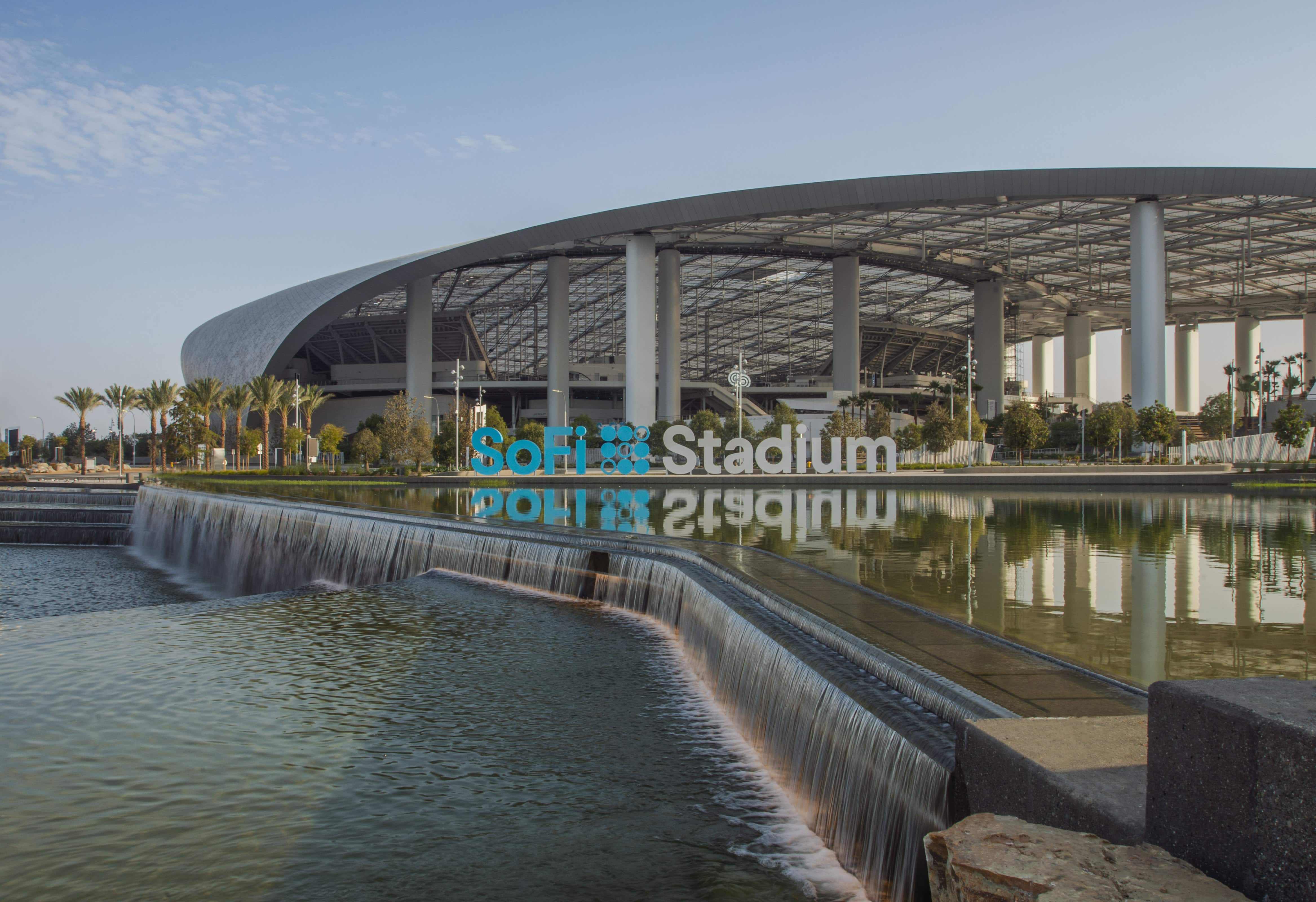
How integrated security platforms support the operation of modern venues – the SoFi Stadium as a case study
International sporting events, concerts and other major events present stadium and venue operators with increasingly complex security challenges. Within a matter of hours, tens of thousands of visitors must be allowed safe access to the site, delivery traffic must be coordinated, access routes monitored, and sensitive areas such as technical rooms, media zones or VIP areas protected. At the same time, video surveillance, access control, number plate recognition and numerous other systems continuously generate security-related information which, in the event of an incident, must be rapidly assessed and correlated.
The real challenge today therefore often lies less in the collection of this data than in its integration. Only when information from different security disciplines is available within a shared context can a situational picture emerge that supports informed decision-making and eases the burden on emergency services personnel.
This development is also reflected in Genetec’s State of Physical Security Report 2026. More than 7,300 professionals from six regions around the world were surveyed for this international study. The results show that organisations increasingly view physical security as a cross-functional task that is closely intertwined with IT, cybersecurity and operational processes. At the same time, the trend continues towards running previously separate systems – such as video management, access control and automatic number plate recognition – on shared platforms in order to streamline processes and provide information centrally.
A recent real-world example of this development is the SoFi Stadium in Inglewood, California. Together with the adjacent Hollywood Park, the operator has consolidated its security infrastructure onto a central platform and brought together various security systems within a shared control centre environment.
An event venue with specific requirements
SoFi Stadium is one of the largest and most modern sports and event venues in North America. The arena has around 70,000 seats and can expand its capacity to more than 100,000 visitors for major events. It is the home stadium of the NFL teams the Los Angeles Rams and the Los Angeles Chargers and is regularly used for international concerts and other major events. In the summer of 2026, the stadium hosted several matches at the FIFA World Cup, and it will also serve as a competition venue for the 2028 Summer Olympics.
The stadium forms the centrepiece of Hollywood Park, a site covering around 1.2 million square metres comprising office space, retail outlets, restaurants, hotels, event venues and public open spaces. As a result, security management extends far beyond the actual stadium operations. Various buildings, access routes and areas of use must be monitored, as must visitor flows, delivery traffic and operational processes across the entire site.
It is precisely such large-scale sites that highlight the limitations of traditional stand-alone solutions. If video surveillance, access control or other systems are operated independently of one another, staff often have to switch between different applications to gain a complete picture of the situation. As the size of a property increases, this leads to a rise in both the organisational burden and the complexity of day-to-day operations.
Standardisation of the security infrastructure
Against this backdrop, the operator of the SoFi Stadium, in collaboration with Hollywood Park, decided to implement the Genetec Security Center as the central platform for physical security management. The aim was to consolidate different security systems within a single software environment, thereby supporting both day-to-day operations and the response to exceptional incidents.
According to Genetec, the platform now manages more than 3,000 video cameras, around 700 access control readers, Automatic Licence Plate Recognition (ALPR) systems, as well as other sensors and security components. Monitoring is carried out from three security control centres, from which both the stadium and the entire Hollywood Park are managed.
Instead of having to consolidate information from multiple applications, security staff have access to all relevant data within a single user interface. This enables incidents to be assessed more quickly and connections to be identified more easily.
Nick Bermensolo, Vice President of Security and Safety at SoFi Stadium and Hollywood Park, describes the practical benefits of the platform as follows:
“Genetec Security Center has improved our response times, as we now receive all the necessary information on a single platform. This enables us to assess the situation quickly and make decisions immediately.”
In addition to supporting exceptional operational situations, day-to-day operations also play an important role. A unified platform makes it possible to provide video surveillance, access control and other security-related information within a single, consistent working environment. This allows operational procedures to be standardised and information to be assessed more quickly in context.
Integration as an organisational task
The consolidation of various security systems is therefore not merely a technical project. It also changes the way the security organisation operates. Instead of managing individual systems independently of one another, the focus is increasingly on cross-functional processes and a shared situational awareness.
Particularly at large-scale event venues with varying usage scenarios, an integrated security platform can help to reduce the coordination burden and shorten decision-making processes. The SoFi Stadium thus serves as a prime example of how physical security is increasingly evolving from a collection of individual systems into a networked operational infrastructure.
IT and security operations are converging
However, the introduction of a shared security platform at Hollywood Park has not only transformed the technical infrastructure but also the collaboration between the security organisation and IT. Modern security solutions are no longer limited to cameras, access control readers or control centre workstations. They form part of a complex IT landscape whose performance depends on a stable network architecture, high-performance servers and secure data communication.
According to the company, SoFi Stadium operates the Genetec Security Centre in an isolated network environment connected to central servers. During major events, the IT team continuously monitors system performance from the Network Operations Centre and ensures that all applications are running reliably. This allows security managers to focus on operational command and control, whilst the IT department safeguards technical operations in the background.
For Paul Maldonado, Vice President of IT Infrastructure and Operations at SoFi Stadium and Hollywood Park, this close collaboration was a key part of the project:
“The Genetec team brings expertise not only in physical security but also in IT systems. This has enabled us to implement a reliable and high-performance security platform on a large scale.”
The fact that IT and physical security are now working more closely together is also highlighted by the State of Physical Security Report 2026. The study illustrates that security managers increasingly view physical security as a cross-functional corporate role. Issues such as cybersecurity, network management and system availability play just as important a role as traditional security tasks. At the same time, open platform architectures are gaining in importance, as they make it easier to integrate existing systems and enable future expansions.
A shared situational awareness for faster decision-making
However, the real added value of integrated security platforms lies not solely in their technical architecture, but above all in their ability to present information from different systems within a shared context.
Particularly at major events, decisions often have to be made within a matter of seconds. Individual camera images or access events are often insufficient for this purpose. Only by linking different pieces of information is it possible to obtain a comprehensive situational overview, helping security staff to assess events more quickly.
At SoFi Stadium, therefore, video surveillance, access control, automatic number plate recognition and other sensors are managed via a single user interface. This gives security staff a centralised overview of security-related events without having to switch between different applications.
According to the operator, this integration helps to reduce response times and enables decisions to be made on the basis of a shared information pool. At the same time, day-to-day operations also benefit, as the administration and monitoring of various systems take place within a single platform.
For large-scale event venues such as Hollywood Park, with its diverse areas of use – ranging from the stadium and multi-storey car parks to catering, office and event spaces – a centralised security platform also facilitates the coordination of day-to-day operations.
Platform strategy rather than individual solutions
With the introduction of the Security Centre, SoFi Stadium and Hollywood Park do not regard their security infrastructure as a completed project. Rather, the platform forms the basis for the gradual further development of security processes.
According to Genetec, operators and technology partners are already working on implementing additional automation functions and evaluating AI-powered tools. Specific use cases have not yet been published. However, the aim is to continuously develop the existing platform and adapt it to future requirements in the areas of network technology, cybersecurity and operational organisation.
Paul Maldonado describes this long-term approach as follows:
“Genetec has really helped us to establish a technological standard. Genetec Security Center is reliable and IT-secure, integrates well into our network and reduces the workload for both IT and security teams. These are precisely the kinds of technologies we intend to rely on across the company in the future.”
These statements illustrate that operators of large event venues are increasingly relying on scalable platforms that can be adapted to future requirements. Rather than the isolated development of individual security components, the focus is now shifting towards the continuous expansion of a shared infrastructure.
Conclusion
The example of the SoFi Stadium demonstrates how physical security at large event venues is increasingly evolving into an integrated management task. The focus is no longer on the isolated consideration of individual systems such as video surveillance or access control, but rather on their integration within a shared platform.
Equally clear is the growing importance of collaboration between security organisations and IT. Network architecture, system availability and cybersecurity are now essential prerequisites for the reliable operation of modern security solutions. At the same time, open platforms provide the basis for gradually integrating new technologies and additional functions into existing infrastructures.
The SoFi Stadium thus provides a practical example of how security processes can be standardised across extensive event venues. The focus here is not so much on the introduction of individual technologies as on their interaction within a shared system landscape. For operators of complex properties, the project demonstrates that integrated security platforms not only support operational situational awareness but can also simplify organisational processes and lay the foundations for the further development of physical security.
[DCM]

