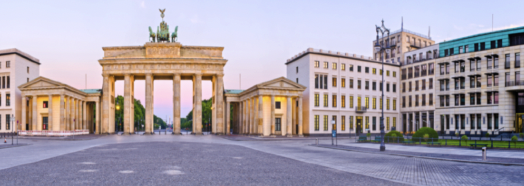
On 3 June 2026, Berlin will once again become the centre of strategic security dialogue. The STATE OF SECURITY 2026 security conference will take place at the Allianz Forum, located in the immediate vicinity of the Brandenburg Gate. The event has established itself as a fixture for interdisciplinary exchange between business, security authorities, politics and technology, and consistently focuses on the protection of companies and critical infrastructures.
Artificial intelligence as a strategic turning point
Under the theme ‘Secure Future – Corporate Protection in the Age of AI’, the conference addresses one of the central challenges of modern security architectures. Artificial intelligence is not only changing the forms of attack and threat situations, but also the possibilities for prevention, detection and response. This makes AI a decisive factor in strategic decision-making processes, governance structures and regulatory design in corporate protection.
STATE OF SECURITY 2026 takes a holistic view of this development: in addition to technological innovations, the focus is on legal frameworks, organisational issues, ethical aspects and the practical implementation of intelligent security systems. The final agenda will be published by the end of February, but it is already clear that the focus will be on practical insights and strategic perspectives.
High-calibre expertise from practice, law and government
Several renowned speakers have already confirmed their participation in this year’s edition, bringing different perspectives on AI and security. Among those confirmed are:
- Franziska Weindauer, Managing Director of TÜV AI.Lab
- Carolin Schilling-Schulz, lawyer and partner at ARNECKE SIBETH DABELSTEIN
- Dennis-Kenji Kipker, Research Director at the cyberintelligence institute and member of the supervisory board of NordVPN
- Key Pousttchi, founder of the Institute for Digital Transformation GmbH
- Günter Welsch, CIO and Head of the Cryptotechnology Department at the Federal Office for Information Security
This line-up underscores the conference’s aim of bringing together technological, legal and governmental perspectives to form a consistent picture of security.
Continuity at the highest strategic level
STATE OF SECURITY thus follows on from a series of high-profile speakers from previous years, including Hans-Lothar Domröse, Joachim Herrmann, Michael Heise and Klaus-Dieter Fritsche. This continuity underscores the conference’s strategic ambition to discuss security-related topics at the highest professional and political level.
Participation and registration
Participation in STATE OF SECURITY 2026 is free of charge. Registration is already open, with final confirmation of participation following internal review. This ensures that the conference remains a curated forum for security managers, decision-makers and technology experts.
Conclusion
With STATE OF SECURITY 2026, Berlin is once again positioning itself as a central location for discourse on future-proof corporate security. The focus on artificial intelligence hits the core of current security debates, in which technological innovation, regulation and real threats are increasingly merging. For companies, the conference offers guidance, context and an exclusive exchange on one of the crucial issues of the coming years.
Further information and registration: