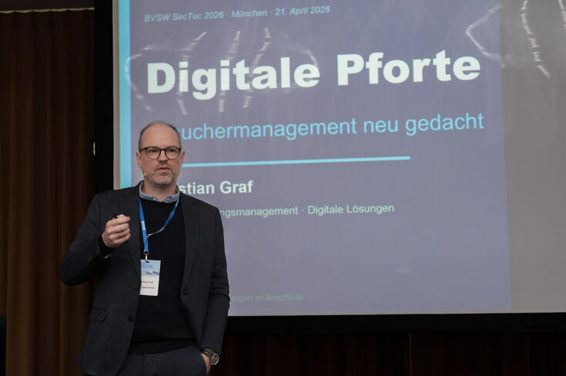
©BSVW/Nadine Stegemann
At SecTec in Munich, organised by the BVSW in mid-April, Christian Graf, Head of Development at NWS Digital GmbH, a subsidiary of Nürnberger Wach- und Schließgesellschaft (NWS), presented a concept demonstrating how gate and reception areas can be organised entirely digitally in future. His presentation focused on digital visitor processes developed in-house by NWS in the DACH region, multilingual and GDPR-compliant procedures, automated check-in and check-out processes, and navigation across company premises.
Why traditional reception desks are reaching their limits
In many places, the traditional reception desk still relies on paper lists, pens, manual ID checks and personal briefings. This model is becoming increasingly problematic. Companies are facing a skills shortage, growing regulation, more complex supply chains, hybrid working arrangements and an escalating threat landscape.
Particularly for industrial companies, critical infrastructure and larger industrial sites, it is no longer sufficient simply to welcome visitors. Companies need to know who is on site and when, which briefings have been completed, which documents have been checked and how to respond quickly in an emergency.
Regulation increases the pressure
In his presentation, Christian Graf pointed out that access processes today are closely linked to issues such as KRITIS, NIS2, GDPR, ISO 27001, the Cyber Resilience Act, as well as documentation and audit trail requirements.
NIS2, in particular, places greater responsibility for security processes on senior management. As a result, access control is increasingly becoming a matter of governance, liability and compliance.
Visitor data is also sensitive information. Anyone using digital systems must therefore ensure that data is processed only for specific purposes, stored securely and deleted in a traceable manner. This applies particularly when document checks or biometric verification are used.
Side note: What is the digital gateway?
The digital gateway presented by NWS no longer views reception as a single checkpoint, but as a seamless visitor journey.
The process begins even before the visit: the host sends a digital invitation link; the guest registers via smartphone, uploads necessary documents, enters vehicle details, completes security briefings and signs digital declarations such as data protection confirmations or NDAs.
On the day of the visit, check-in takes place via QR code, kiosk terminal or door station. Depending on security requirements, document checks, PIN verification, biometric authentication (2FA) and/or the verification of specific credentials may be added. After gaining access, the visitor can be guided to the destination building via digital navigation. Check-out takes place upon leaving the premises, ensuring that it remains clear at all times who is still on site.
The unique approach lies in automating routine processes without leaving security-related decisions entirely to the system.
Humans remain involved in line with the ‘human-in-the-loop’ principle.
Multilingualism as a security factor
A major problem with traditional gates is the language barrier. International guests, drivers or service providers require clear information – particularly when it comes to safety instructions, danger zones or rules of conduct.
Digital systems can provide this content in multiple languages and document it in a standardised manner. This reduces misunderstandings and ensures safety information is communicated more reliably. For companies, this means greater process reliability and less dependence on individual staff members with specific language skills.
From paper-based processes to audit trails
Another advantage of digital access control lies in its traceability. Every step of the visitor process can be logged: invitation, registration, document verification, safety briefing, check-in, stay and check-out.
This creates a seamless audit trail. This is a key added value, particularly for regulated companies. In an emergency, during internal audits or when dealing with authorities, it is possible to trace which individuals were on the premises and when, and which requirements were met.
Technology must remain integrable
Graf emphasised that a practical solution must not displace existing systems. Many companies already have card readers, transponders, barriers, access systems or Microsoft 365 environments. A modern digital gate system must therefore be integrable.
Existing systems can be connected via interfaces. Outlook appointments can also serve as the starting point for the visitor process, so that hosts do not have to do double the work. When an appointment is created, the digital visitor process can be triggered automatically in the background.
Data protection and biometrics: sensitive, but possible
Biometric verification can make check-in more secure and faster, but must be implemented with particular care. It is crucial that sensitive data is not transmitted unnecessarily. In the concept presented, biometric verification takes place locally on the device. Processing is therefore carried out as close as possible to the end device and is not transferred to an external cloud.
This reduces risks and supports a more data-protection-friendly architecture. Nevertheless, it remains clear that biometrics requires transparent rules, clear consent and proper coordination with data protection officers and employee representatives.
Navigation across the factory premises
Access control does not end at the barrier. Orientation can be difficult for visitors, particularly on large industrial and logistics sites. Digital navigation can guide visitors from reception to their destination building whilst taking security-relevant areas into account.
Restricted zones, hazardous areas or ATEX zones can be integrated into the route guidance. If a visitor strays from the designated path or enters a sensitive area, the system can trigger an alert. This adds an operational security component to visitor management.
Relief for site security and reception
The digital gate does not replace people, but rather relieves them of the burden. Routine tasks such as data entry, training records, document checks or standard communication can be automated. This frees up time for security staff to deal with exceptions, assessments, interventions and situation analysis.
This is a particularly important point given the shortage of skilled workers. Digital systems help to deploy existing resources more effectively whilst simultaneously improving the quality of processes.
User-friendliness remains crucial
Despite all the security measures, a digital access system must remain easy to use. Visitors should not have to struggle with complicated forms. Hosts should not face additional administrative hurdles. Acceptance stands or falls on intuitive user guidance.
A good system therefore combines security with convenience: mobile pre-registration, clear language, QR code check-in, multilingual instructions, automatic approvals and simple integration into existing workflows.
The gate becomes a security platform
The presentation at SecTec in Munich made it clear: access control is evolving from an analogue reception process into a digital security platform.
Visitor management, document verification, site security, evacuation, navigation, compliance and, in the future, AI-supported assistance systems are converging.
For businesses, this means that anyone considering access control today should look beyond just doors, cards and barriers. What matters is the entire process – from the invitation to the check-out. A modern digital entrance provides greater security, improved auditability, more efficient processes and a more professional visitor experience.