Electronic monitoring of high-risk domestic violence offenders, digital restraining orders and new powers to detect and counter hostile drones: the German state of Mecklenburg-Western Pomerania is modernising its security legislation in response to a changing threat environment. The reform illustrates a broader challenge facing European security policy — how to give law enforcement authorities effective technological tools without lowering the constitutional thresholds for state intervention.
Germany’s north-eastern state of Mecklenburg-Western Pomerania is expanding the legal instruments available to its police and public-order authorities. At a specialist conference held at the University of Applied Sciences in Güstrow on 8 October, officials discussed the practical implementation of the revised Security and Public Order Act, known in German as the Sicherheits- und Ordnungsgesetz Mecklenburg-Vorpommern, or SOG M-V.
The legislation introduces significant changes in two areas that have moved rapidly up the European security agenda: the protection of victims of domestic violence and the detection and defence against unmanned systems.
For international readers, the regional nature of the legislation requires some explanation.
Germany is a federal republic consisting of 16 constituent states, known as Länder. Under the Basic Law, Germany’s constitution, state powers and legislative responsibilities generally remain with the Länder unless the constitution specifically assigns them to the federal level. This means that everyday policing and preventive public-security law are largely organised at state level. Each Land therefore has its own police legislation governing when its authorities may intervene to prevent threats to public safety.
The SOG M-V is Mecklenburg-Western Pomerania’s central statutory framework for precisely this purpose. It should not be confused with German federal criminal law: its principal function is preventive. It defines the circumstances in which police and regulatory authorities may act before a criminal offence has occurred in order to avert a concrete threat.
That distinction is particularly important in understanding the latest reform.
Electronic monitoring enters domestic violence prevention
One of the most politically significant elements concerns high-risk cases of domestic violence.
The revised legislation strengthens the options available to authorities when conventional measures such as eviction orders, restraining orders or bans on approaching a victim prove insufficient. Contact restrictions can now explicitly cover digital channels, including telephone calls, text messages and messenger services.
More intrusive measures are also becoming available.
Under defined conditions, authorities may order electronic location monitoring of individuals considered to present a serious continuing threat. The measure is intended particularly for cases in which offenders repeatedly disregard police orders and there is reason to believe that existing restrictions are no longer sufficient to protect the person at risk.
Mecklenburg-Western Pomerania is also introducing an approach based on what German policymakers refer to as the “Spanish model” of electronic protection.
Instead of monitoring only the offender, the system can also provide the person at risk with an electronic warning device. If a monitored individual breaches a defined exclusion zone and approaches the victim, an alert can be generated before physical contact occurs.
The distinction matters. Electronic monitoring then becomes more than a mechanism for documenting a violation after the event. It becomes part of an active early-warning system.
Interior Minister Christian Pegel presented the reform as a means of intervening before another violent incident occurs. The political rationale is clear: in cases involving persistent offenders, the interval between the violation of a restraining order and a physical assault may be extremely short.
The development also reflects a broader shift in European discussions on domestic violence. Protection increasingly focuses not only on prosecution after an attack but on identifying escalating risk and creating mechanisms capable of triggering intervention before renewed violence occurs.
Yet electronic location monitoring represents a substantial intrusion into individual rights. Its effectiveness therefore depends not only on technical performance but on clearly defined legal thresholds, judicial safeguards where required, reliable risk assessment and proportionality.
Those questions are particularly important in Germany, where constitutional jurisprudence places demanding limits on intrusive police surveillance.
A new legal basis for counter-drone operations
The second major pillar of the reform addresses a very different security problem.
A new Section 67e of the SOG M-V creates an explicit legal basis for the use of technical systems against threats posed by unmanned vehicles.
Although drones are the most visible example, the legislation is broader than conventional unmanned aerial vehicles. It can also apply to unmanned systems operating on land or water.
Under specified conditions, state police will be able to use technical means against an unmanned system, its control unit or the communications link connecting the two. Intervention requires a concrete threat and is intended for situations in which averting that threat by other means would be impossible or substantially more difficult.
Equally significant is the legal framework for detection.
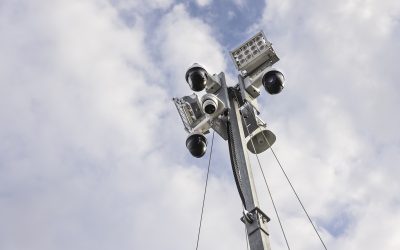
Police may use systems capable of identifying acoustic, optical or electromagnetic signatures associated with unmanned platforms. This potentially includes combinations of cameras, radio-frequency sensors and other technologies used to establish what is operating in a particular area of airspace.
The reform comes as European governments increasingly confront the dual-use nature of commercially available drones.
The same technology used for photography, infrastructure inspection and logistics can also support surveillance, espionage, disruption or sabotage. Police operations, ports, energy facilities, military installations and other elements of critical infrastructure therefore face a security challenge that conventional perimeter protection alone cannot address.
The result is a growing requirement not merely to stop hostile drones, but first to distinguish suspicious activity from legitimate civilian operations.
Building a regional drone situational picture
Mecklenburg-Western Pomerania is attempting to address that problem at a wider operational level.
Its Interior Ministry has entered into a cooperation agreement with the Institute for Secure Mobile Communication at Stralsund University of Applied Sciences. The project is intended to develop a large-scale situational picture of drone activity across the state.
Rather than viewing individual sensors as isolated security devices, the concept aims to combine detection information into a broader operational picture that can help authorities identify unusual activity and determine where intervention may be required.
This is an important evolution in counter-UAS policy.
The central challenge is increasingly not the availability of a single detection technology. Radar, radio-frequency analysis, acoustic sensors and optical systems already exist. The harder problem is integrating data, filtering legitimate activity and producing reliable information quickly enough for authorities to make an operational decision.
For police forces, that changes counter-drone operations from a purely technical issue into one of intelligence, command and control.
It also raises new questions about data processing. A system designed to monitor large areas may inevitably collect information connected to legitimate drone operators or other communications. Clear rules governing retention, access and use of such information therefore become an integral part of the security architecture.
Why state law matters in the German system
For readers accustomed to more centralised policing systems, Germany’s division of responsibilities can initially appear complicated.
Germany does have federal law-enforcement organisations. The Federal Criminal Police Office, or BKA, carries out defined national and international functions, while the Federal Police has responsibilities including border security and the protection of certain federal infrastructure.
But ordinary preventive policing remains primarily a responsibility of the Länder. The Basic Law reserves only specific policing and security matters to the federal government — including certain forms of international counter-terrorism and federal cooperation in criminal policing.
This means innovations in German policing frequently emerge state by state.
Bavaria, North Rhine-Westphalia, Berlin or Mecklenburg-Western Pomerania may therefore adopt different provisions, terminology and intervention thresholds. Those laws must nevertheless remain compatible with Germany’s federal constitution and are subject to review by the Federal Constitutional Court.
That constitutional dimension is particularly relevant in Mecklenburg-Western Pomerania.
Constitutional limits remain central
The state’s security legislation has already faced significant judicial scrutiny.
In a decision issued in December 2022 and published in February 2023, Germany’s Federal Constitutional Court found several provisions of an earlier version of the SOG M-V unconstitutional or incompatible with the Basic Law. The case concerned investigative powers including covert surveillance and the processing of personal information.
The judges did not reject modern investigative techniques as such. Rather, they emphasised that particularly intrusive measures require sufficiently precise legal rules, appropriate thresholds of danger and strong protection for fundamental rights.
The Court identified violations affecting, among other things, the right to informational self-determination, the confidentiality and integrity of information-technology systems, telecommunications privacy and the constitutional protection of the home.
That history gives the latest reform additional political significance.
Mecklenburg-Western Pomerania is not simply adding new security technology. It is doing so against a constitutional background in which courts have already made clear that expanding police capabilities must be accompanied by precise limits on when and how those capabilities may be used.
The tension is particularly apparent with technologies such as electronic location monitoring and wide-area drone detection. Both may provide substantial security benefits. Both can also involve intensive processing of information relating to individuals.
European security is moving further into the preventive domain
The wider importance of the Mecklenburg-Western Pomerania reform lies in what it reveals about the changing nature of internal security.
Police legislation was once largely associated with familiar physical situations: public disorder, dangerous individuals, vehicles, buildings and conventional crime scenes.
That boundary is becoming less distinct.
A restraining order now has to cover WhatsApp and other digital communication. Protection from domestic violence may involve geolocation technology. Critical-infrastructure security increasingly requires monitoring of low-altitude airspace. A police situational picture may incorporate data from distributed sensor networks.
As a result, preventive policing is becoming simultaneously more technological and more data-intensive.
That creates a difficult policy equation.
Authorities need sufficient powers to intervene against threats that can develop far more rapidly than traditional policing procedures were designed to handle. At the same time, earlier intervention often means acting before a criminal offence has been committed — precisely the point at which legal thresholds and proportionality become especially important.
Mecklenburg-Western Pomerania’s revised security law is therefore about more than electronic tags or drones.
It reflects a wider transformation of European internal security: from reacting to incidents towards identifying, assessing and disrupting threats before they materialise.
Whether that transformation ultimately strengthens public security will depend not simply on how sophisticated the technology becomes. The more consequential test will be whether governments can combine those capabilities with sufficiently precise law, effective oversight and clearly defined limits on state intervention.
In Germany’s federal system, Mecklenburg-Western Pomerania is now one of the jurisdictions putting that balance into practice.